By Katie Dzurec
Director, Public Policy Outreach
As is usually the case with the National Association of Insurance Commissioners’ (NAIC) Summer National Meeting, the August conference in Columbus was a mid-year progress report on major initiatives across its committees—and a look at some of the issues likely to shape insurance regulation in the months ahead.
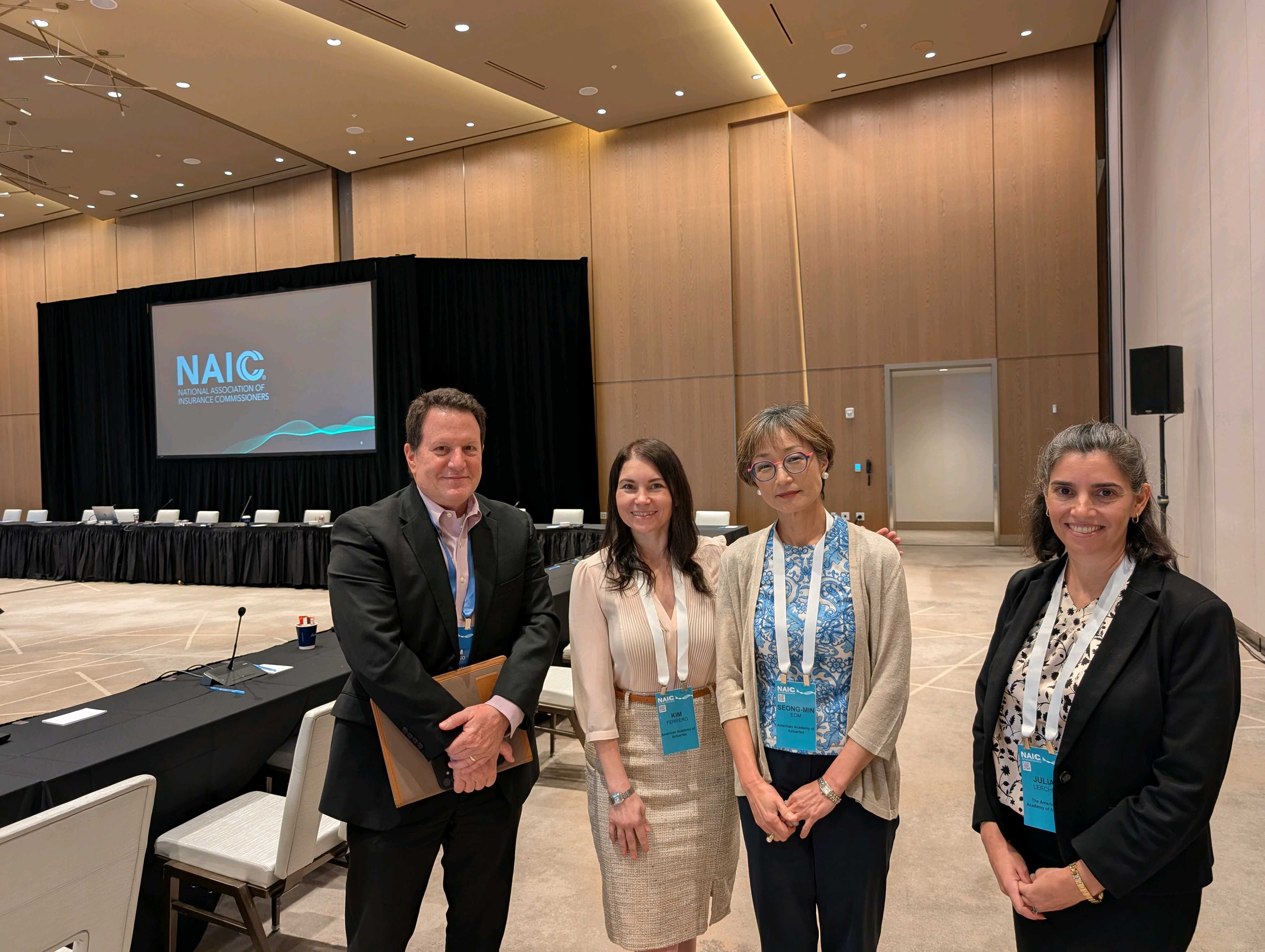
The Academy’s professionalism and public policy teams were on-site, engaged with regulators, especially through Academy updates at the three actuarial task forces—life (LATF), health (HATF), and casualty (CASTF). Professionalism volunteers highlighted actuarial standards of practice (ASOPs) that are open for comment and the current activities of the Committee on Qualifications, while the public policy team highlighted the work of this year’s Academy Award for Research recipient, Olivier Côté, co-author of “A Scalable Toolbox for Exposing Indirect Discrimination in Insurance Rates” published as part of the Casualty Actuarial Society’s Series on Bias and Insurance.
Life Vice President Kirsten Pedersen and Senior Life and Risk Management Actuary Seong-min Eom discussed several cross-practice efforts involving life, risk management, and retirement, and sought additional clarification on LATF’s request to review valuation manual prescribed spreads and defaults. Meanwhile, Health Vice President Annette James and Senior Health Actuary Julia Lerche shared key priorities for the Health Practice Council (HPC) at HATF, highlighting results of the “Broadening the Focus” initiative and the launch of the Academy’s joint life and health long-term care (LTC) combination products committee. And at CASTF, the Academy turned the spotlight toward a forthcoming paper on the anatomy of bias in commercial multi-peril policies.
Other highlights from the meeting include:
From the NAIC leadership:
- Virginia Insurance Commissioner and NAIC President Scott White opened the meeting by noting, “Real progress takes time. It comes from years of steady effort.” That reminder framed the important work underway amid the acceleration of artificial intelligence, rising catastrophic events, and uncertainties surrounding insurance affordability and availability.
- The Risk-Based Capital Model Governance (EX) Task Force exposed priority formula components for comment, aiming to narrow the list to five to seven for 2027 and seeking input on the structure of a successor body.
In the property and casualty (P&C) space:
- The Natural Catastrophe Risk and Resilience (EX) Task Force noted a season marked by wildfires, flooding, derechos, and back-to-back super typhoons. Homeowners’ insurance affordability and availability dominated commissioner and legislator discussions, with access and affordability likely to remain a legislative focus into 2027.
- To support state action, the Property and Casualty Insurance (C) Committee adopted the Affordability and Availability Playbook for homeowners’ insurance.
- At CASTF, members debated over the draft homeowners’ regulation white paper, while a Center for Insurance Policy and Research panel examined reinsurance as a market stability tool.
- The American Property Casualty Insurance Association reported positive auto insurance trends, including improved rate adequacy and loss experience.
- Consumer Liaison Peter Kochenburger urged regulators to examine criminal history as a rating factor, while ZestyAI, a climate and property risk analytics platform, presented on using verified mitigation data to expand eligibility and improve homeowners’ insurance affordability.
In the health space:
- Affordability and availability were also a center of discussion, with consumer liaisons, commissioners, and legislators citing rising premiums, out-of-pocket costs, and broader household cost pressures.
- Regulators raised market stability concerns, including deteriorating risk pools and tools such as 1332 waiver reinsurance and cost-sharing reduction silver loading losing effectiveness or facing scrutiny.
- Legislators also stressed the societal impact of higher uninsured rates, especially on rural hospitals and health systems.
- The Health Insurance and Managed Care (B) Committee and its subgroups continued steady work on state support for Medicare and Medicare Advantage consumers, a forthcoming paper on level-funded insurance, prior authorization, individual coverage health reimbursement arrangements , and independent dispute resolution under the No Surprises Act.
- The Health Care Affordability and Mitigation (B) Working Group is developing short issue briefs on state options to improve affordability.
- HATF and the Senior Issues (B) Task Force will work with Life Insurance and Annuity (A) Committee groups on LTC issues ranging from form and rate review to market conduct and solvency. The consumer liaisons raised concerns about consumer clarity for these products, as well as life insurance in retirement income planning.
In the life space:
- The ‘A’ Committee and its groups exposed several documents for comment, with a focus on its continued work on annuity illustration updates, including a white paper and potential revisions to Model #245.
The Academy will continue its close tracking of developments at the NAIC and our robust engagement, thanks to our committed cadre of volunteers and staff. To learn more about Academy activities at the summer meeting, listen to the upcoming Actuary Voices podcast. And check back here to learn about the fall meeting, set for Dallas from Nov. 14 to 17.