Q&A: Connecting Life Actuarial Expertise With Policymakers’ Needs
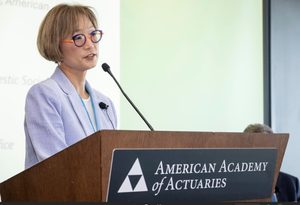
This summer, the Academy hired two staff actuaries, in the health and life and risk management practice areas—part of its strategic investment in what will be four full-time, in-house actuaries to deepen member and stakeholder value and benefit Academy work in policy and professionalism.
Seong-min Eom joined the Academy in mid-July as Director and Actuary, Public Policy, Life and Risk Management. Eom has more than 25 years of diverse actuarial experience spanning regulatory, consulting, and corporate environments, and over 15 years of experience as an Academy volunteer, including as the Academy’s vice president, risk management and financial reporting, from 2021 to 2023. She also chaired the Climate Change Joint Committee, shepherding the Academy’s work in this priority public policy domain. Most recently, she was chief actuary at the New Jersey Department of Banking and Insurance, and served on several NAIC task forces including the Life Actuarial (A) Task Force (LATF), the Valuation Analysis Working Group, and the Longevity Risk (E/A) Subgroup, which she chaired.
Life Perspectives spoke with Eom about her new role at the Academy.
You’ve already represented the Academy at several events, including the NAIC Summer Meeting and the Academy’s recent retirement symposium. How are your interactions going with the Academy’s many stakeholders?
It has been energizing to interact with stakeholders in my new role! While I have attended many of these venues before as a regulator or a volunteer, representing the Academy in this dedicated position allows me to engage with them through a different lens. Instead of approaching these discussions strictly from a regulatory standpoint, my focus is now on how the Academy can proactively facilitate these dialogues and help shape conversations as issues evolve.
I am also finding that my background gives me a unique dual perspective that really enhances these interactions. Having been a longtime Academy volunteer, I intimately understand the point of view of our members and how our committees operate. When you combine that with my prior experience as a regulator, I can effectively look at issues from both sides. Because I already understand regulators’ primary focuses and underlying concerns, I can often grasp what they need without lengthy explanations. This allows me to act as a highly efficient bridge—proposing direct, insightful ways our volunteers can assist them, which makes our partnerships much more dynamic and impactful.
How do you want to work with Academy volunteers to make sure their expertise reaches the right people at the right time?
To ensure our members’ expertise makes an impact, effective coordination is essential. Through my prior leadership role as RMFRC [Risk Management and Financial Reporting Council] vice president, my years as a dedicated volunteer across various committees, and my time as a regulator, I was able to build insight into how to strategically coordinate our skills and resources to meet the specific requests and needs of our stakeholders.
Externally, I love having conversations with stakeholders to understand their needs more comprehensively, to understand their ultimate goals, the surrounding environment, including regulatory factors, and the underlying background where those needs originated.
Internally, I view our volunteers as incredibly important stakeholders in their own right, and I am very eager to have active, ongoing discussions with them. By sharing the direct insights I gather from external stakeholders, I want to encourage our committees to be even more proactive in their engagement. Because I can help bridge that gap, we can align our volunteers’ deep expertise with the exact needs and timelines of policymakers. This ensures that the rigorous work our committees do is actively tailored and delivered to the appropriate stakeholder in a timely manner.
What are some ways members can engage with the Academy’s work in the life-practice area and make their expertise heard?
Active participation in our committees and work groups is the absolute cornerstone of our work. To truly build a holistic and comprehensive view of the industry, we genuinely need diverse voices in those rooms—whether you are from the corporate, consulting, or regulatory side, and regardless of what stage you are at in your career.
However, having been a volunteer for over 15 years, I know firsthand how demanding our day jobs can be. If committing to a standing committee isn’t feasible right now, there are still highly impactful ways to contribute. For example, stepping in as a peer reviewer for a specific paper or deliverable is a more contained task, but it is incredibly valuable because we are always in need of fresh eyes to review our work. On an everyday level, simply attending our webinars, reading our issue briefs, and staying connected allows you to remain informed and apply that knowledge to your daily work.
Finally, I want our members to know they always have an accessible partner inside the Academy. I truly value open discussions and am always happy to serve as a sounding board. If your engagement with our work sparks a new idea, a concern, or a suggestion for a project, please feel free to reach out. Hearing what is on your mind helps me ensure we are supporting our volunteers and their work as effectively as possible.
Are there audiences, venues, or conversations where you’d like the Academy to have a stronger presence in 2027—and how can members help?
Focusing on the life and risk management areas, the NAIC remains one of the Academy’s primary stakeholders. While we already have a strong foundational relationship there, my goal for 2027 is to elevate our presence by anticipating emerging needs and engaging in those critical dialogues much more proactively. I also plan to apply this proactive approach to build a stronger presence with federal offices, which are increasingly focused on life issues like offshore reinsurance and complex asset strategies. Furthermore, I want to ensure the Academy brings a strong, objective voice to rapidly evolving, cross-practice topics like artificial intelligence and climate risk, which are key priorities on the risk management side of my role.
Ultimately, achieving all of this relies on our members. Drawing on volunteer experience, I want to ensure our members feel they have an internal partner who speaks their language and strategically champions their work. When we cultivate a highly supported and cohesive volunteer culture internally, it directly translates into a more powerful and trusted Academy presence externally.
Looking across the life area, which issues do you expect to matter most to members in 2027?
There are a few major topics that I expect will dominate the conversation. First is the ongoing evolution of offshore reinsurance, particularly as it aligns with complex asset strategies. This issue has gained significant traction not just with state regulators, but also at the federal level, as seen with recent inquiries by lawmakers like Sen. Warren. [Sen. Elizabeth Warren of Massachusetts wrote a well-publicized September letter to the NAIC on insurer investments, to which the NAIC responded.] Furthermore, the rise in these transactions is directly driving other critical regulatory developments. For instance, concerns around offshore reinsurance and these underlying complex assets are the catalyst behind the remaining items within VM-22, including the current reinvestment guardrail proposal, as well as the focus on AG 55 and certain RBC developments. This entire ecosystem of regulation is highly complex and requires our members’ objective, technical analysis.
Second, the broader implementation of principle-based reserving (PBR) remains a massive undertaking. As I just noted, while VM-22 will see ongoing refinements, the major industry milestone is VM-22 becoming effective in 2026 with a three-year phase-in. Alongside this is the implementation of the new Generator of Economic Scenarios (GOES), which is also effective in 2026. Because this is the first implementation of GOES, there will inevitably be practical issues and technical questions raised as actuaries apply it. It is a highly impactful project that will significantly affect not only PBR, but also risk-based capital (RBC).
Finally, that brings us to a continued focus on those evolving RBC frameworks. As investment strategies and product designs shift, ensuring capital requirements appropriately reflect underlying risks remains a top priority. I expect our members will be heavily engaged in ongoing NAIC RBC activities, specifically the developments around C-1 asset risk components, the C-3 field study, and the cross-practice Risk-Based Capital Model Governance Project. These technical evolutions require a comprehensive understanding of the core objectives of risk-based capital, coupled with the rigorous analysis our committees provide to help ensure these new frameworks are both technically sound and practically applicable.
With your experience as an Academy vice president, you’re well-versed in the work of the RMFRC and the life area. From a big-picture perspective, what are some of the highlights of the LPC’s work that you’re already involved with?
From a big-picture perspective, the most significant highlight has been acting as a direct bridge between our stakeholders and our volunteer committees. For example, I have been actively connecting with regulators not only to understand their specific requests, but also to proactively identify their needs and any underlying analytical gaps.
By sharing these insights, I help our committees refine their focus and tailor their technical efforts to current policy priorities. But my role isn’t just as an external ambassador. I also work on internal coordination across the various committees and subcommittees. Because many of today’s issues are so multifaceted, I actively help our volunteer leaders map out the work, break down silos, and coordinate with other committees to ensure we have all the necessary experts.
Ultimately, whether through external or internal coordination, by aligning our volunteers’ passion and expertise with our stakeholders’ needs, I contribute to the Academy’s visible presence at the table.
How are you finding the Academy working “inside” as a staff member?
Honestly, seeing how the Academy operates from the inside has been a great learning experience. As both an Academy volunteer and a vice president, I always knew the internal team was helpful, but being on the inside has shown me just how much support they actually provide behind the scenes. The amount of daily work, coordination, and attention to detail the staff commits to successfully running our events, publishing our reports, and supporting our volunteer leaders is quite substantial. By coordinating between multiple stakeholders and managing all the tangled logistics, the internal team allows our volunteers to focus on their actuarial analysis. It gives me a whole new level of appreciation for what it takes to make the Academy function effectively.
Academy Holds Sold-Out VM-22 Practitioners Forum
The Academy held a successful and sold-out VM-22 Practitioners Forum in Denver in late August to help actuaries who have moved beyond the introductory phase better navigate VM-22 issues.
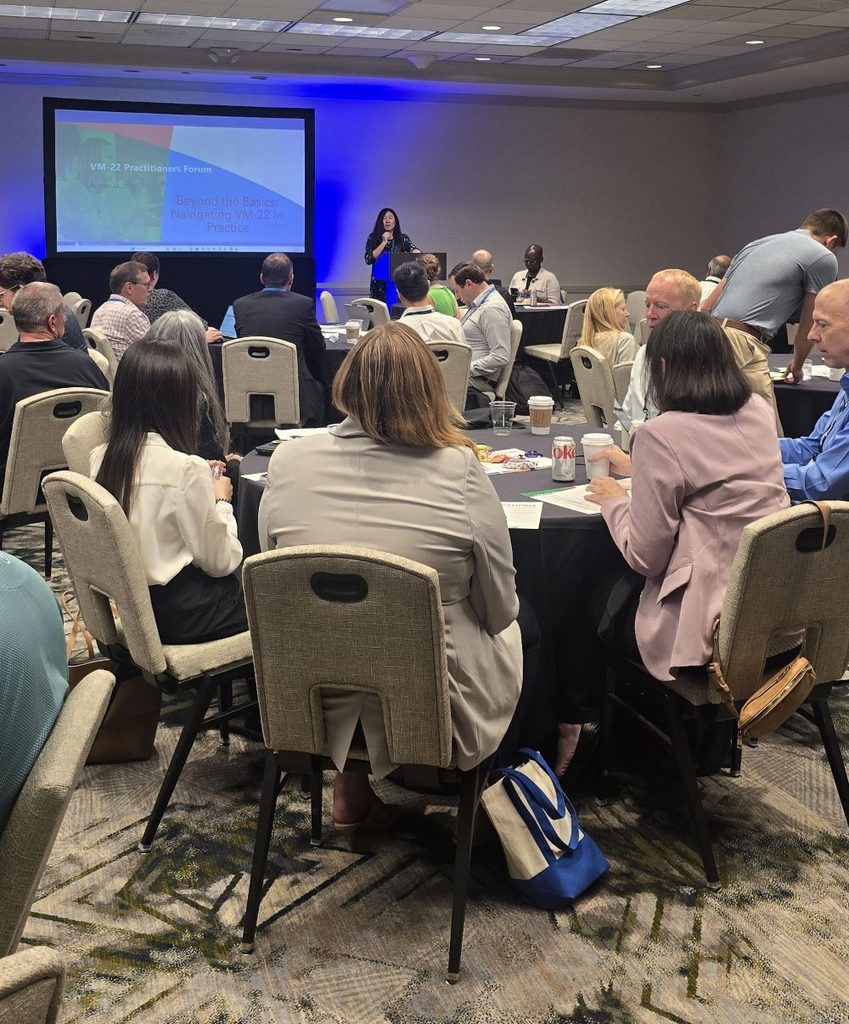
The event was held at the tail-end of the Society of Actuaries Valuation Actuary meeting (ValAct 2026). Discussions were led by Academy Life Practice Council (LPC) leaders recognized for their expertise in this area, including Kathy Bachman, Robert Eaton, Bruce Friedland, Linda Lankowski, Craig Michaud, and Jonah von der Embse. (PBR Implementation Subcommittee Chairperson April Shen previewed it in the Summer Life Perspectives.)
Academy Volunteers Share VM-22 Lessons at SOA ValAct
Academy volunteers presented at a number of ValAct sessions—including what was learned in the first year of VM-22, featuring Friedland (moderator), von der Embse, and Benjamin Buttin; reinsurance considerations under VM-22, with Academy Life Actuary Seong-min Eom, Lankowski, and Wendy Young; economic scenario generators (ESGs), Hal Pedersen (moderator and panelist), Kent Barchers, and Andrew Erman; C-3 reform updates, Richard Hayes (moderator) and Academy Member-Selected Director Maambo Mujala; and an update on NAIC current events, Donna Claire (moderator), Lankowski, and Anji Ines Li Zhao.
PBR Webinars Offer Practical Guidance on Projections, Modeling, and Hedging
LPC held two webinars on PBR, beginning on July 29 with PBR in Practice: A Practical Look at PBA Projections. Former life Vice President Jason Kehrberg, a member of the Life Reserves Subcommittee, moderated the inaugural session, which featured presentations by representatives of Thrivent, PwC, and Northwestern Mutual.
An Oct. 21 webinar, VM-22 in Practice: Asset Modeling, Reinvestment, and Hedging in Practice, examined PBR issues and featured presenters from the PBR Implementation Subcommittee, including Chairperson April Shen, who moderated. Look for the third installment of this “In Practice” series later this year.
▶ Academy Learning—Watch replays of these and more life webinars on Academy Learning.
VP Corner
LPC Priorities for Fall
Kirsten Pedersen, Vice President, Life
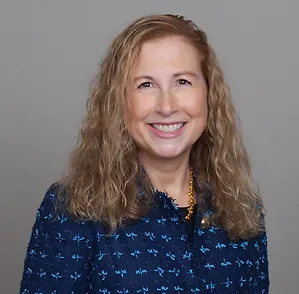
The LPC’s busy 2026 continues into the fall. August’s VM-22 Practitioners Forum in Denver—a first for the Academy—was a successful and sold-out affair, showing the ongoing importance of PBR-related practice. Kudos to April Shen for spearheading the planning for this successful event!
In the tradition of PBR “Boot Camps” held in recent years, the LPC also held two webinars—one in August, and one most recently in October—offering more insight and expertise into the topic. As always, catch a replay on Academy Learning. And, of course, the Academy held its annual Life and Health Qualifications Seminar in late September, a bit earlier than previous years.
I, and the LPC, are thrilled that Seong-min Eom has started as the Academy’s actuary for life and risk management! Many of us have interacted very positively with Seong-min over the years at NAIC meetings and Academy events, at which she’s been a regular attendee. (And make sure to read her Q&A in this issue.) Welcome Seong-min!
Congratulations to LPC volunteer extraordinaire Stephen Smith, who is among the Academy’s incoming member-selected directors. His efforts in collateralized loan obligations (CLOs) and more helped him get nominated to receive an Academy Outstanding Volunteerism Award, to be presented in December when he joins the Board.
And a special thank you to all the LPC volunteers for the many comment letters and other recently completed projects, including the two new papers in this issue.
Looking ahead to November and into next year, the LPC will participate in the NAIC Fall Meeting in Dallas, giving our stakeholder regulators the Academy’s insight and perspective, and we’re looking forward to the Academy’s annual Hill visits with federal lawmakers, policymakers, and regulators on Capitol Hill next March.
C1 Report Summarizes CLO Modeling to NAIC
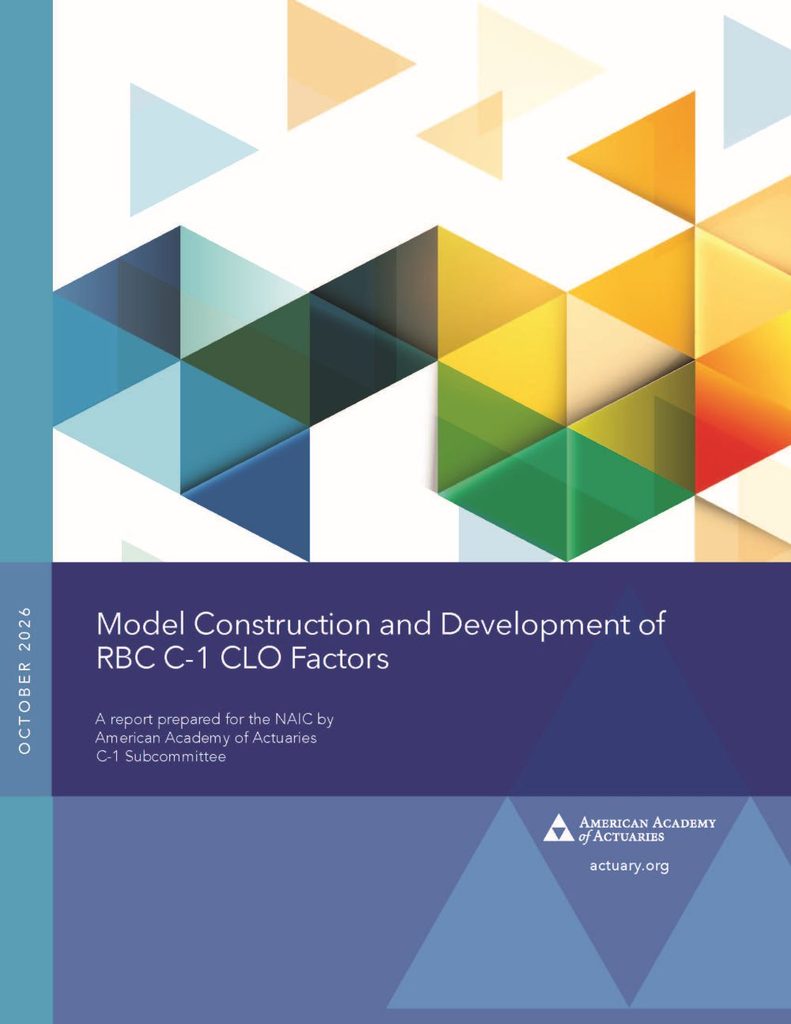
The C1 Subcommittee sent a report to the NAIC, Model Construction and Development of RBC C-1 CLO Factors, summarizing its work on collateralized loan obligations (CLO) modeling work completed in the past several years. The report outlines CLO basics and describes the modeling approach, data universes, and assumptions and methodology. It also identifies final C-1 factors and portfolio adjustment factors—and summarizes reconciliation of the proposed model with proposed CLO C-1 factors, as well as limitations and areas for future work.
Paper Explains Modeling and Risks of LTC Combo Products
A new policy paper by the Life Experience & Assumptions Committee, Long-Term Care Combo Products—Modeling, Assumptions, and Risks, provides a practical actuarial overview of combination insurance products that pair life insurance or annuities with long-term care (LTC) benefits. It examines the growing market for LTC products, their underwriting and modeling approaches, and the key assumptions used for mortality, morbidity, persistency, expenses, and utilization. It also explains the product, reputational, and regulatory risks involved, including reserve requirements and the evolving principle-based reserving framework.
Stephen Smith to Join Academy Board and Receive Volunteer Award

Life volunteer Stephen Smith will be an incoming Academy member-selected director, taking his seat on the Board at the Academy’s Leadership Summit and Governance Transition in December. Smith—who chairs both the Life Investment and Capital Adequacy Committee and the C1 Subcommittee—has been widely engaged with the news media in promoting the Academy’s life practice work and is recognized by regulators and the media as an expert on the Academy’s work on collateralized loan obligations (CLOs). The Outstanding Volunteerism Awards (OVAs) and other Academy service and recognition awards will also be given to recipients at the December event. Read more about this year’s Academy Award recipients.
‘Save Ferris!’ Makes a Case for Life Insurance
September was Life Insurance Awareness Month, and an Actuarially Sound blog post, Save Ferris! Don’t Let Life Pass You by Without Getting Life Insurance, looked at the importance of life insurance, paraphrasing the iconic 1986 movie, “Ferris Bueller’s Day Off.” It notes that a little over half of U.S. adults have life insurance, led by Gen X adults (ages 46 to 61), at 58%.
Academy Presents at SOA ImpACT, Will Present at NAIC Fall Meeting
LPC volunteers and Academy staff presented at the Society of Actuaries (SOA) 2026 ImpACT Conference in Pittsburgh Oct. 25–28, and will present at the NAIC Fall National Meeting in November in Dallas.
At SOA, Academy Life and Risk Management Actuary Seong-min Eom represented the Academy in a “Reinsurance Considerations for VM-22” session. She also moderated “The Impossible Equation: Navigating Systemic Climate Risk, Affordability, and the Widening Protection Gap,” a session featuring Academy Climate Change Joint Committee Chairperson Jon Wu and member Daniel Pribe. Life Illustrations Subcommittee members Eric Peterson and Hannah Suh also presented in a “Professionalism for the Illustration Actuary” session.
At NAIC, the LPC and other Academy practice-area councils will give updates on their respective activity, and the Academy will also give professionalism updates to NAIC practice-area task forces, including the Life Actuarial (A) Task Force (LATF).
Academy Holds Successful LHQ Seminar
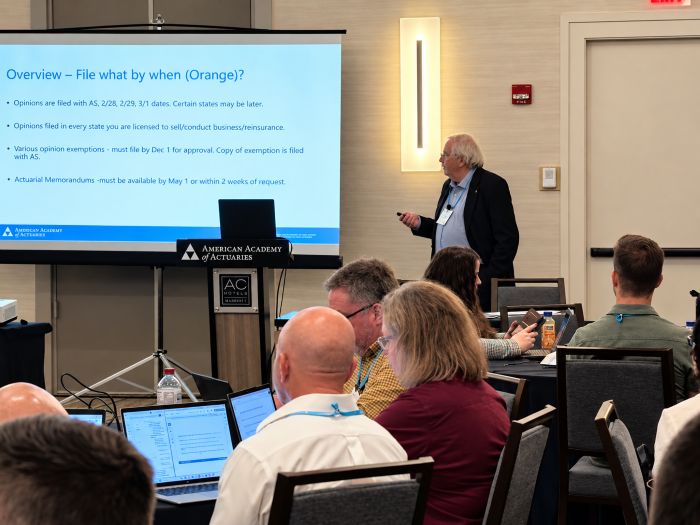
The Academy held a sold-out Life and Health Qualifications Seminar in late September in Arlington, Va. The annual seminar remains a great way to achieve basic or CE needed to qualify to issue actuarial opinions for the NAIC Life and Accident & Health (A&H) Annual Statement or the NAIC Health Annual Statement. The event was held earlier than in past years, based on attendee feedback.
Past President Darell Knapp, who led the seminar committee-planning, said, “The true highlight of this year’s seminar was the remarkable attention and dedication shown by attendees as they navigated complex statutory and qualification topics throughout the week. We owe a tremendous debt of gratitude to our esteemed LHQ Seminar faculty whose time, knowledge, and commitment to the profession made this successful educational experience possible.”
Highlights From
Life Perspectives

Prefer to watch your news? Check out this “Highlights From Life Perspectives” video for a quick recap of what you need to know.
Life Public Policy in Brief
The LPC commented in response to the NAIC Life Actuarial (A) Task Force’s (LATF) request regarding VM prescribed spreads and default costs.
The Annuity Products Subcommittee submitted comments on the NAIC Draft Buyer’s Guide for Deferred Annuities.
The C-3 Subcommittee presented proposed C-3 Field Test Specifications revisions to the NAIC’s Life RBC Work Group.
The Life Reserves Subcommittee responded to LATF’s request to review the Valuation Manual prescribed default and spread methodology used in VM-20, VM-21, and VM-22.
The Life Illustrations Subcommittee offered comments to the NAIC Life Insurance and Annuities (A) Committee in response to a June presentation regarding IUL and premium financing.
The Annuity Products Subcommittee provided comments to the NAIC on the June 2 exposure of the List of Potential Modifications to Model 245 Summary Guide and Actuarial Guideline.
The cross-practice Risk-Based Capital (RBC) Task Force commented on the NAIC’s RBC Model Governance (EX) Task Force’s exposure of potential gaps and inconsistencies for prioritization.
RBC-related Academy committees provided priority considerations in response to an NAIC RBC Model Governance (EX) Task Force exposure on proposed RBC oversight structures.
The Reinsurance Work Group submitted comments in response to the NAIC Life Risk-Based Capital (E) Working Group’s referral on developing a reinsurance recapture RBC factor. It also submitted comments in response to the NAIC Financial Condition (E) Committee’s memorandum on Model Act #285.
In a presentation at the NAIC Insurance Summit, C1 Subcommittee Chairperson Steve Smith gave an update on CLO modeling work completed in the past several years.
Read more—For the latest updates on the Academy’s life practice work, visit the Life Public Policy page.
Academy in the News
Financial Advisor’s coverage of registered index-linked annuity sales and projections noted regulators’ attention to annuity disclosures and cautions made by the Academy with respect to interpreting illustrations.
Lexology and other regulatory bulletins noted the NAIC’s adoption of RBC C-1 factors whose development was led by the Academy.
Investing.com’s coverage of the Barclays 24th Annual Global Financial Services Conference included panel discussion remarks on CLOs that noted the value of the Academy’s work with the NAIC in this area.
An independent regulatory update highlighting the NAIC Risk-Based Capital Investment Risk and Evaluation (E) Working Group’s adoption of a framework for CLO factors also noted the Academy’s work in this area.
Academy Life Actuary Seong-min Eom highlighted regulators’ plans for an annual data call on group annuity mortality experience for a Life Annuity Specialist story (subscriber-only) on mortality models.
The Academy’s life-practice work on asset-intensive reinsurance and capital requirements was highlighted by Reinsurance Business and BeInsure.
Legislative/ Regulatory Activity
Federal
The IRS issued a final rule providing guidance on the application of the transfer for valuable consideration rules and associated information reporting requirements for reportable policy sales of interests in life insurance contracts to exchanges of life insurance contracts. The final regulations affect parties involved in these life insurance contract transactions, including with respect to payments of reportable death benefits.
State
California Gov. Gavin Newsom signed AB 1798 on Sept. 30, prohibiting life and disability insurers from requesting, using, disclosing, or relying on genetic information or full genomes in insurance transactions or adverse underwriting decisions, subject to narrow medical-record exceptions.
Illinois Gov. J.D. Pritzker signed the following life insurance-related bills:
▶ SB 2872, stating that specified provisions of the state’s Standard Nonforfeiture Law for Individual Deferred Annuities do not apply to contingent deferred annuities. The language also affirms that the state’s director of insurance has the ability to adopt nonforfeiture benefits for such annuities.
▶ SB 2866, extending genetic-information privacy protections to biomarkers and biomarker testing and prohibiting insurers, employers, licensing agencies, and testing companies from obtaining, using, disclosing, or requiring related information except as authorized.s that the state’s director of insurance has the ability to adopt nonforfeiture benefits for such annuities.