
Editor’s Note: This article is the second in a two-part series on turning points in the history of insurance. Part I, which appears in the July/August 2026 issue of Contingencies, examined foundational developments in law, data, and public policy. This installment focuses on late-20th century innovations that reshaped how insurers and actuaries measure and manage risk.
From personal computers and new retirement products to financial crises that reshaped regulation, the postwar era transformed the actuarial profession and the business of insurance.
By James Lynch
In the decades after World War II, the insurance industry entered a period of rapid transformation. Personal computers transformed modeling. New retirement products reshaped how Americans save. And financial crises forced insurers and regulators to rethink how risk should be measured across entire organizations. While Part I of this series examined earlier institutional and technological developments that shaped modern insurance, Part II highlights how later innovations expanded the scope of actuarial work and risk management.
The Spreadsheet Revolution (1979)
It was spring 1978, and Harvard business student Dan Bricklin watched as his professors plugged and chugged a series of calculations on the blackboard. They solved one problem, then moved that answer into the next calculation. That answer fed the next one, and so on.
Then they wanted to change the input to the first equation. They laboriously erased all the previous answers, all the way down, and began again.
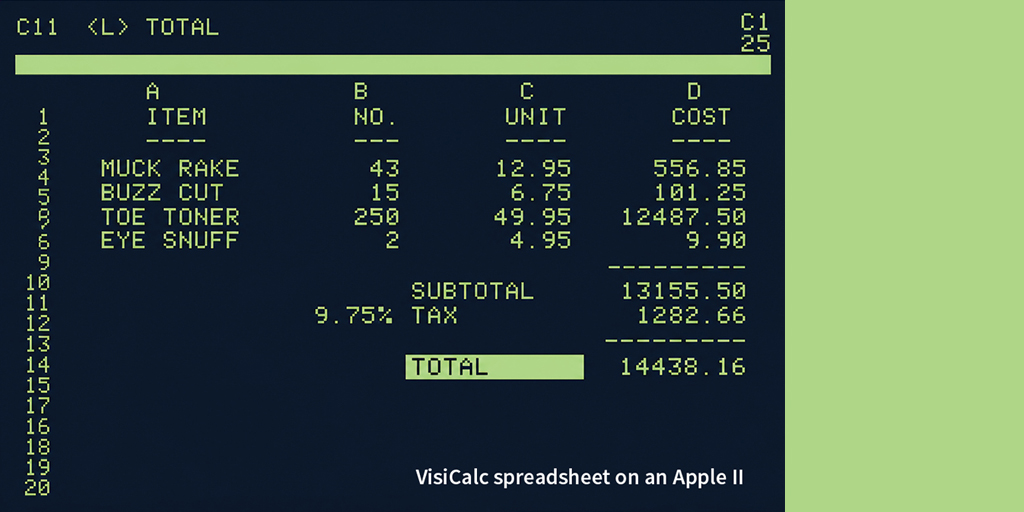
Bricklin figured he could do it better—and faster—with his Apple II microcomputer. There, you could chain all the formulas together; when you updated the first number, the rest would instantly recalculate.
With his friend Bob Frankston, Bricklin created VisiCalc, the first spreadsheet for personal computers. It was the forerunner of Microsoft Excel, perhaps the actuary’s best friend.
VisiCalc was an instant hit. It unleashed the microcomputer as a business product, and, more important, made it easy to create complicated mathematical models.
VisiCalc sold 200,000 copies in two years.1 Its publisher was sold in 1985 to Lotus, whose 1-2-3 spreadsheet had come to dominate the market—at least until Microsoft took control with Excel.
In those early days, people would show off VisiCalc at (admittedly nerdy) parties:
Look! You put in a new number at the top, and the answer at the bottom automatically changes. So do the subtotals! And the totals in the far right column change too!
Now put in a new number . . . see! They all changed again!
Consider how actuaries crunched numbers before the spreadsheet. Jerry Tuttle, a retired FCAS, started work at Crum & Forster in 1974. Data for a rate review came from a 1,000-page computer printout that contained information for every state, every line, every coverage within each line, and every product the insurer wrote.
An actuary went page by page, picking out the relevant numbers—one or two on this page, two or three from a few pages down—across 1,000 pages. Another actuary double-checked every selection.
The ratemaking model was stuffed into a timesharing mainframe—one machine for a department of 20. When it was available, you punched your data into the model, which was written in BASIC. (Not every actuary could program in BASIC.)
You took your review to the bosses. If they wanted revisions, back to the mainframe you went.
Some calculations were too complicated for a computer. Those were solved via green (always green!) worksheets: legal-sized sheets in landscape mode with maybe 16 columns, remembers Joe Herbers, a principal at Pinnacle Actuarial Resources. Data in the early columns fed calculations in the later columns.
Herbers, like his fellow actuaries, did the math on a four-function calculator that lacked even a square-root button. (He became a local hero for figuring out how to do reciprocals without using the memory key.)
The worksheet’s last column was left blank. It was for data checkers. They verified each calculation. If all was good for a given row, they put a dot in red ink in that last column.
“Red-dotting the green worksheets” was an important job.
Spreadsheets weren’t the only upgrade personal computers introduced. Storage grew, so datasets could capture more variables. Processing power accelerated, so more powerful models could glean those datasets.
The spreadsheet made complicated models easy to build. It let the actuary develop Monte Carlo projections to show a range of outcomes.
Perhaps just as important, spreadsheets are communication tools. Their displays show how data flows inexorably toward a conclusion. Their colorful, detailed charts illustrate the important points. And if something changes, with a few keystrokes you can update everything.
Actuaries went from being smart folks pulling stuff from a black box to communicators who could show underwriters and management the story the data told. When they understood what actuaries could deliver, management craved more insights.
They needed more actuaries.
The Casualty Actuarial Society, for example, added 1,783 members in the 1990s—more than in the previous 75 years combined.2
There were a lot of things going on—insurance companies needed an actuary to certify their reserves, and the first Jobs Rated Almanac (1988) rated actuary as the No. 1 job—but spreadsheets led the data revolution and made the actuary more valuable than ever.
The spreadsheet transformed how actuaries and financial analysts worked. But technology alone was not reshaping the insurance and financial landscape. While computers were making modeling easier and faster, new financial products were redefining how Americans saved for retirement—and expanding the role actuaries would play in managing those long-term promises.

The Birth of 401(k) (1980)
In 1980, Ted Benna used a new, overlooked subsection of the 1978 tax code (Section 401(k)) to change pension history.
Benna, then a consultant for The Johnson Companies in suburban Philadelphia, had a banking client that wanted a tax-deferred profit-sharing plan where employees couldn’t access the money until they stopped working for the bank.
One way was to replace the cash bonus with a retirement contribution. But two-thirds of employees had to take the deal, and lower-paid employees wouldn’t want the entire bonus tied up that way.
But starting Jan. 1, 1980, Section 401(k) of the tax code would become effective. It would let each employee put as much as they wanted into the retirement plan. Still, lower-paid workers might be reluctant to take the financial hit.
Here, Benna had his nation-changing insight: The employer could match the employee’s contribution. An employee contributes $1, the company contributes, say, 75 cents, and the entire amount grows, tax-deferred, until retirement.
The bank rejected the idea, Benna writes. Too risky, its attorney said.
So Benna’s consultancy adopted the first 401(k) plan for its own employees. In 1981, the IRS confirmed that the employer could deduct its matching funds as a business expense. The 401(k) craze was under way.3
By 2020, according to the Census Bureau, more than one-third of Americans had a 401(k) or one of its brethren, such as 403(b)s or 457(b)s. Only about 14% had defined-benefit or cash balance plans.4
The traditional defined-benefit pension had already been in decline, but Benna’s insight made the 401(k) a viable alternative.
As retirement planning shifted from employer-managed pensions to employee-directed savings, the financial system grew more complex. Insurers, pension managers, and regulators increasingly relied on specialists who could model long-term risk and uncertainty. Just as the profession’s importance was expanding, it received an unexpected burst of public recognition.
“The late 1980s were a period when the financial system itself was being tested. Rapid innovation in investment strategies and financial products was pushing insurers into unfamiliar territory. When those risks collided with volatile markets, the consequences would reshape how the entire industry measured and managed risk.“
When Actuary Became the “Best Job in America” (1988)
In 1988, when almanacs were a thing (as a kid, I wanted an almanac for Christmas; it took three years before my parents believed me), the World Almanac put out a side venture: The Jobs Rated Almanac. Author Les Krantz rated 250 jobs according to work environment, income, outlook, stress, security, and physical demands.
The No. 1 profession: actuary.
It wasn’t the money ($45,780 was good, not great). “Don’t expect a cushy job if you want to earn more than $50,000 a year,” Krantz told the Flint Journal.6
But in his system, actuary outranked football player, cowboy, nuclear plant decontamination technician, and more than 240 other professions.
The ranking was a surprise. Most articles about the book mimicked the quote above: What’s an actuary?
But if you were a budding quant from 1988 on, you knew what an actuary was, thanks to the Jobs Rated Almanac. The book helped create a supply of actuaries when circumstances—laws requiring actuarial certification of reserves and the digitalization of insurance data—increased demand.
There were six editions, the last published in 2002, with the actuarial profession landing at or near the top the entire time.
Of course, actuaries already knew why.
The late 1980s were a period when the financial system itself was being tested. Rapid innovation in investment strategies and financial products was pushing insurers into unfamiliar territory. When those risks collided with volatile markets, the consequences would reshape how the entire industry measured and managed risk.
The Failure that Sparked Modern Risk Management (1990)
As it grew rapidly in the 1970s and 1980s, First Executive Life Insurance Company looked like it would revolutionize the insurance industry.
It did, but not as anyone would have expected. Its spectacular failure created the pathway for risk-based capital and led to the modern enterprise risk management (ERM) framework, within which actuaries became a critical piece.
First Executive was a ragged holding company with two subsidiaries—one in California and one in New York—when Wall Street whiz Fred Carr took over in 1974.7
The moment was ripe for innovation. Inflation pushed interest rates into double digits, yet traditional life insurers were still primarily selling whole-life and term policies. Policyholders could borrow against their whole-life policies at low rates and earn guaranteed returns. By 1980, policyholder loans made up 22% of funds available for investment, up from just 4% only two years earlier.8
With its weak capital position, First Executive couldn’t launch many products. But it could write single-premium deferred annuities: The policyholder sent cash up front, but the insurer began annuity payments only years later. In five years, sales of First Executive single-premium annuities grew almost 100-fold.
First Executive also invested unconventionally, pouring millions into high-yield bonds, known colloquially as junk bonds. These were bonds issued by highly speculative enterprises or by struggling companies that had been severely downgraded.
The junk bond market had been small and illiquid until the 1980s, when the brokerage Drexel Burnham Lambert became its market maker. If no one else would buy a bond, Drexel would. When Drexel wanted to sell, First Executive was one of the first in line.
By the end of 1987, more than 40% of First Executive’s assets were in B- and BB-rated bonds. These boosted returns: First Executive’s portfolio yielded 270 basis points higher than the industry average at midyear 1983.
But First Executive’s actions concerned regulators.
They required First Executive to add capital to account for the bonds’ riskiness.
To regulators, First Executive’s reinsurance treaties looked like circular arrangements. Business was ceded to companies connected to First Executive, and they were backed by letters of credit issued by First Executive itself. New York regulators rejected the treaties in 1985, the first of a series of setbacks.
- Global financial markets collapsed in October 1987. Junk bonds fell as well—First Executive’s by 20%.
- Tax changes robbed First Executive’s annuities of much of their value. Sales volume fell.
- Regulators sharpened their focus, so First Executive couldn’t get enough reinsurance. Junk bonds were capped at 20% of its portfolio.
- Running partner Drexel Burnham Lambert collapsed in 1990 amid a hodgepodge of criminal and civil investigations, some involving First Executive. The junk bond market Drexel had created faltered, with securities trading at 60% to 80% of face value.
The key moment came on Jan. 22, 1990. The Wall Street Journal published an article: “First Executive Expects to Take Charge of Up to $515 Million for Bond Losses.” It appeared on page A3.9
“Even after the write-down, the Los Angeles-based insurance holding company said the market value of its $14 billion bond portfolio is $1.4 billion less than its book value . . . future charges may be needed.
“Friday’s surprise announcement hints at potential repercussions from the crumbling junk bond market . . .”
The insurer had made similar write-downs before, but this story got policyholders’ attention. A run on the insurer began.10
First Executive had always anticipated cash withdrawals. It had $2.5 billion in cash when the article was published, but in the first half of 1990, policyholders withdrew $4 billion—three times the amount redeemed during the entire prior year.
In the company’s defense, CEO Carr told the Journal that junk bond prices were “unrealistically low.” He was right. The junk bond market recovered the following year and remains viable today. In the long term, Executive Life would have remained solvent.
But the run crushed it.
On April 11, 1991, California regulators placed one major subsidiary into conservatorship. Five days later, New York regulators seized the other. The parent company became the largest U.S. insurance failure to that date.
Its end was spectacular, but First Executive was not the only insurance collapse during the whipsawing financial markets of the 1980s. There were several more, including Mutual Benefit Life, a venerable insurer that had lasted more than a century before it was crushed by falling real estate values.
As always, disaster begets blame.
State insurance laws were blamed for not giving regulators the tools to act faster and more decisively. Congress was told: “State insurance regulators lacked timely, complete, and accurate information needed to effectively monitor” troubled insurers.11
The three major rating agencies were blamed for reacting too slowly. They downgraded First Executive after the Wall Street Journal article appeared. A 1991 Miami Herald captured the skepticism surrounding insurer financial-strength ratings at the time, describing industry leader AM Best had “handed out top ratings like they were campaign buttons.”12

The agencies asserted that it wasn’t the crumbling junk bond market that threatened First Executive. It was the run on the company. While this was ultimately true, it ignored the importance of cash flow to a company that promises liquidity.
Meanwhile, property/casualty insurers were going down a similar path. High interest rates tempted many companies to write weak business and depend on investments to make up for underwriting losses.
Dozens of property/casualty failures in the late 1980s triggered a blistering 1990 report from a congressional subcommittee. The report, Failed Promises, came to be known as the Dingell Report, after subcommittee chairman John Dingell.
Criticisms cut across both disciplines, including:
- State insurance departments were overburdened and understaffed, and they monitored companies based on outdated information. The report noted that, at the time, “State governments collect twenty times more from premium taxes than they spend on insurance regulation.”13
- The National Association of Insurance Commissioners was designed to develop uniform insurance laws, but it had no enforcement mechanism. In 35 states, audits were not required. In 33 states, there was no requirement that actuaries certify the adequacy of reserves.
The Dingell Report hinted broadly that the federal government should override traditional state regulation under the McCarran-Ferguson Act and take a larger role in regulating insurance. Regulators and rating agencies took a different route.
The NAIC developed an accreditation program. A state insurance department needed to conform to NAIC standards regarding solvency. If it didn’t, other states would not accept its work.14
The program effectively leveled the playing field among regulators. Every state was held to a standard, but the states remained independent.
Among the requirements: All domestic insurers needed to issue a Statement of Actuarial Opinion.15 This marked a watershed moment in the development of the actuary as a professional.
All states are accredited today.
The NAIC also developed a quantitative tool: risk-based capital (RBC), a model that estimates the minimum capital an insurer needs to operate and then instructs regulators on how to act when an insurer’s actual capital approaches that level.
Before RBC, regulators trying to remediate a struggling company often ended up in court. With RBC—and the laws backing it up—they could move quickly and objectively.16
The formula takes an enterprise risk management approach. It considers risks from across the company and tests whether the surplus held can withstand disaster from multiple directions. Life insurers, for example, must have enough capital to ensure that they are protected should some of their investments default, or should their mortality/morbidity assumptions prove faulty, or the markets bludgeon their investments. It also accounts for the default of an affiliate and the risk of derivatives.
AM Best adopted a similar model in 1994, which it called BCAR (Best’s Capital Adequacy Ratio). Like the NAIC model, it’s not the sole determinant of company health. But, as Best puts it, “BCAR can assist . . . in determining whether . . . capitalization is appropriate for [an entity’s] risk profile.”17 Other rating agencies have followed suit.
ERM and RBC weren’t new concepts. They can trace their lineage to the computerized management information systems that IBM was touting in the 1960s. But the acceleration is hard to miss. Two years after First Executive’s demise, James Lam became the first chief risk officer.
The failure of First Executive and other insurers forced regulators, rating agencies, and companies to rethink how risk should be measured—not just within individual products, but across entire organizations. Out of that turmoil came risk-based capital requirements, stronger regulatory coordination, and the emergence of enterprise risk management as a defining framework for modern insurance.
“Two and a half centuries after the nation’s founding, the core mission of insurance remains unchanged: understanding uncertainty well enough to allow people and businesses to take risks. Insurance enables commerce, stabilizes families, protects businesses from catastrophe, and helps societies absorb shocks that might otherwise derail growth.”
Insurance Today
Two and a half centuries after the nation’s founding, the core mission of insurance remains unchanged: understanding uncertainty well enough to allow people and businesses to take risks. Insurance enables commerce, stabilizes families, protects businesses from catastrophe, and helps societies absorb shocks that might otherwise derail growth.
The turning points described here—legal decisions, technological inventions, political movements, and financial crises—show that insurance has always evolved alongside the nation itself.
As the United States enters its next 250 years, the profession will almost certainly encounter new turning points of its own.
Academy Volunteers Bring Expertise to RBC Discussions
Over the past year, the NAIC has held commissioner-led conversations about risk-based capital (RBC). Historically, the Academy has worked with the various NAIC working groups focused on RBC. These working groups are led by state insurance department staff, many of whom are actuaries, and are responsible for maintaining and updating the tool. These working groups conversations do not usually reach the Executive Committee level, making it noteworthy when the 2025 NAIC president, Jon Godfread, identified RBC as a priority for his tenure.
The NAIC created the RBC Model Governance (EX) Task Force, charging it with a three-prong focus: developing guiding principles for the RBC framework to ensure a consistent approach to future adjustments; conducting a gap analysis and consistency assessment to improve the framework; and creating an education and public messaging campaign to highlight the value of the RBC framework as an important part of the U.S. state-based insurance regulatory system.
As the Task Force was established, the Academy was asked to provide an “RBC 101” session for the commissioners and their staff, offering historical and current perspectives on the tool across the life, health, and property/casualty sectors. Since then, the Academy has become an active partner to the Task Force, meeting regularly with the lead consultant and other key stakeholders to help educate and inform their work.
In response to the need for collaboration across its practice councils, the Academy created the Cross-Practice RBC Task Force. This group, composed of volunteers from the life, health, and property/casualty practice councils, has submitted several comment letters in response to public exposure drafts and questions posed by the NAIC Task Force, most recently commenting on the proposed RBC preamble revisions and providing verbal testimony at NAIC national meetings.
The work with the NAIC continues, and the Academy’s volunteers remain key voices in shaping conversations about the future of RBC.
James Lynch, MAAA, FCAS, is a retired property/casualty actuary in New Jersey who writes articles on insurance history and financial matters.
Endnotes
- Frank Gibney Jr., “The Tail That Wags the Dog,” Newsweek, Feb. 22, 1982.
- Author’s calculations based on data received from Casualty Actuarial Society, Feb. 20, 2026.
- Ted Benna, “The Day I Designed The First 401K Savings Plan,” Benna401k, accessed Feb. 2, 2026.
- US Census Bureau, “New Data Reveal Inequality in Retirement Account Ownership,” Census.Gov, accessed Feb. 2, 2026.
- Will Hoover, “Actually, the Best Job Is Being an Actual Actuary,” The Sunday Star-Bulletin & Advertiser (Honolulu, HI), April 17, 1988.
- Gene Mierzejewski, “Money Isn’t Everything When Changing Careers,” The Flint Journal (Flint, MI), May 1, 1988, C3.
- A simple history of First Executive is “FIRST EXECUTIVE CORPORATION— Company History,” accessed Feb. 24, 2026.
- Timothy Curry and Mark Warshawsky, “Life Insurance Companies in a Changing Environment,” FRASER (St. Louis), July 1986.
- Kathleen A. Hughes and Frederick Rose, “First Executive Expects to Take Charge of Up to $515 Million for Bond Losses,” Wall Street Journal, Eastern Edition (New York, N.Y.),
Jan. 22, 1990. - Harry DeAngelo et al., “The Collapse of First Executive Corporation Junk Bonds, Adverse Publicity, and the ‘run on the Bank’ Phenomenon,” Journal of Financial Economics 36 (January 1993): 287–336.
- Statement of Richard L. Fogel, assistant Comptroller General, General Government Programs, “Insurance Regulation: The Failures of Four Large Life Insurers,” testimony before the Committee on Banking, Housing, and Urban Affairs, United States Senate, Feb. 18, 1992.
- OK, that was me: Jim Lynch, “‘Guru of Gloom’ rankles insurance firms,” Miami Herald (Miami, Fla.), June 3, 1991.
- United States, Failed Promises: Insurance Company Insolvencies: A Report (U.S. G.P.O. : For sale by the Supt. of Docs., U.S. G.P.O., 1990).
- Kay Noonan, “NAIC Accreditation Program,” National Conference of Insurance Legislators, Nov. 16, 2017.
- For life insurers, NAIC in 1975 required actuaries signing the Annual Statement to render an opinion on reserves, but of course it had no way to ensure states would adopt that requirement.
- Joseph A. Herbers and Aaron N. Hillebrandt, “A Recent History of the Statement of Actuarial Opinion, Solvency Regulation and the Actuarial Profession in the United States,” author’s copy, n.d.
- Mathilde Jakobsen et al., Understanding Universal BCAR (AMBest, 2020).