Automobile Insurance Committee in Focus—New Leadership and Perspectives on Tariffs
The Academy will present at the Casualty Actuarial Society (CAS) Spring Meeting in New York in early May on cost drivers in auto insurance and auto insurance affordability. The presentation will define metrics for the affordability of auto insurance, cover changes in U.S. affordability trends in recent years, and discuss factors that are driving changes to auto insurance costs such as inflation, social inflation, behavioral changes in drivers, and tariffs.
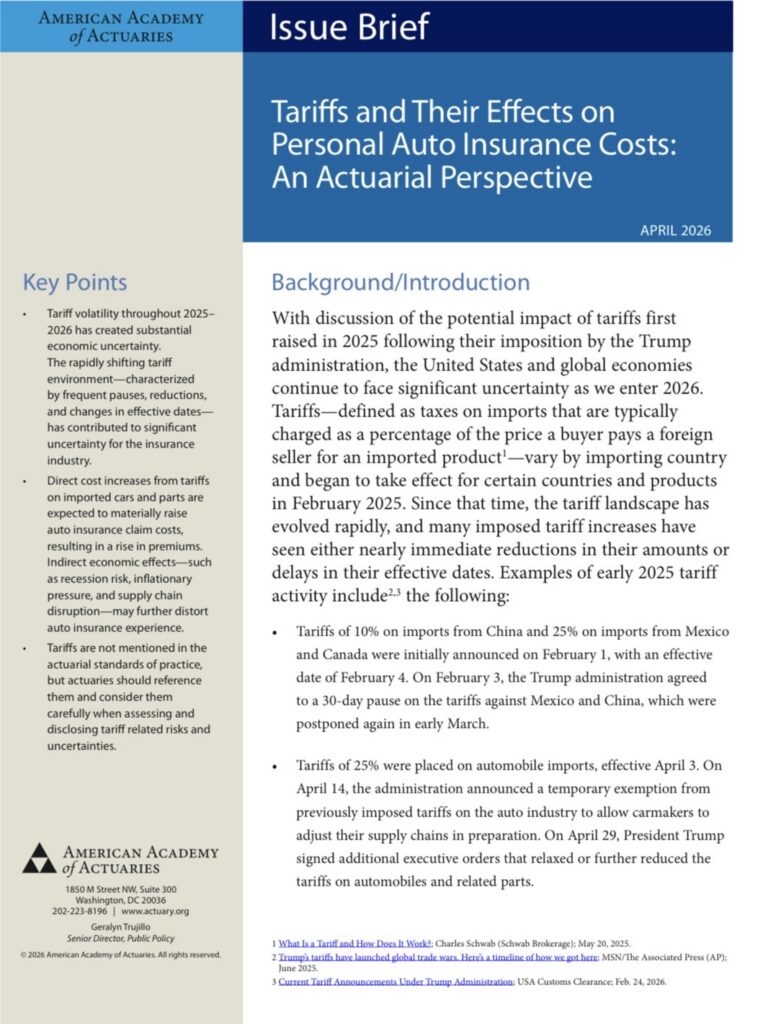
The presentation ties in with a new Academy Automobile Insurance Committee paper on tariffs, Tariffs and Their Effects on Personal Auto Insurance Costs: An Actuarial Perspective, which looks at tariff-related issues including volatility in the past year that has created substantial economic uncertainty, a rapidly shifting tariff environment that has contributed to uncertainty for the insurance industry, cost increases from tariffs on imported cars and parts that are expected to materially raise claim costs, and premiums; indirect economic effects such as recession risk, inflationary pressure, and supply chain disruption; and other risks and uncertainties that may further distort the auto-insurance space.
“I’m excited to step into the role of Automobile Insurance Committee chairperson and build on the momentum set by previous chairperson Jared Smollik and the committee members,” said new Chairperson Amy Ning. “Over the past few weeks I’ve enjoyed connecting one‑on‑one with members to learn more about their interests, expertise, and what excites them most about the committee’s work, and it’s been great to see the depth and breadth of actuarial experience across the group. Looking ahead, the committee will continue to provide objective actuarial expertise to help inform sound public policy, stay ahead of industry trends, and advance work on emerging topics such as telematics. We’re also excited to collaborate and support each other’s professional growth through committee involvement,” she said.
The committee also submitted a comment letter to the District of Columbia Department of Insurance, Securities and Banking (DISB) in mid-April on a telematics bill under consideration in the city, and is preparing a paper on that subject. It also sent a joint letter to the DISB In conjunction with the P/C Extreme Events and Property Lines Committee on DISB’s upcoming market conduct data call.
Academy Holds Spring Policy Summit, Annual Hill Visits
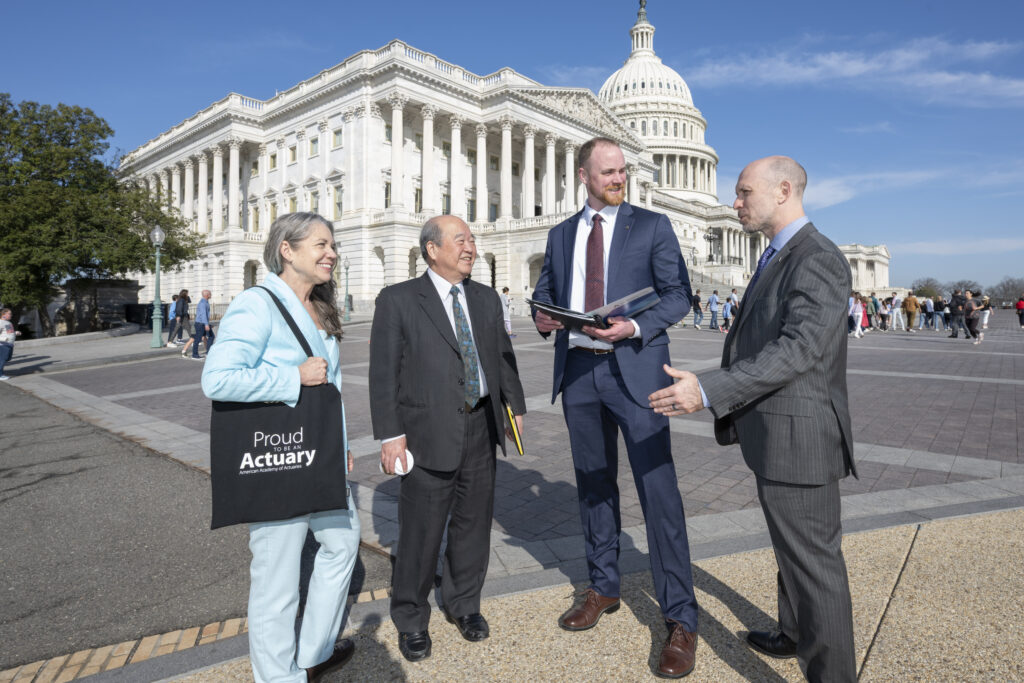
The Academy held its inaugural Spring Policy Summit in Washington on March 9, followed by the annual “Hill visits” in which Casualty Practice Council (CPC) and other practice-area volunteers and Academy staff fanned out across Capitol Hill, meeting with congressional and committee staff, and federal agencies.
The summit featured multiple sessions with legislative, regulatory, and stakeholder groups, all of whom reinforced the value received through the Academy’s objective and nonpartisan information on important public policy issues. A key theme across sessions was delivering the Academy’s expertise and insights by “meeting stakeholders where they are”—whether through short bullet-point highlights, infographics, issue briefs, or more detailed comment letters, papers, and monographs.
▶ Video—Watch a short video about the Hill visits.
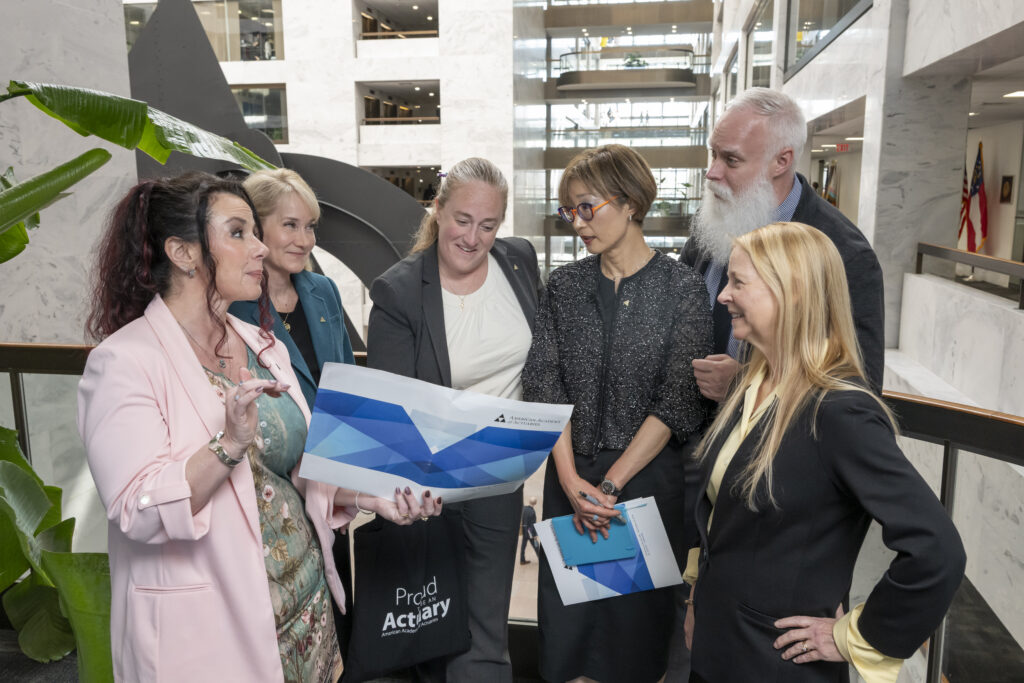
As noted by Casualty Vice President Susan Kent (see “VP Corner,” below), for the Hill visits, CPC and Risk Management and Financial Reporting Council (RMFRC) volunteers formed three groups that met with 15 different congressional offices and committees on topics ranging from cybersecurity to extreme weather events and the National Flood Insurance Program (NFIP). The meetings included the House Budget, Judiciary, Homeland Security, and Financial Services committees, along with the Senate Banking, Housing and Urban Affairs Committee and the Commerce, Science and Transportation Committee, as well as staff of key individual members of Congress.
Federal officials were “very open to the Academy’s Hill visits,” said Wanchin Chou, a past chairperson of the CPC’s Committee on Cyber Risk and a current member of the Climate Change Joint Committee, who has taken part in Hill visits for the past several years.
Congressional staff and federal agency officials “appreciate the Academy’s expertise in many key areas that we as actuaries have,” he said, including “AI, the availability and affordability issue, cyber risk, catastrophe, and cyber risk—they are facing many challenging questions from the public to address.”
VP Corner
CPC Off to a Strong Start in 2026
Susan Kent
Vice President, Casualty
The CPC is off to a strong start in 2026! The CPC released the annual P/C Loss Reserves Law Manual and Statements of Actuarial Opinion on P/C Loss Reserves practice note, sent a joint comment letter with RMFRC and the Academy Research Committee to the National Science Foundation (NSF), urging retention of National Center for Atmospheric Research, and released an issue brief, Homeowners’ Insurance: Filling the Coverage Gap. Additionally, the CPC held a February webinar, Key Insights from the P/C RBC Committee.
A highlight of the quarter was the cross-practice Academy Hill visits, which involved all practice areas. The CPC, in conjunction with RMRFC, visited federal policymakers and regulators on Capitol Hill in the nation’s capital on April 10. CPC/RMFRC volunteers formed three groups that met with 15 different congressional offices and committees on a variety of important topics including cybersecurity, affordability, extreme weather events, the NFIP, and third-party litigation funding. Hill visits are a meaningful—and fun!—way of fulfilling one of the main missions of the Academy: informing public policy.
▶ New volunteers welcome!—A big thank-you to the many volunteers who make all of these accomplishments possible. The CPC always welcomes new volunteers. If you are interested, please let us know via the Academy’s volunteer contact form.
Homeowners’ Task Force Releases Issue Brief
The Homeowners’ Insurance Task Force released its first paper, Homeowners’ Insurance: Filling the Coverage Gap, an issue brief examining how the home replacement cost calculation process is more complex than it appears, as market value and insured value do not always align.
Academy Presents at NAIC Spring Meeting
Academy volunteers and staff presented at the NAIC Spring National Meeting in San Diego in late March, covering multiple practice areas, including casualty, as well as professionalism and cross-practice policy issues.
Academy President Tricia Matson introduced professionalism updates to NAIC practice-area task forces including the Casualty Actuarial and Statistical (C) Task Force (CASTF) by Actuarial Standards Board Chairperson Laura Hanson, Actuarial Board for Counseling and Discipline Chairperson William Hines, and Committee on Qualifications member Linda Lankowski.
The Academy also gave several practice-area presentations, including an update of CPC activity to CASTF by Director of Public Policy Outreach Katie Dzurec and Research updates from Director of Research, Steve Jackson, who shared some research findings on risk-based capital (RBC) and impairment to the Joint Meeting of Catastrophe Risk (E) Subgroup and Property and Casualty RBC (E) Working Group.
▶ Blog, podcast—For a deeper dive into the Academy’s presentations at NAIC, see the Actuarially Sound blog post and listen to an Actuary Voices podcast, in which Dzurec joins podcast host Ted Gotsch to discuss the meeting.

P/C ASOPs Roundup
ASOP Nos. 30, 39 Second Exposure Drafts Open for Comment
The Actuarial Standards Board (ASB) approved second exposure drafts of ASOP No. 30, Profit Provisions, Contingency Provisions, and the Cost of Capital in Property/Casualty Risk Transfer and Risk Retention, and No. 39, Treatment of Catastrophe or Extreme Event Losses in Future Cost Estimates for Property/Casualty Risk Transfer and Risk Retention.
ASOP No. 41 Webinar Set for May 1
An upcoming professionalism webinar will cover proposed changes to ASOP No. 41, Actuarial Communications, which applies to all practice areas. A third exposure draft is currently open for comment. Register today.
▶ Comment to the ASB—Comments on ASOP No. 41 are due June 1, and comments on ASOP Nos. 30 & 39 are due July 1. To comment on the exposure drafts, visit the ASB website.
ASB Adopts Revisions of ASOP No. 20
The ASB also adopted a revision of ASOP No. 20, now titled Analysis of Property/Casualty Cash Flows, Including Discounting. The effective date is for actuarial work performed on or after June 1, 2026.
Cyber Risk Toolkit Updated With New Cyber Data Paper
An updated Cyber Data paper by the Committee on Cyber Risk is the latest update to the committee’s Cyber Risk Toolkit. Cyber insurers lack the years of historical data typically used in other property/casualty lines to build reliable pricing models. It notes that as data grows, cyber risk remains difficult to evaluate due to limited experience or the evolving nature of exposure, which can also complicate reserving.
Registration Opening Soon for CLRS, P/C Opinion Seminar
Mark your calendar for two annual property/casualty events sponsored and co-sponsored by the Academy.
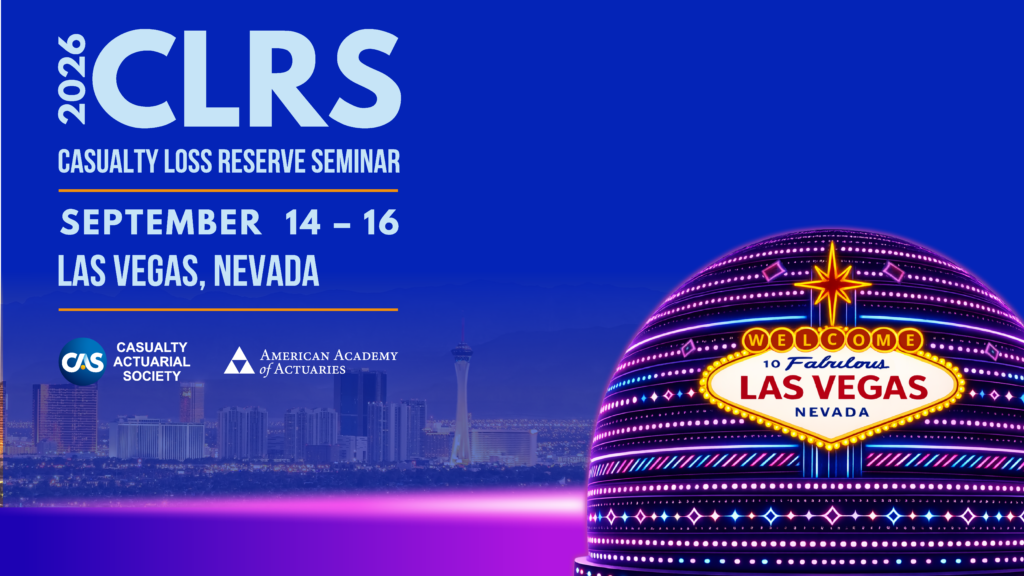
▶ CLRS, Sept. 14–16, Las Vegas—The annual Casualty Loss Reserve Seminar (CLRS), co-sponsored with CAS, will be held Sept. 14–16 in Las Vegas. Registration will open soon, with early registration discounts available.
▶ P/C Opinion Seminar, Dec. 7–8, Nashville—The Academy’s Seminar on Effective P/C Loss Reserve Opinions will be held Dec. 7–8 in Nashville, Tenn. Called by one past attendee “a great distillation of changing requirements and rules, as well as a good pooling of experience,” the seminar is designed for P/C actuaries who prepare NAIC statements of actuarial opinion. Registration, with early discounts, will open in June.
New on Academy Learning: Webinar Offers RBC Insights
A February webinar, Key Insights From the P/C RBC Committee, offered a detailed examination of the committee’s dependency report to the NAIC and the committee’s work, as well as an understanding of the critical issues surrounding P/C risk-based capital (RBC) issues. Watch a replay on Academy Learning.
Highlights From
Casualty Quarterly
Prefer to watch your news? Check out this “Highlights From Casualty Quarterly” video for a quick recap of what you need to know.
Contingencies Covers Cyber Risk, Pricing Fairness
The March/April issue of Contingencies leads with the impact of extreme cyber risks and the need for insurers, risk managers, and policymakers to act in a timely manner, and another feature article examines fairness in insurance pricing.
Committee on Cyber Risk Chairperson Sam Tashima discussed opportunities for growth and more about cyber risk in Contingencies’ February web exclusive, and offered highlights in an accompanying short video.
ACI Releases Latest Data

The Actuaries Climate Index (ACI) has been updated through August 2025, with the index’s five-year moving average decreasing slightly from 1.43 to 1.41 above the ACI reference period. Although the five-year average temperature anomalies increased, wind and sea-level anomalies decreased, the net effect being a slight drop in the composite index. The ACI is a research project funded jointly by the Academy, CAS, the Canadian Institute of Actuaries, and the Society of Actuaries. For more, visit the ACI website.
COPLFR Releases Annual Practice Note
The Committee on Property and Liability Financial Reporting (COPLFR) released its annual practice note on Statements of Actuarial Opinion on P/C Loss Reserves, including discussion of statements of actuarial opinion (SAOs).
Academy in the News
Former Academy Casualty Vice President Rade Musulin’s receipt of the Academy’s 2025 Jarvis Farley Service Award was reported in Actuarial Review’s “Comings & Goings.” Watch his acceptance remarks on the Academy’s YouTube channel (at the 21:53 mark).
Casualty VP Susan Kent provided an actuarial public policy perspective to National Mortgage News (subscriber-only) for a story on a proposal by a group of U.S. senators to end implementation of the NFIP’s Risk Rating 2.0 system.
Risk Market News published an article focused on the Academy’s recent cross-practice letter to the NSF, outlining concerns over the potential impact of announced plans to dismantle the National Center for Atmospheric Research. Politico Pro (subscriber-only) reported on the letter as well, quoting Research Committee Chairperson Peter Ott.
A European Actuarial Journal research article on the implications of changing climate risks for life insurance reserves noted the role of the ACI in educating actuaries about climate trends.
Legislative/Regulatory Activity
Federal
The Senate confirmed Lt. Gen. Joshua Rudd to serve as commander of the U.S. Cyber Command. He was nominated by President Trump in late 2025 to lead both USCYBERCOM and the National Security Agency in a dual capacity.
President Trump issued an executive order in response to the January 2025 wildfires in Los Angeles instructing the Federal Emergency Management Agency and the administrator of the Small Business Administration to draft regulations that would preempt state or local permitting processes that are found to unduly impede the timely use of federal emergency rebuilding monies and instead require builders self-certify to a federal designee that they have complied with all applicable state and local health and safety standards with respect to the structure that will be rebuilt using federal emergency-relief funds within 30 days. The executive order also calls for proposed federal legislation to support prompt responses and for an audit of the Hazard Mitigation Grant Program granted to California.
The U.S. Department of Agriculture’s Farm Service Agency issued a final rule making significant changes to the Agricultural Risk Coverage, Price Loss Coverage, and Dairy Margin Coverage programs, affecting agricultural producers from 2026 to 2031. Key modifications include adjustments to payment structures, eligibility criteria, and the allocation of base acres, particularly impacting farmers involved in crop and dairy production.
Rep. Madeline Dean of Pennsylvania introduced HR 7355, a bill that requires the disclosure and sharing of certain policy and claims information under the NFIP.
State
South Dakota Gov. Larry Rhoden signed SB 36, authorizing utilities to develop a wildfire mitigation plan that must be approved by state regulators and will allow damages to be recovered if the utility fails to substantially comply with essential plan elements.
Indiana Gov. Mike Braun signed HB 1260, enhancing oversight and enforcement against insurance fraud by expanding the scope of fraudulent acts, establishing mandatory reporting requirements, and clarifying civil liability protections. It also modifies property and automobile insurance regulations.
Alabama Gov. Kay Ivey signed SB 109, creating a framework for peer-to-peer car sharing services that addresses insurance, liability, and operational requirements. It makes clear that the car service assumes primary liability coverage when the car is used for business purposes.
Ivey also signed SB 27, creating catastrophe savings accounts for individuals designed to cover deductible and uninsured costs related to catastrophic windstorm events.
New York Gov. Kathy Hochul signed A 9508/S 8786, allowing a rental vehicle company or peer-to-peer car sharing program administrator to act as an agent for an authorized insurer offering accident and health insurance that provides coverage to shared vehicle owners and/or shared vehicle drivers.
Both the Florida House and Senate have passed SB 1028, a measure creating personal and commercial lines clearinghouses designed to facilitate the placement of insurance coverage, promote competition, and divert ineligible applicants from the Citizens Property Insurance Corporation into the private market.
Both Florida legislative chambers have also passed SB 7024, establishing comprehensive confidentiality and exemption provisions for sensitive cybersecurity, information technology, and operational technology data held by Florida state agencies.
The Virginia House and Senate passed SB 693, prohibiting motor vehicle insurers from using unfairly discriminating factors, such as consumer credit information or credit-based insurance scores, when determining premiums, rates, or coverage terms.
The Mississippi House and Senate are meeting to approve final amendments to SB 2409, which authorizes inspections and certifications for wind resistance and hurricane mitigation in addition to offering grants of up to $15,000 to property owners for mitigation measures for retrofittable insurable homes.
The Arizona Senate passed SB 1206, introducing specific requirements for residential construction contracts following catastrophic storms, including restrictions on contractor conduct related to insurance claims and deductibles.
The Arizona House passed HB 2174, enhancing regulatory oversight of the insurance industry by requiring insurers licensed for property and casualty coverage to report loss, expense, and investment data, which may be gathered by designated modeling, data, or rate service organizations.
The Idaho House passed H 562, which revises current law regarding cancellation and nonrenewal of certain commercial and homeowner policies.
The Maryland House approved HB 1186, a peer-to-peer car sharing measure requiring vehicle owners and drivers be covered by a motor vehicle liability insurance policy that meets or exceeds state minimums, with the sharing program serving as the primary insurer if personal coverage lapses.
The Kentucky House passed HB 527, which creates a grant program aimed at enhancing the resilience of insurable dwellings against wind and hail damage.
The Hawaii House approved HB 2282, requiring insurers to provide explanation of premium increases upon request, as well as amending the notice requirements for cancellation or nonrenewal of a property insurance policy.
The Oklahoma House approved HB 4202, updating the regulation of medical care and costs under Oklahoma’s workers’ compensation system by establishing a revised fee schedule for medical reimbursements.
The Georgia Senate approved SB 503, which establishes procedures for refunds of excess profits by automobile insurers and introducing storm damage mitigation programs to reduce property damage costs from natural disasters.