|
|
RECENT ACADEMY ACTIVITY | | |
|
| |
|
|
Only have a minute? Catch up on this week’s top public policy stories with the latest “This Week … In a Minute” video. Subscribe to our YouTube channel to receive alerts as they are released. | |
|
|
| | |
This Week—A Focus on Policy | | |
Spring Policy Summit, Hill Visits Mark a Busy Week in D.C. | | |
 |
|
|
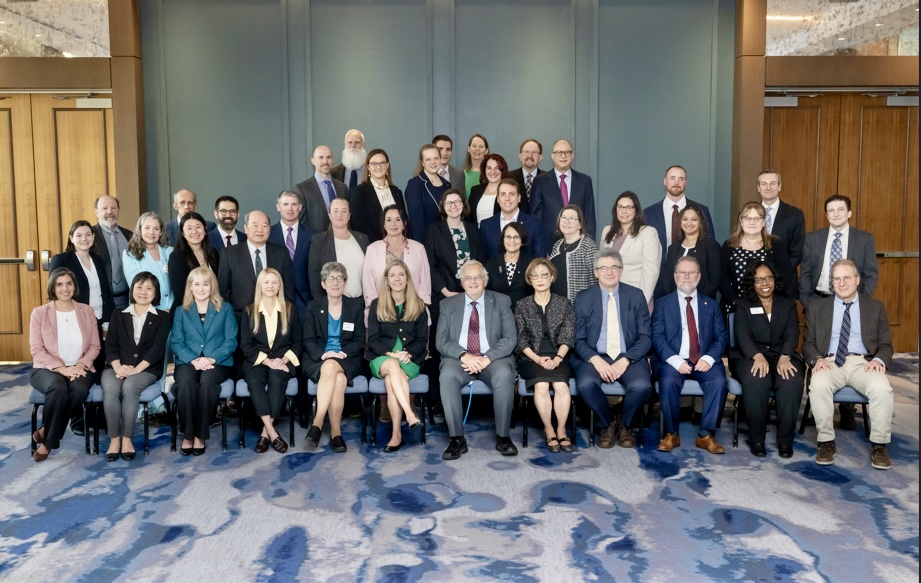
Academy volunteers get set for the Hill visits | | | |
The Academy held its inaugural Spring Policy Summit Monday in Washington, followed by the annual “Hill visits,” during which groups of volunteers and staff fanned out across Capitol Hill to meet with staff of congressional members and committees, and regulatory agencies. Summit Focuses on Legislative, Regulatory Issues The summit featured multiple sessions with governmental, regulatory, and stakeholder groups, all of whom reinforced the value received through the Academy’s objective and nonpartisan information on important public policy issues. A key theme across sessions was delivering our expertise and insights by “meeting stakeholders where they are”—whether through short bullet-point highlights, infographics, issue briefs, or more detailed comment letters, papers, and monographs. Academy President Tricia Matson said in short interview between sessions that the summit was a good opportunity for the Academy to get feedback from its many stakeholders. “We’re very good at the actuarial work,” she said. “I think [a big focus was] making sure that we know our audience and that our work product is understandable for them.”
| | | |
 |
|
|
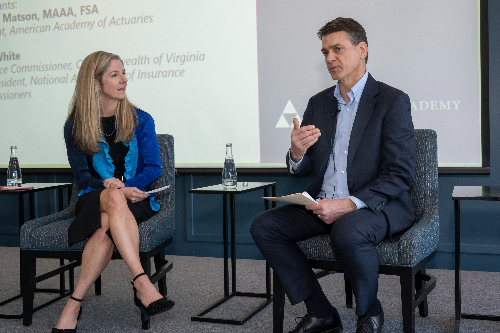
Matson & White in the fireside chat session | | | |
▶ NAIC, State Perspective—Session highlights were led by a “fireside chat” featuring a discussion between Matson and keynote guest Scott White, Virginia insurance commissioner and NAIC president. White gave an overview of issues of interest to the NAIC and the Academy, ranging from insurance affordability and availability, artificial intelligence (AI) and cyber risk, to collateralized loan obligations (CLOs). The Academy has provided the NAIC with “a lot of actuarial bandwidth,” including important detail on issues such as risk-based capital, asset adequacy testing, and the adoption of VM-22 last year, White said. ▶ Legislative, Agency Perspectives—Separate sessions on legislative and federal agency priorities featured congressional staff and agency personnel, who shared their perspectives on the Academy’s value and interaction on public policy issues, including health care, lifetime income, property/casualty, and retirement. Rachel Dolin, a minority staff member of the House Ways and Means Committee’s health subcommittee, discussed health issues with moderator Jason Russell, a past Academy retirement vice president. Seong-Min Eom, chairperson of the Academy’s Joint Committee on Climate Change, moderated the agency-focused session that included Frank Todisco, chief actuary with the U.S. Government Accountability Office (Todisco is also the Academy’s president-elect, but in this session was representing GAO, from which he will retire in two weeks), along with Matt Barry with the Congressional Research Service and Julie Topoleski with the Congressional Budget Office. All three talked about how their agencies provide extensive information in response to requests from members of Congress and congressional committees, and the importance of independent and objective perspective like that which the Academy delivers.
| | | |
|
|
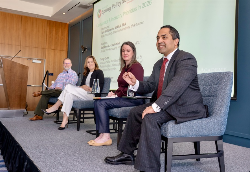
Consumer & industry priorities session panelists | | |
▶ Industry & Consumer Perspective—Academy Past President Tom Wildsmith led a lively session of trade and industry association staff, including Kathleen Coulombe of ACLI, Tony Cotto of NAMIC, and Meghan Stringer of AHIP. Asked how the Academy’s role differs from industry groups, Stringer said the Academy’s emphasis “on the way the math works” as an objective perspective is always seen as valuable—“math is not partisan, and a formula is not worried about the next election,” she said—while Cotto noted that “insurance wouldn’t be possible without the universe of actuaries.” ▶ Professionalism Perspective—A panel including two past Academy presidents gave an overview of actuarial professionalism. Immediate Past President Darrell Knapp moderated, and Penultimate President Lisa Slotznick gave perspective from the Committee on Qualifications (COQ), of which she was recent member. They were joined by Actuarial Standards Board member Dave Heppen and Actuarial Board for Counseling and Discipline member Tim Geddes, who outlined their respective boards’ roles in developing actuarial standards of practice and managing the discipline process for the self-regulating actuarial profession.
| | | |
Hill Visits Cover Key Public Policy Issues, Reinforce the Value of an Actuarial Perspective | | |
|
|
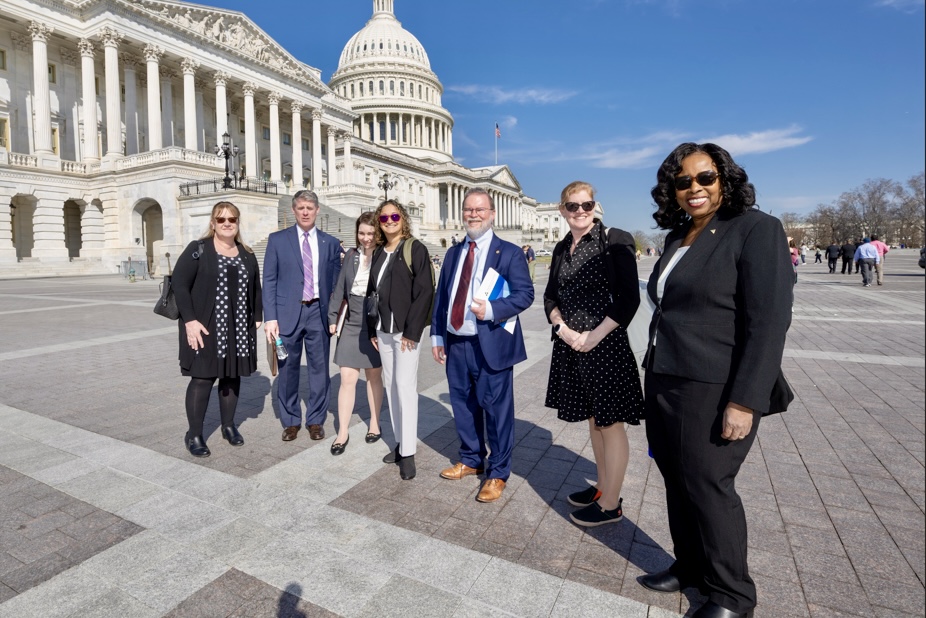
Health VP Annette James (right) & volunteers at the Capitol | | |
The Academy’s annual “Hill visits,” held on Tuesday, featured more than 40 Academy volunteers and staff, “making the rounds” to congressional offices on Capitol Hill, discussing today’s biggest issues and the importance an actuarial perspective can be to addressing those through the independent and objective lens delivered by the Academy. In addition to meeting with staff members of key senators and members of the House, they met with committee staff, including the House Ways and Means Committee; Homeland Security Committee; Senate and House Budget Committees; the Senate Commerce, Science & Transportation Committee; and Senate Health, Education, Labor & Pensions Committee. Health volunteers also met with the Congressional Budget Office and the Center for Consumer Information and Insurance Oversight (CCIIO). Matson said that “in addition to the benefit we’ll get from meeting with [policymakers], we’re also providing a benefit to our members, because a lot more folks were able to participate and represent the critical role played by the actuarial profession and the Academy.”
| | | |
|
|
CPC/RMFRC volunteers at a Senate office building | | |
Health Vice President Annette James said affordability and availability were key topics of interest; Retirement VP Bruce Cadenhead cited Social Security as a top issue and highlighted a new issue brief (see story, below); and Casualty VP Susan Kent said key casualty issues included climate and extreme events, affordability, property insurance, and cyber risk. The Risk Management and Financial Reporting Council (RMFRC), which held its meetings jointly with CPC, had a good deal of overlap with issues including AI, climate work, and financial reporting, Kent added.
| | | |
‘Sooner Than Later’ Social Security Issue Brief Updated |
|
A revision of a 2023 retirement issue brief, Reforming Social Security Sooner Rather Than Later, includes updated projections of Social Security’s combined trust fund reserves, which are projected be depleted around 2034. At that time, its income would be able to pay only about 80% of the benefits scheduled for its anticipated 81 million beneficiaries. The issue brief notes that it is important that Congress focus sooner rather than later on solvency, as delay narrows the viable options to those that rely primarily on significant tax increases. Homeowners’ Insurance Task Force Releases Issue Brief The Homeowners’ Insurance Task Force released its first paper, Homeowners Insurance: Filling the Coverage Gap, examining how the home replacement cost calculation process is more complex than it appears, as market value and insured value do not always align. Public Policy in Action - The Individual and Small Group Markets Committee, along with the Health Solvency & Financial Reporting Committee, submitted a joint comment letter in response to the HHS Notice of Benefit and Payment Parameters (NBPP) for 2027 and Basic Health Program proposed rule.
- The cross-practice Risk-Based Capital (RBC) Task Force submitted comments to the NAIC’s RBC Model Governance (EX) Task Force’s public exposure of RBC gaps.
- The Reinsurance Working Group submitted comments to the NAIC Statutory Accounting Principles (E) Working Group on the SAPWG 2025‑22 exposure draft regarding IMR impacts on reinsurance collateral.
- The C-1 Subcommittee provided an update to NAIC’s RBC Investment Risk and Evaluation (E) Working Group on the CLO Comparable Attributes project.
- The Life Products Committee submitted a comment letter to the NAIC’s Life Actuarial (A) Task Force (LATF) on the exposed question on nonforfeiture clarifications.
- The Annuity Reserves and Capital Subcommittee (ARCS) submitted a comment letter in response to LATF’s VM-22 In Force Questions exposed during NAIC’s 2025 Fall Meeting.
- The ARCS submitted comments on principles for applying an illiquidity spread in PBR calculations to the NAIC’s Life Actuarial (A) Task Force.
Resource Center—Visit the Academy Resource Center to stay on top of the latest Academy news and activity. | | | |
Academy Events Reminder—Health Summit Coming April 16 The Health Practice Council will hold an April 16 Health Summit: Broadening the Focus that builds on the ideas presented in the broadening the focus series of issue briefs, the most recent being, Beyond Financial Return on Investment. HealthBegins founder and President Rishi Manchanda will deliver the summit’s keynote address. Register today. CLRS—Call for Presentations The Casualty Actuarial Society (CAS) issued a call for presentations for the annual Casualty Loss Reserve Seminar (CLRS), co-sponsored with the Academy, which will be held Sept. 14–16 in Las Vegas. In addition to general sessions, CLRS is looking for presentations in the following tracks: advanced reserving; health care; workers’ compensation; insurance technology and AI; business line insurance; professionalism; risk management and financial reporting; and roundtables and special topics. Submissions that address “bias” may also be submitted under these tracks. Speakers must attend the event in person, and preference will be given to presentation submissions with speakers representing multiple organizations. The submissions deadline is April 6. Click here to submit. (Registration required.) | | |
News & Outreach ACI Releases Summer 2025 Data The Actuaries Climate Index (ACI) has been updated through August 2025, with the index’s five-year moving average decreasing slightly from 1.43 to 1.41 above the ACI reference period. Although the five-year average temperature anomalies increased, wind and sea-level anomalies decreased, the net effect being a slight drop in the composite index. The ACI is a research project funded jointly by the Academy, CAS, the Canadian Institute of Actuaries, and the Society of Actuaries. For more, visit the ACI website. Volunteers Present at Iowa Actuaries Club Academy volunteers presented public policy and professionalism sessions as part of the Iowa Actuaries Club virtual Education Day on Thursday. Bruce Friedland, chairperson of the Annuity Reserves and Capital Subcommittee, presented “VM-22: What You Need to Know,” and COQ member Kevin Russell presented “USQS: Review and Discussion with a COQ Member.” |
|
Academy In the News - Academy material noting the consequences of delayed congressional action on Social Security's projected financial shortfall was included in a USA TODAY column on recent trust fund depletion date projections.
- C1 Subcommittee Chairperson Stephen Smith interviewed with 9fin for a subscriber-only update sent Thursday on the Academy's and NAIC's work on CLOs and structured securities.
- A European Actuarial Journal research article on the implications of changing climate risks for life insurance reserves noted the role of the ACI in educating actuaries about climate trends.
- WealthUp Editor-in-Chief Kyle Woodley dedicated a column to exploring the value of the Academy’s Social Security Challenge.
- An Oklahoma Voice column discussing a legislative proposal's effects on the state's Teachers Retirement System funding cited Academy analysis of the 80 percent funding standard myth.
| | | |
Public Employment Opportunity DOD Seeking Actuary for Virginia Office The U.S. Department of Defense (DOD) Office of the Actuary is seeking an actuary to work in its Alexandria, Va., office (Washington, D.C., area). The office provides actuarial expertise on all matters relating to military compensation and benefits. This role is responsible for providing expert advice and assistance to DOD’s chief actuary on all actuarial matters bearing on military personnel benefit programs; and applying professional actuarial principles and techniques in the analysis, evaluation, and projection of data with emphasis on pension, survivor benefits, retiree health care, education benefits, and employee benefit plans. |
|
The job notice closes today, March 13. For more information and to apply, visit USAJobs. | | | | |
|
Having trouble viewing this email? View it in your browser. | |
|
©2026 American Academy of Actuaries. All rights reserved. | | | | | | | | | |