Cybersecurity Awareness Month—Academy Updates Cyber Risk Toolkit, Plans Oct. 29 Webinar
Cybersecurity risks and the financial protection offered by cyber insurance continues to be a top concern for risk management professionals. As noted by Committee on Cyber Risk Vice Chairperson (and incoming Chairperson) Sam Tashima, as an insurance product offering, cyber insurance premium growth slowed from 30%+ from 2017 through 2022, to 5% from 2023 to 2025.[1] The global cyber insurance premium is expected to be between $15 billion and $16 billion in 2025. Despite this slowing growth, there is still potential for the product to continue to grow globally by identifying underpenetrated markets, as well as targeting large organizations that have not purchased cyber insurance.
For example, the Co-Operative Group in the United Kingdom faced a cybersecurity attack that will cost it £120 million [$161 million] in lost profits, which won’t be recovered because it did not purchase cyber insurance.[2] Another U.K. retailer, Marks & Spencer, disclosed it had a £300 million [$403 million] impact to operating profit from a cyberattack,[3] and it was expected to recover £100 million [$134 million] from its cyber insurance coverage.[4] Both of these cyberattacks emphasize the current business reality – organizations continue to struggle to protect themselves from cyberattacks and the current environment reflects scenarios that find them either underinsured or responsible for covering any losses due to remaining completely self-insured. As organizations evaluate their need for financial protection from cyberattacks, the global cyber insurance industry can help to financially protect corporations.
The Academy and the Committee on Cyber Risk’s recent and upcoming activity in this evolving space includes:
Cyber Risk Toolkit—With the global cyber insurance market evolving rapidly, the latest addition to the Cyber Risk Toolkit is the Committee on Cyber Risk’s paper, An Overview of the Global Cyber (Re)Insurance Market. Offering a high-level overview of the global cyber reinsurance market, the paper highlights similarities and differences among regions and comments on relevant history that has shaped each region’s experience to date.
Actuarially Sound—A new Actuarially Sound blog post covers Cybersecurity Awareness Month, focusing on this year’s theme, selected by the federal Cybersecurity & Infrastructure Security Agency, “Building a Cyber Strong America.” With growing cyber threats facing individuals, businesses, and governments, the blog emphasizes the role of actuaries and cyber insurance in managing risk, pointing to Academy resources to help everyone stay informed.
Actuary Voices—For Cybersecurity Awareness Month, in an Actuary Voices podcast episode, Committee on Cyber Risk member Bobby Jaegers discusses building a strong U.S. cybersecurity infrastructure and cyber resilience at the personal level.
Cyber Risk Webinar—The annual Committee on Cyber Risk 2025 webinar, set for October 29, will feature members of the Casualty Practice Council (CPC)’s Committee sharing an overview of the 2025 cyber insurance market and reviewing the latest additions to the Academy’s Cyber Risk Toolkit. Register today.
Co-Sponsored CLRS a Success
COPLFR Meets to Discuss Its Work Products
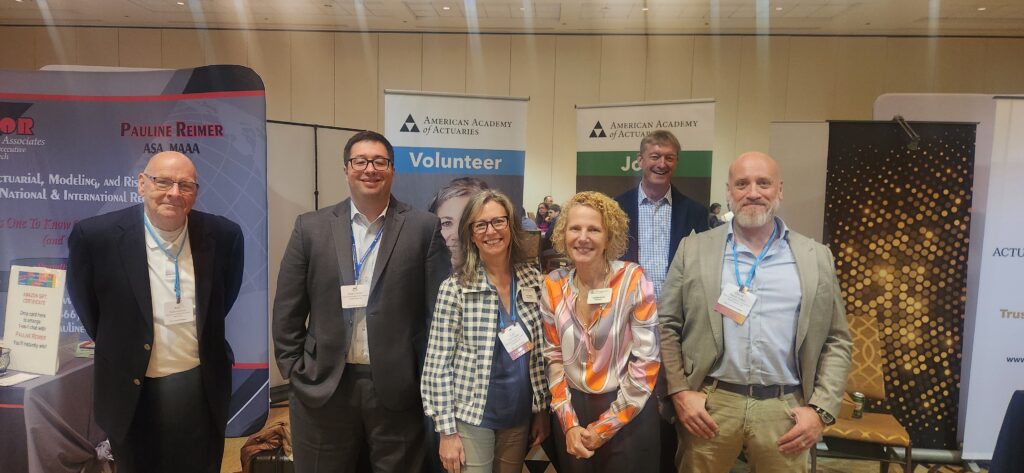
The 2025 Casualty Loss Reserve Seminar (CLRS) in Philadelphia in mid-September—an annual education event co-sponsored by the Academy and the Casualty Actuarial Society—featured over 50 sessions and drew more than 350 attendees. Academy volunteers led sessions on a variety of topics, including flood insurance, cyber risk, and professionalism. Academy staff enjoyed interacting with CLRS attendees at the Academy’s booth, promoting the work products of the CPC and highlighting the benefits of Academy membership.
Highlights included:
- CLRS’s opening keynote session featured Academy Senior Casualty Fellow Rich Gibson and Connecticut Insurance Commissioner Andrew Mais. The two discussed the Commissioner’s achievements as NAIC president, particularly his focus on AI, and the career opportunities available in the insurance and financial services industry.
- Gibson also moderated a flood insurance session featuring CPC member Steve Kolk.
- Koca and COPLFR Vice Chairperson Michelle Iarkowski participated in a session on wildfires, highlighting the Academy’s FAQs on California wildfires from earlier this year.
- Current and former COPLFR members participated in a workshop on “Maximizing the Value of Your Actuarial Report and Opinion.”
- Committee on Cyber Risk Vice Chairperson (and incoming Chairperson) Sam Tashima and incoming Vice Chairperson Isabelle McCullough participated in a session on cyber insurance market trends, citing the Committee’s regularly updated Cyber Risk Toolkit.
Following CLRS, the CPC’s Committee on Property and Liability Financial Reporting (COPLFR) met to discuss the annual updates of the Academy’s practice note on Statements of Actuarial Opinion (SAOs) on P/C Loss Reserves, the P/C Loss Reserve Law Manual, and the upcoming Seminar on Effective P/C Loss Reserve Opinions.
Also discussed were the two recent public exposures from the NAIC’s Actuarial Opinion Working Group—2025 Regulatory Guidance and the 2026 P&C Opinion Instructions. Outgoing COPLFR Chairperson Stephen Koca closed the in-person meeting by thanking Academy volunteers and staff for their work over his many years serving on and leading COPLFR.
CAS Annual Meeting Session to Feature Academy Presenters
CAS’ 2025 Annual Meeting, being held in Austin, Texas in November, will feature Academy Casualty Policy Project Manager Rob Fischer moderating and Senior Casualty Fellow Rich Gibson presenting in a session on public policy issues. The Nov. 11 “CS-30—2025 Public Policy Update” session also features Academy member Nicole Elliott, director and chief actuary with the Texas Department of Insurance. The session will highlight current and emerging issues within the regulatory and legislative environment, with a focus on the CPC’s engagement with the NAIC.
New Publications Examine Emissions, Workers’ Comp

Two October casualty-related publications address issues of emissions and workers’ compensation.
Policy Paper—In Scope 3 Emissions for Property/Casualty Insurers, the Climate-Related Financial Disclosures Subcommittee details some of the challenges involved in financial reporting of Scope 3 Emissions for U.S. insurance companies. While Scope 1 and 2 Emissions originate in the operations of the reporting company, Scope 3 Emissions originate in the operations of companies upstream and downstream from the reporting company. While recognizing the stated benefits from proponents of Scope 3 reporting, the paper documents issues of scope, clarity, and data availability as problematic for those tasked with this reporting.
Issue Brief—A Workers’ Compensation Committee issue brief, Influential Features in the Workers’ Compensation System—What You May Not Know, examines how state-specific mechanisms—including rating bureaus, residual markets, state funds, self-insurance, and insurer non-premium-based assessments—affect the pricing and availability of workers’ compensation coverage.
Former Casualty VP Musulin to Receive Farley Award

Rade Musulin, who served as the Academy’s casualty vice president from November 2016 to November 2018, will receive the Jarvis Farley Service Award—the Academy’s lifetime achievement award honoring a member whose volunteer efforts have made significant contributions to the advancement of the profession. Musulin’s nearly 25 years of Academy volunteer service stand as an extraordinary testament to his commitment to the U.S. actuarial profession.
OVA—Tyson Mohr is among those volunteers receiving the 2025 Outstanding Volunteerism Award (OVA). Mohr is being recognized for his significant contributions as vice chairperson of the Property and Casualty Equity and Fairness Committee. He has actively participated in the Academy’s engagement with NAIC subgroups and provided valuable input on bias and fairness.
Rising Actuary Award—Casualty volunteer Scott Merkord, with Risk & Regulatory Consulting, is among the seven 2025 Rising Actuary Award recipients.
Read more—See more on all the recipients here, and look for more about all the Rising Actuary Award recipients in an upcoming issue of Contingencies.
Academy Presents at NAIC Summer Meeting
Academy volunteers and staff offered public comments at the NAIC Summer National Meeting in Minneapolis in mid-August, covering multiple public policy practice areas and professionalism issues. Presentations included an update on CPC activities to the NAIC’s Casualty Actuarial and Statistical (C) Task Force (CASTF).
Blog post, video recap—More details of the Academy’s engagement in Minneapolis are available in an Actuarially Sound blog post, and the video recap on the Academy’s YouTube page.
NAIC Fall Meeting—The CPC will also present at the NAIC’s Fall National Meeting, set for early December in Hollywood, Fla.
Climate Paper Examines Actuarial Data
The Climate Change Joint Committee released a policy paper, Climate Data: Actuarial Perspectives on Quality, Challenges, and Effective Risk Quantification, examining data challenges in climate-related risk quantification. While reflecting the current emphasis on property and casualty, the paper also explores the distinct and evolving data needs for life, health, and pension actuaries.
Highlights From
Casualty Quarterly

Prefer to watch your news? Check out this “Highlights From Casualty Quarterly” video for a quick recap of what you need to know.
Register for December’s P/C Loss Opinion Seminar

There’s still time to register for the 2025 Seminar on Effective P/C Loss Reserve Opinions, being held Dec. 8–9 in Salt Lake City. The seminar is designed for P/C actuaries who prepare SAOs. Register today.
Pre-seminar webinar—New this year: a webinar designed for first-time opinion writers or those seeking a refresher, which will be offered prior to the event.
Academy in the News
Former Academy Casualty Vice President (2016–18) Rade Musulin’s selection as recipient of the 2025 Academy lifetime achievement Jarvis Farley Service Award, was reported by Australia’s Insurance News.
Legislative/Regulatory Activity
Federal
President Trump signed HR 1 into law on July 4, which addresses a number of property/casualty issues, including raising the federal share of crop insurance premiums by 3 to 5 percentage points across all coverage levels—making higher levels of protection more affordable.
The Senate confirmed Sean Cairncross as National Cyber Director. Cairncross will serve as President Trump’s principal advisor on national cybersecurity policy and strategy.
President Trump issued an executive order calling on the Interior Secretary and the Agriculture Secretary to consolidate their wildland fire programs and coordinate programs, budgets, procurement processes, and research.
Rep. Troy Downing of Montana introduced HR 5229 in September, which calls for improvements to the National Flood Insurance Program’s rate maps.
State
Illinois Gov. J.B. Pritzker signed SB 2480, enhancing the state’s emergency management capabilities by granting the governor significant powers to create comprehensive emergency management plans and activate personnel for disaster response. Pritzker also signed HB 2987 into law, which enhances tornado preparedness for warehouse operations, and signed SB 1289, clarifying regulations surrounding surplus line insurance and enhancing compliance measures within the industry.
Oregon Gov. Tina Kotek signed HB 3940, expanding funding to the state’s Landscape Resiliency Fund and Community Risk Reduction Fund to combat wildfires through a tax on oral nicotine products. Kotek also signed SB 83, establishing minimum defensible space requirements for properties in high wildfire hazard zones, which local governments will enforce, and HB 2563, mandating that insurers provide clear written explanations for premium increases on certain homeowner and personal insurance policies upon renewal.
Hawaii Gov. Josh Green signed SB 1044, creating a condominium loan program to assist associations with deferred maintenance, which is meant to stabilize the insurance market by expanding the authority of the Hawaii Property Insurance Association. Green also signed HB 97, establishing a comprehensive regulatory framework for the sale of travel insurance in Hawaii which enhances consumer protection and ensures that travel insurance is sold in a regulated manner.
Rhode Island Gov. Dan McKee signed HB 5569, establishing a new legal framework for pet insurance in the state.
Louisiana Gov. Jeff Landry signed HB 280, prohibiting workers’ compensation insurers from recovering past due payments related to employee misclassification, unless they provide written notice to the insured within 90 days of completing a premium audit. Landry also signed SB 61, mandating that insurers disclose whether credit information will be utilized in the underwriting process to consumers, and signed SB 136, requiring insurers that are licensed to write homeowner’s or private passenger automobile insurance file an annual rate transparency report by Jan. 1.
North Carolina Gov. Josh Stein signed HB 251, which prohibits the use of political affiliation or political speech in the denial of disaster recovery assistance, as well as eliminating a requirement for personal demographic information when applying for state emergency assistance in the form of grants unless it is necessary in order to comply with state or federal law.
Florida Gov. Ron DeSantis signed SB 948, requiring residential property sellers to complete a flood disclosure form, informing buyers that standard homeowners’ insurance does not cover flood damage and encouraging the purchase of separate flood insurance.
On June 20, Texas Gov. Greg Abbott signed four bills: SB 1644, requiring insurers to notify applicants or customers within 30 days if an adverse action is taken based on credit report information; SB 458, introducing an appraisal process for disputed losses under personal automobile and residential property insurance policies; SB 213, prohibiting insurers from requiring the purchase of residential property insurance as a condition for obtaining personal automobile insurance, and vice versa; and HB 3689, permitting the Texas Windstorm Insurance Association to secure financing arrangements of up to $500 million before a catastrophe and up to $1 billion afterwards.
Casualty News in Brief
Homeowners’ Insurance Task Force Chairperson Ken Doss sent a comment letter to the NAIC in response to the Property and Casualty Insurance (C) Committee’s recently released Availability and Affordability Playbook Outline draft.
The CPC submitted comments on the exposure draft of ASOP No. 20, Analysis of Property/Casualty Cash Flows, Including Discounting.
Read more—For the latest updates on the Academy’s P/C-practice work, visit the Casualty Public Policy page.