By Kim Ferrero
Assistant Director, Research
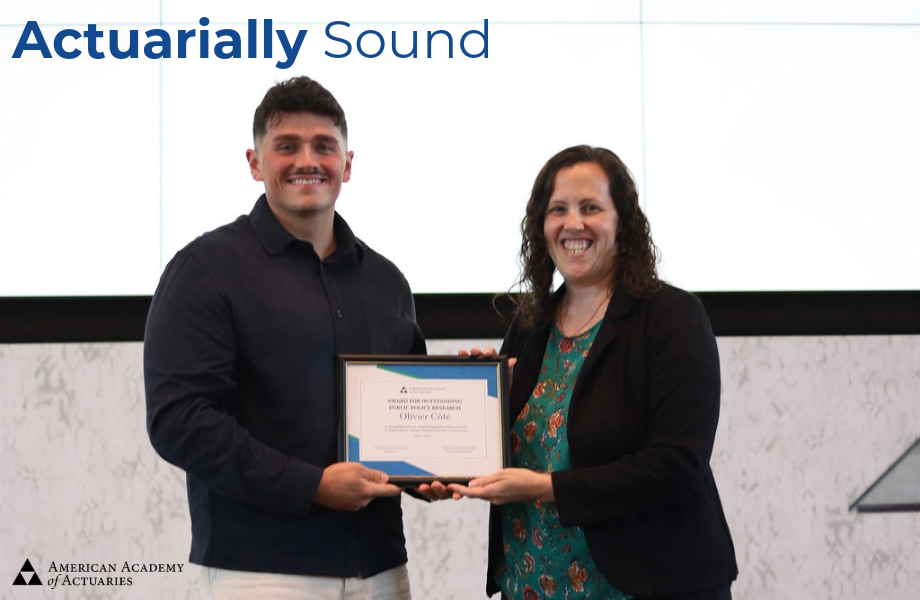
The American Academy of Actuaries presented its fourth annual Award for Research to Olivier Côté during the 61st Actuarial Research Conference (ARC), hosted by The Ohio State University in Columbus. The award recognizes early-career scholars’ innovative work which contributes significantly to an actuarial perspective on pressing public policy issues that actuaries, regulators, and policymakers are addressing.
This year, the Academy’s Research Committee solicited research centered on the theme of “Access, Affordability, and The Protection Gap: Determinants, Consequences, and Policy Recommendations to Manage Financial Risk.”
Olivier Côté, a Ph.D. candidate at Université Laval in Quebec, was honored for his paper co-authored with professors Marie-Pier Côté, Ph.D. and Arthur Charpentier, Ph.D., titled “A Scalable Toolbox for Exposing Indirect Discrimination in Insurance Rates.” The paper addresses a pivotal challenge in modern rating models: how can insurance companies identify and quantify proxy discrimination without compromising predictive accuracy or market viability?
By establishing a practical methodology for detecting hidden disparate impacts across rating structures, this work provides actionable tools actuaries can use to navigate evolving regulatory expectations surrounding fairness, rating equity, and consumer protection. The paper directly connects technical algorithmic auditing with broader public policy imperatives, addressing how unmitigated rating disparities can inadvertently exacerbate coverage gaps and restrict access for underserved risk pools.
In addition, the Academy recognized two finalists for their exemplary work in access and affordability. Assistant Professor Shimeng Huang of Purdue University’s mathematics department co-authored a paper with her mentor Dr. Peng Shi titled “Bridging the Disaster Protection Gap with Index Insurance,” which presents a novel conceptual framework demonstrating how index-based coverage can complement traditional indemnity insurance to expand market access. By leveraging deep learning models and high-resolution weather data, the authors reduce basis risk and showcase practical solutions to enhance climate resilience and consumer welfare.
The second finalist, Carlos Andrés Araiza Iturria, a recent Ph.D. graduate from the University of Waterloo’s Department of Actuarial Science, was recognized for his paper, “A Discrimination-Free Premium under a Causal Framework,” co-authored with Dr. Mary Hardy and Dr. Paul Marriott. In this paper, Iturria uses causal models to determine whether a pricing detail directly causes financial risk or merely correlates with a protected trait. While simply ignoring a sensitive trait works well when it has no direct link to loss, specialized “discrimination-free” pricing formulas are essential when variables act as hidden bridges for bias. Ultimately, the paper argues that fair insurance pricing cannot rely on math alone but must also account for social context to help undo historical inequities like redlining.
During the conference, the Academy hosted a panel featuring the award winner and two finalists. Unfortunately, Iturria was unable to attend this year’s conference, but Olivier Côté and Huang presented their work with responses from Academy research staff, Dr. Kim Ferrero and Dr. Steve Jackson, in a panel which was moderated by Academy volunteer Susan Kent, the Casualty Practice Council’s vice president. Among the many topics discussed during the session was the question of whether index coverage would be better utilized as a complement to, or a full replacement for, traditional insurance products.
The Academy hosted an “Industry Insights” session with Academy volunteer Rebecca (Becky) Sheppard (Research Committee Vice Chairperson and Health Practice Council (HPC) member) and Academy Senior Research Analyst Dr. Julie Goodwin. The session focused on how best to connect research findings with the insurance industry, with examples from the HPC Health Equity Committee’s work which Sheppard chairs and its recently unveiled Broadening the Focus framework.
Academy staff made an appearance alongside representatives from the Society of Actuaries (SOA) and Casualty Actuarial Society (CAS) to talk about research funding in the field. Finally, Kent and Sheppard took the stage at the ARC banquet to provide updates on Academy research in the past year and present Olivier Côté with an award plaque.
The 2026 ARC brought together academic researchers, practitioners, and public policy experts from across the globe. The Academy was proud to continue our co-sponsorship for this vital meeting. Looking ahead, the Academy research team will finalize the topic for next year’s Academy Award for Research later this fall and anticipates opening the official call for 2027 submissions shortly thereafter to continue highlighting actionable research at the intersection of actuarial science and public policy.
To learn more about the Award for Research and the Academy’s broader public policy research initiatives, visit actuary.org.
Photo: Cheywags Photography