By Geralyn Trujillo
Senior Director, Public Policy
One of the first things the Academy mentions in every presentation, publication, and event is that we have been the professionalism and public policy voice for U.S. actuaries for more than 60 years. Our mission is to serve the public and the profession—which frequently means being the objective and balanced perspective in the halls of Congress and in statehouses around the country.
Last week, the Health Practice Council (HPC) brought that mission and voice to Texas. The Academy was asked to testify before the Texas House Select Committee on Health Care Affordability, along with other witnesses, during a two-day hearing. As a newly created select committee in the Texas House of Representatives, the legislative panel was given the charge to comprehensively review the factors impacting healthcare affordability in Texas.
The hearing on April 30 and May 1 was the first of an anticipated series of conversations between the state legislators, insurers, hospitals, academics, consumers—and actuaries—to understand the underlying cost drivers in healthcare, to find affordability solutions within the commercial market, and to study potential improvements in healthcare delivery.
For this first hearing, the committee’s chairman very clearly laid out that he didn’t want to talk about solutions. Instead, he wanted to understand the current healthcare system and what factors lead to the current costs and prices of healthcare, including insurance. Each invited speaker was asked to focus on one or more of four key points:
- The impact of cost drivers, including legislative, regulatory, and administrative burdens, along with the impact of fraud, waste, and abuse.
- The impact of insurance design, cost sharing, market structure, and payment policies on consumers and employers.
- The impact of consolidation on patient choice, market competition, and price and value in healthcare services.
- The level of transparency in healthcare markets to ensure consumers have access to clear, accurate, and actionable information on prices, benefits, and out-of-pocket costs.
It speaks volumes that the chair sees actuaries as essential to those conversations. So much of that value is grounded in the analysis and work that is done every day by the HPC and health actuaries throughout the nation.
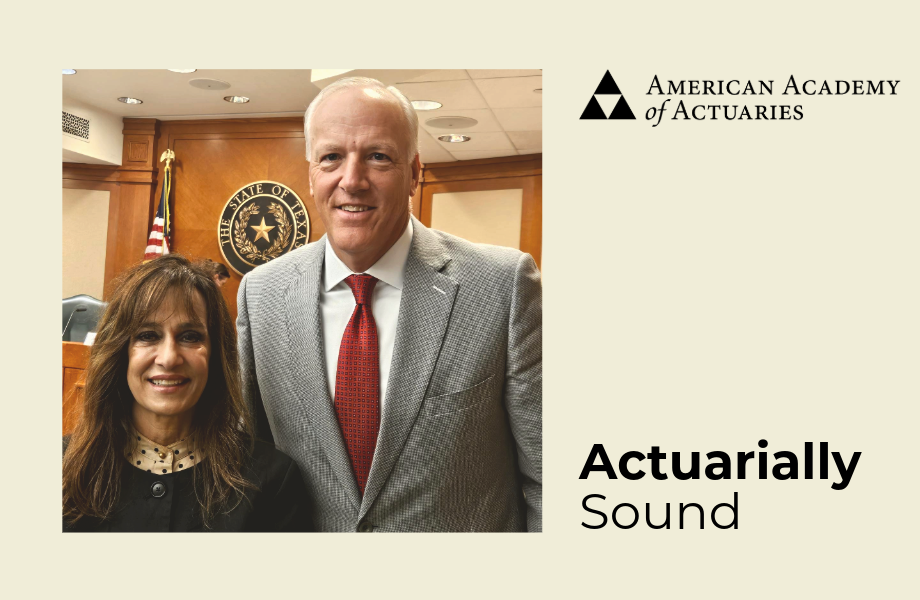
Along with the Academy—represented by HPC Co-Vice Chairperson Susan Pantely—the Select Committee heard from several academics, representatives from the National Academy for State Health Policy and the Kaiser Family Foundation, a practicing physician, and private consultants. Over the course of the two days, panels focused on providing a general overview of the system, hospitals, pharmaceuticals, insurance, and state purchasers.
More than once throughout the testimony and active question-and-answer periods, individuals noted that the conversation remained laser-focused on understanding the current system and avoided partisan attacks. Instead, the Select Committee members asked questions to gain clarity and to understand some of the mechanics of the current system, and avoided jumping straight into solutions.
Pantely did exactly what we want our Academy volunteers to do, reflecting the Academy’s commitment to professionalism, objectivity, and balance. She stayed focused on the actuarial considerations, she answered questions in ways to educate and inform, and she drew on the depth of resources that the HPC has created, demonstrating why the committee needed—and—wanted to have an actuary at the table.
The HPC will be following up with the Select Committee over the next weeks, answering some additional questions and providing resources on the topics discussed. We’ll continue to engage with the individual legislators and the committee itself as they continue their series of hearings. We will also collaborate with the Texas Department of Insurance to share information and encourage conversations, as some of the questions during the hearing underscored the role and responsibilities of the regulatory arm of state government.
We also met some new health care stakeholders at the hearing—individuals who share our desire to understand the data—with whom we can continue open and honest dialogues about the pain points in our system. Working collaboratively, we’ll be better equipped to find better ways to address the affordability challenges, improve access to appropriate coverage and outcomes, and grow consumer healthcare literacy.
The HPC immediately met the challenge of presenting to state legislators when we were asked. More importantly, by offering our testimony, the HPC held true to the Academy’s mission and goals. Actuaries were at the table, sharing their insights and their expertise with policymakers.
Policymakers who will soon be looking to evaluate potential solutions already recognize that some policy decisions in the past were focused on immediate needs, and that their attention is needed again on health care policy, including raised by the Academy. That’s a meaningful outcome for six minutes of testimony in Austin, Texas (and the Academy’s work preparing for it).
If you’d like to read Pantely’s testimony or watch a recording of it, you’ll find both online. For more information on the work of the Health Practice Council or to learn more about volunteering, visit actuary.org.