
Questions About Governance Changes?
The Academy is phasing in three-year Vice President terms and updated bylaws between 2026 and 2030. Here’s what’s changing, why, and what it means for you.
Governance FAQs
The American Academy of Actuaries is the professional organization that represents and unites actuaries from all areas of practice. The Academy is the voice of the U.S. actuarial profession on public policy and professionalism issues, both domestically and internationally.
In 2025, the Board of Directors asked a Governance Task Force to review how the Academy is governed. The goals were to make decision-making more nimble and transparent, put every Board director on equal footing with equal access to information, and free volunteer leaders to focus on strategy and on serving members. The review ran about nine months and drew on an external consultant, surveys, one-on-one interviews, and an in-person workshop.
The Task Force began its work in April 2025 and reported to the Board in January 2026. The Board voted on April 9, 2026, to adopt the recommended changes in principle, then approved an implementation plan and worked through the Bylaws amendments needed to carry them out. It approved changes to the Bylaws at a special meeting on Sept. 11 and at its Oct. 15–16 meeting.
The Board’s approval process is now complete. The revised Bylaws take effect Dec. 10, 2026, at the Academy’s annual meeting during the Leadership Summit & Governance Transition. The three-year Vice President terms phase in over the following three years (see question 5).
- A single, unified Board. The Executive Committee is disbanded. Under the current Bylaws, it carries out the Board’s business between Board meetings, which means that Executive Committee members have access to information before the rest of the Board does. Under the revised Bylaws, the full Board takes on that role, operating as a unified oversight body, and will meet more often (four times a year).
- Committee changes. A new Officers’ Committee handles a few narrow tasks the Executive Committee used to do, such as reviewing membership appeals under the newly adopted Membership Application Procedures and considering resignation requests under the Bylaws. A new Cross-Council Leadership Committee (CCLC) brings council leaders together to encourage cross-practice collaboration.
- More focus on membership. The Committee on Membership becomes a Council on Membership, led by a new Vice President, Membership. This decision reflects the Board’s continued focus on elevating and reinforcing member value and the importance of the MAAA credential.
- Clearer Board authority over membership requirements. The revised Bylaws make clear that the Board holds the authority to set membership requirements and application procedures.
- Longer VP terms. Vice Presidents’ terms increase from two years to three, phased in over three years, and their roles are refocused on strategic oversight. This aligns all Board members’ terms to be three years.
- A leaner Board. The Board will have 20 members, with the option to add up to two more members if needed. Board-Selected Director seats drop from up to seven to up to two, each serving up to three years (one year, renewable twice). The Penultimate President no longer sits on the Board, making presidential officers now serve three years on the Board instead of four (as President-Elect, President, and Past President).
- Calendar-year rhythm. The Board will meet quarterly, and the annual meeting of Academy members moves to December. This provides a more consistent leadership transition and aligns the transition more closely with committee volunteer terms, which begin Jan. 1 of each year.
Both the Governance Task Force and the Board kept member rights at the forefront, shaping the changes so that they strengthen governance without altering the rights members hold.
Member-selected directors. Members continue to select three directors each year, nine in total. Because the Board may now include no more than two Board-Selected Directors, down from up to seven, Member-Selected Directors make up a larger share of the Board than before.
Resignations. The Officers’ Committee, a new body made up of the 10 Academy officers, takes over the Executive Committee’s role in considering resignations from members against whom a complaint or charge is pending, or is filed within 60 days after the attempted resignation. The committee is the same size as the Executive Committee; the only difference is that the Immediate Past President, who is not an officer, is replaced by the Vice President, Membership. A member whose resignation is rejected may still appeal to the Board.
Membership applicants. Applicants are not yet members, so Bylaws changes affecting them do not touch member rights. Even so, applicants whose applications are rejected by the Officers’ Committee, for any reason, maintain the right to ask the Board to review that decision under the newly adopted Membership Application Procedures.
Under the revised Bylaws, most Executive Committee business now goes to the full Board, which will add a fourth meeting each year. A few narrow functions move to the Officers’ Committee, such as reviewing the rare case in which a resignation may be rejected because a disciplinary complaint is pending, and handling occasional membership-application issues. The Cross-Council Leadership Committee coordinates cross-practice collaboration on public policy and professionalism work; it is not meant to conduct Board business between Board meetings as the Executive Committee does under the current Bylaws. Instead, it is intended to help connect issues across practice areas and help the Academy respond more quickly to member and stakeholder needs.
Two things are changing together: how long Vice Presidents serve and what they are asked to do.
Terms. Vice Presidents will serve three years instead of two, in line with other Board members’ terms. The longer terms are meant to give councils greater continuity and deeper institutional knowledge. Because the Nominating Committee’s 2026 recruiting was already well underway, the change is being phased in. Recruiting for three-year terms begins in 2027 for the class of 2028, with starts staggered so that new VPs with three-year terms do not all join at once. By Jan. 1, 2030, every VP term will be three years.
Vice Presidents may serve consecutive terms in different VP positions (for example, Casualty, then Professionalism and Education). The expectation is that this option will be used when it serves the Board’s needs, given a candidate’s skills and experience.
Roles. Under the current structure, the division of labor between VPs and their council Vice Chairpersons (VCs) varies from council to council, and in some cases, VPs have absorbed operational tasks that pull them away from the Board’s strategic focus. The new structure anchors VPs in their role as strategic Board members: setting council priorities, reporting Board decisions back to their councils, mentoring future leaders, and representing the Academy in public-facing engagements. VCs take on a more robust operational role, working with staff liaisons to facilitate meetings, leading special projects, coordinating with committee chairs and liaisons, and stepping in for the VP when needed. This gives VCs a clear path to greater responsibility and strengthens the Academy’s bench of future volunteer leaders. Standardizing how VPs communicate Board decisions back to their councils should also improve communication between the Board and the broader membership.
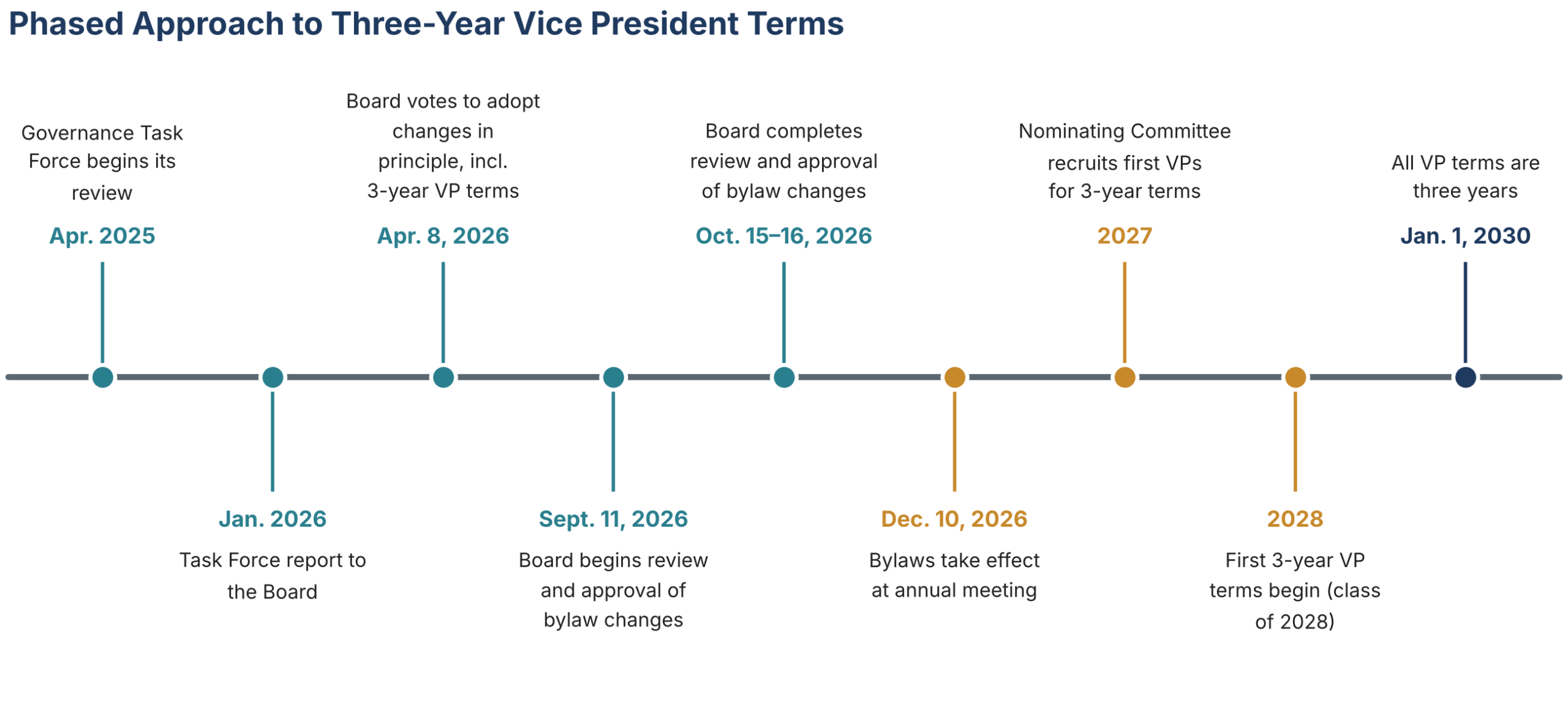
Timeline details
- April 2025: Governance Task Force begins its review.
- January 2026: Task Force report to the Board.
- April 8, 2026: Board votes to adopt changes in principle, including three-year VP terms.
- September 11, 2026: Board begins review and approval of bylaw changes.
- October 15–16, 2026: Board completes review and approval of bylaw changes.
- December 10, 2026: Bylaws take effect at the annual meeting.
- 2027: Nominating Committee recruits the first VPs for three-year terms.
- 2028: First three-year VP terms begin (class of 2028).
- January 1, 2030: All VP terms are three years.
The Committee on Membership’s work has grown with the competency framework, new membership requirements, and efforts to enhance and communicate the Academy’s value through the MAAA. Elevating it to a council with its own seat on the Board highlights membership as the Academy pursues its long-term strategy and works toward universal Academy membership for actuaries practicing in the U.S. The Board stays within its size range of 20 to 22 directors.
Yes, somewhat. The number of Board-Selected Directors is reduced from up to seven to no more than two; the larger number of seats had never been fully used. Their terms become one year, renewable twice, for a maximum of three. The Penultimate President leaves the Board, which offsets the new Vice President, Membership, seat and aligns presidential officers’ roles to three vs. four-year terms. Member-Selected Directors are unchanged: Academy members continue to select three each year for three-year terms, for a total of nine on the Board at all times.
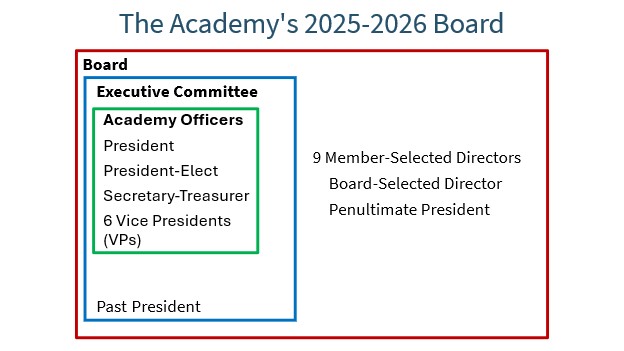
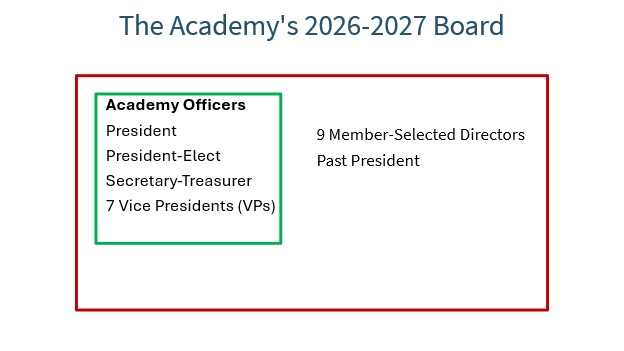
Not directly, but over time, these changes are intended to enhance the Academy’s governance and service to members. The changes concern how the Board and its leadership are organized. Members can expect greater transparency and understanding of the Academy’s governance, a stronger focus on membership issues and, over time, steadier continuity among council leaders. The Leadership Summit & Governance Transition on Dec. 10 will include a free livestream for members, during which we will cover these and other important updates.
See the September and October issues of the Actuarial Update for more information about the changes. The revised Bylaws, which take effect Dec. 10, 2026, will be posted to our site then to avoid confusion with the current version.