
How actuarial modeling and long-term planning can help determine whether a Roth conversion will increase a retiree’s after-tax wealth.
By Mark Shemtob
How does a retiree use their accumulated wealth?
Generally, it is allocated to one or more of the following four areas:
1. To fund living expenses during retirement, including both fixed and discretionary costs.
2. To leave to heirs, whether family or friends.
3. To support charities or other favored causes.
4. To pay taxes owed to the government.
With few, if any, exceptions, retirees prefer to limit the taxes owed to the government to the extent legally possible. Most funds accumulated for retirement are in traditional tax deferred retirement accounts such as 401(k) plans and individual retirement accounts (IRAs) and are subject to taxation in retirement. While taxes generally cannot be completely avoided, retirees can sometimes reduce them, thereby providing more funds for living expenses, bequests, and charitable giving. This article will focus on the Roth conversion: A strategy that some retirees can use to achieve this tax-savings goal.
The Roth Conversion
Well-trained and experienced professionals working as wealth managers or financial advisors, often provide some clients with an analysis of the potential value of a Roth conversion. Under a Roth conversion, some or all of an IRA or 401(k) account that has not yet been taxed is transferred to a Roth account. The amount transferred is subject to income taxes payable for the year of the transfer. Thereafter, withdrawals of earnings from the Roth account are generally tax-free, provided the funds have been in the Roth account for at least five years and the owner is at least 59½ years old.1 In addition, under current SECURE 2.0 rules, original owners of both Roth IRAs and Roth 401(k)s are entirely exempt from lifetime required minimum distributions (RMDs), which otherwise begin at age 73 for traditional accounts. This allows for true tax-free accumulation in, and distribution from, a Roth account.
Whether a conversion is a sound strategy depends on whether it provides a sufficiently greater net wealth for the retiree or beneficiaries over time.2 The increased wealth is derived primarily from three main sources:
- Shifting taxable income across years to take advantage of lower marginal tax rates.
- Using funds outside of retirement accounts to pay the taxes incurred by the conversion, which would otherwise be subject to income taxes on investment earnings.
- Reducing RMDs, which are taxable.
A thorough analysis of the advantage (if any) of a Roth conversion requires building a model which uses a variety of assumptions and testing alternative strategies. This type of modeling and testing is the experience actuaries can bring to individual retirement planning.
So, what does such an analysis involve?
Components of Roth Conversion Analysis
A Roth analysis requires information regarding demographic data, assumptions, and strategies
to be tested.
A. The items listed below represent the required data. Each is fixed at a point in time but is constantly changing.
- The retiree(s) age
- IRA/401(k) balances (non-Roth): amounts that are available for conversion
- Current Roth balances, if any3
- Nonretirement account savings and investments, including unrealized gains/losses: funds available to pay taxes on Roth conversions
- Income sources (pensions, annuities, Social Security, part-time employment, etc.): amounts available to supplement nonretirement funds
B. The items listed below represent assumptions used to perform the analysis. Each may be modified periodically to reflect alternative or changing scenarios.
- Tax rates: rates used to determine the taxes to be paid on income including Roth conversions
- Expected tax deductions (itemized or standard): deductions used to determine taxes to be paid
- Living expenses (discretionary and nondiscretionary), including gifts to family, friends, and charities): spending levels that affect nonretirement assets available to pay tax on Roth conversions
- Annual increase in expenses: projected future expenses
- Expected rates of returns on investments: different accounts may call for different asset allocations and expected returns. For example, nonretirement assets that are needed to live on and pay taxes are likely more conservatively invested and thus assume a lower return assumption than retirement accounts that may not be needed for many years.
- Social Security cost-of-living adjustments (COLA): projected future benefit increases
- Overall relative value of different types of investments (Roth, pretax, and nonretirement funds): used to analyze the extent to which a Roth conversion strategy increases wealth based on tax considerations. Roth funds are the most valuable, followed by nonretirement funds (taking into account any potentially taxable unrealized gains) and regular pretax funds.
C. The items listed below are among the parameters generally tested to analyze the value of different strategies:
- Annual Roth conversions amount
- Social Security Commencement Age: annual cash flow permits payment of Roth conversions. This might be a reason to accelerate and/or delay Social Security payments either for cash flow or shifting taxable income between years.
- Timing of taxable income and tax-deductible expenses in retirement where available
Issues with Current Roth Conversion Tools
There are many programs available either online or through financial advisory firms that are designed to assist in the Roth conversion analysis. However, some may lack certain key components:
- Designed only to analyze a conversion for the current year as opposed to building a multiyear variable strategy
- Do not allow for different rates of returns for investments with different tax considerations
- Ignore some cash flows (income and expenses) in the determination of available funds to use to pay taxes on conversions
- Don’t provide an “overall relative valuation” based on different investment types (pretax, Roth, nonretirement funds)
- Focus too much on doing conversions based on timing market dips which are tough to predict
- Provide as the sole measure of value the amount of taxes saved as opposed to the increase in overall tax adjusted wealth
- Don’t analyze optional timing of payments such as Social Security or tax deductions
Example of Roth Conversion Strategy Analysis
The following example illustrates the potential value of Roth conversions. It has been kept relatively simple by assuming a single retiree with limited future income options.
Data
- Age: 67 single
- Pretax funds: $500,000
- Current Roth funds: $0
- Nonretirement funds: $350,000 (includes $50,000 in unrealized gains)
- Social Security at age 67: $3,000 per month
- Fixed-income annuity: $2,500 per month (no option to vary start date or amount)

“A thorough analysis of the advantage (if any) of a Roth conversion requires building a model which uses a variety of assumptions and testing alternative strategies. This type of modeling and testing is the experience actuaries can bring to individual retirement planning.“
Assumptions
- Current and future income tax rates: based on rates for 2026 for a New Jersey resident
- Expected income tax deductions:
Federal: $15,750; New Jersey: $15,000 - Expenses: $80,000 per year
- Annual increase in expenses: 2% per year
- Rates of return on investments: Roth and pretax: 6.5%; nonretirement: 5%
- Social Security COLA: 3%
- Relative value adjustment for different types of taxable investments:
- Roth: Full value
- Pretax: 75%
- Nonretirement: 94%4 and a 20% tax on unrealized gains
Note that depending on the specific circumstances of the retiree (or the retiree and partner), additional data and assumptions might be called for. Thus, there is a need for customization in the analysis.
Strategies
There are many possible strategies that can be analyzed. This article illustrates only four strategies for simplicity’s sake. However, once the model is built and assumptions are selected, dozens or more alternative strategies can be analyzed. This Appendix provides a complete year-by-year comparison based upon the four different strategies with respect to the following:
A. Roth conversion pattern
B. Social Security commencement age (Other refers to nonretirement assets)
- Strategy 1 (base case): No Roth conversions or Social Security delay
- Strategy 2: $19,000 annual Roth conversion and no Social Security delay
- Strategy 3: $24,000 annual Roth conversion and delay Social Security to age 70
- Strategy 4: $70,000 annual Roth conversions for three years, $50,000 for three years, and $10,000 for two years with Social Security delayed to age 70
Table 1 provides a limited sample of information from the results of the comparisons of the four strategies. It is important to review results at a variety of future ages to help the retiree in considering the alternative strategies. The Appendix provides much greater detail by showing, for all ages from 67 to 95, the amount of funds projected to be in each of the three classes of funds—Roth, pretax retirement, and nonretirement (Other)—as well as the overall relative value.
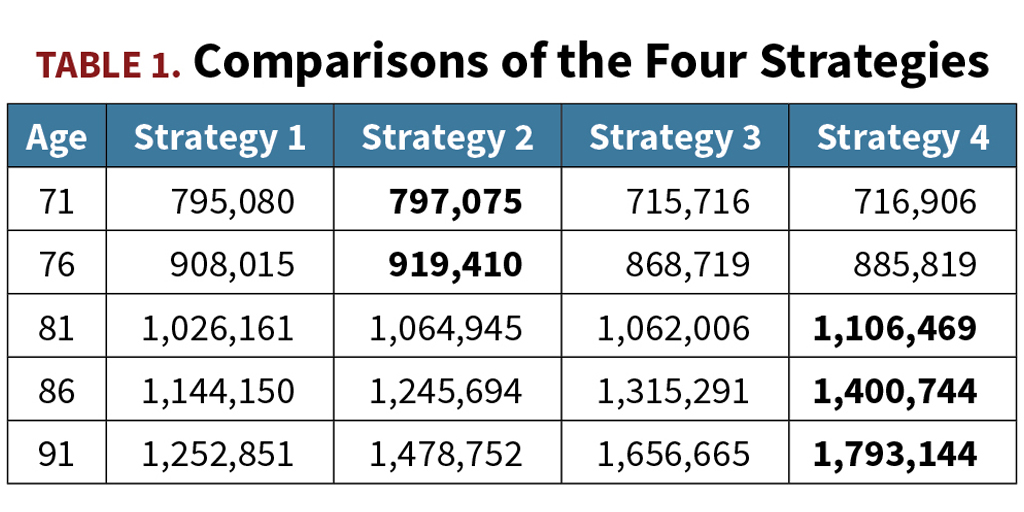
As illustrated above, the use of Roth conversions will negatively impact overall relative wealth in the earlier years, but over time, it will provide greater overall wealth. Twenty years (the approximate life expectancy for a very healthy 67-year-old male) into the future, strategy 4, which is the most aggressive conversion option modeled, provides an additional $256,000, or 22% of wealth, over the base non-conversion strategy. This is accomplished by front-loading Roth conversions and delaying Social Security, which can reduce taxes and increase overall wealth.
Considerations and Comments
- The analysis used here is based on deterministic modeling and assumptions. Models can be built using stochastic methods with Monte Carlo simulations. Most retirees, however, are better able to evaluate a deterministic approach while also incorporating some alternative assumptions to test different scenarios.
- Any sort of analysis regarding future outcomes requires assumptions that should be selected with care based on best estimates.
- Lack of sufficient nonretirement funds limits or eliminates the value of Roth conversions since funds are needed to pay taxes on conversions.
- Not all retirees will benefit from Roth conversions, and those that do will not realize any significant increase in wealth for many years.
- Analysis should be performed annually with updated data and assumptions as appropriate.
- Generally, starting Roth conversions younger in retirement improves results.
- For those with very large accumulations of wealth, Roth conversions can also be used to reduce estate taxes by reducing the actual dollars in one’s estate through payment of taxes upfront.
- Though not modeled in this article, retirees can use the increased wealth in later years to cover long-term care costs as well as give away funds to charities or family.
- What is critical in reviewing results of different strategies is not the actual dollars in the accounts but the overall relative value after taxes at different points in time in the future.
Summary
Retirees are often reluctant to incur taxes until necessary. For that reason, some retirees may exhibit hesitation toward Roth conversion strategies. Therefore, it may be more palatable to stretch conversions over multiple years, even if this approach does not provide the best long-term results. Doing so also allows for changes to strategy in the future, based on changes in health, actual or expected market returns, and/or tax rates.
Although retirees might prefer to attempt to achieve increased overall wealth through greater exposure to risky assets, this approach could actually reduce wealth if poor market returns occur. Roth conversions, by contrast, allow for improved wealth accumulations in the later years of retirement without additional investment risk.
Roth conversion analysis is a critical service that advisors offer, and it is clearly in the wheelhouse of actuaries, particularly in building models that incorporate relevant assumptions. This work requires careful analysis using a comprehensive model, with the understanding that all assumptions should be clearly explained to and agreed upon by the client.
MARK SHEMTOB, MAAA, FSA, EA, provides consulting on retirement income security at both the individual and the institutional levels.
Disclaimer: This article is for informational and educational purposes only and does not constitute individualized tax, legal, or financial advice. Readers should consult a qualified professional regarding their specific financial circumstances
Endnotes
- Retirement plan FAQs on designated Roth accounts; IRS.
- It generally takes several years before the increase in wealth is recognized.
- This is not necessarily needed but may help in reviewing overall wealth at different times in the future which could be subject to estate taxes.
- Assumes a 10-year payout and a 25% effective tax rate.