
By Noah Kirsch
An evolving Social Security, rising health care costs, and climate-driven insurance challenges are impacting retirement in ways that are increasingly interconnected. Actuaries are uniquely positioned to analyze how these pressures intersect and affect retirement outcomes.
Americans have set aside more money than ever for their golden years. At the end of September 2025, total U.S. retirement assets hit a record high of $48.1 trillion, according to third-quarter 2025 retirement market data from the Investment Company Institute—more than double the overall figure from 2015.
Still, huge gaps remain. According to the 2025 Vanguard Retirement Outlook, less than half of the country is on pace “to maintain their lifestyle in retirement.” Baby boomers—those born between 1946 and 1964—are even less prepared on average. Just 30% have the necessary funds to retire, according to the Vanguard report.
Millions of these retirees will therefore depend on monthly Social Security benefits, though the program faces a severe financial shortfall by 2032 if policymakers don’t enact significant changes, according to the 2025 OASDI Trustees Report.
For actuaries, this retirement preparedness crisis affects virtually every practice area, from pensions to health care to property and casualty insurance. Other looming issues, including climate change, economic pressure, longer lifespans, and an aging population, will exacerbate concerns about financial readiness and insurance affordability.
“People don’t have different incomes for home insurance and for medical coverage,” said Seong-min Eom, chairperson of the Academy’s Climate Change Joint Committee, as one example of how financial stress can bleed from one practice area to another.
“If retirees are living longer, then their savings need to last longer,” echoed Ken Doss, chairperson of the Academy’s Homeowners’ Insurance Task Force.
In some cases, he said, retirees on a fixed income may seek to reduce their short-term costs by reducing their insurance coverage. In Doss’s view, actuaries can help consumers understand why under-protecting their assets can create larger, more expensive problems down the road. Doss was referring to homeowners’ insurance, though his analysis extends to many other forms of coverage, such as auto insurance, he said.
Aaron Wright, vice chairperson of the Academy’s Long Term Care Committee, said actuaries should prioritize cross-practice collaboration in order to understand the interconnectedness of these issues and help policymakers address the retirement crisis.
“How can we leverage learnings from, say, retirement or long-term care with traditional health care to better address the situation?” he asked.
That question frames the challenge facing the profession. This feature examines retirement issues from three distinct perspectives: the Social Security system and the gig economy; health and long-term care costs; and the role of property, insurance, and climate risk in retirement security. Together, they show how interconnected these systems are and why actuarial insights across multiple disciplines will be essential to shaping the future of retirement.
Social Security at Risk
Social Security’s precarious financial position is well documented. In her letter explaining the financial effects of the One Big Beautiful Bill Act to Sen. Ron Wyden, Karen Glenn, the Social Security Administration’s chief actuary, said the administration’s Old-Age and Survivors Insurance (OASI) Trust Fund reserves will be depleted by the end of 2032.
Once that happens, benefit payouts will need to be reduced by 23%, the Bipartisan Policy Center reported in its article, “2025 Social Security Trustees Report Explained.” Between 2025 and 2100, Social Security faces a funding shortage of $25 trillion.
“An aging population is a major contributor to the problem,” the report said. “In 1960, there were more than five workers paying Social Security taxes per beneficiary, but that ratio has dropped to less than three-to-one.”
Claire Wolkoff, former chairperson of the Academy’s Retirement Policy and Design Evaluation Committee, added that Americans are living longer, and net immigration counts have declined, both of which put pressure on Social Security funding.
Demographics aren’t the only problem; tax collection is also less robust than it used to be. Payroll taxes are being applied to 83% of overall income, the Bipartisan Policy Center said in the same report, down from 90% in 1983.
“We’ve known it’s a looming problem for decades,” said Lee Gold, chairperson of the Academy’s Retirement Policy and Design Evaluation Committee.
“The demographic projections were not wrong,” Wolkoff added. “There are a lot of young people who don’t believe Social Security is going to be there for them when they retire.”
Nevertheless, lawmakers have been reluctant to address the issue, knowing that any change to benefits—or increase in taxes—will be politically unpopular, Gold said. “But certainly, something has to be done.”
He outlined several possible changes: increasing the eligibility age to receive benefits, raising payroll taxes, cutting benefits for more affluent retirees, or making the program altogether means-tested, thereby targeting payments to those who are financially vulnerable.
“We see this in some other countries where they means-test their social benefits, so that if you have significant resources, even though you’ve paid into the system your whole life, you may not get anything,” Gold said. “In countries where this is done, we often see significant mandatory occupational pension programs.” Such a proposal, however, would almost certainly face pushback if lawmakers sought to enact it.
The reality, Gold said, is that no single policy change is likely to fix the budget shortfall. “It’s probably going to have to be a combination of all of those things together in some fashion to get you to long-term sustainability.”
Rise of the Gig Economy
It is difficult to precisely quantify the percentage of workers who participate in the so-called “gig economy,” not just because quality data is hard to obtain, but also because the definition of a “gig worker” is not always consistent. Some studies include freelancers and part-time staffers, in addition to independent contractors like Uber drivers and DoorDash delivery workers.
Clearly, though, gig workers comprise an increasingly large percentage of the workforce, Gold said. A fall 2024 survey of 1,000 American workers from TransUnion, for instance, found that nearly half (43%) of respondents participated in the gig economy in some way.
As it relates to Social Security, this introduces multiple possible concerns, Gold continued. The first is that gig workers may be tempted to underreport their income, or not report it at all. In the short term, that would lead to tax savings for the individual. But many of these workers may not realize what they are sacrificing by not reporting their full income and paying their required FICA (Federal Insurance Contributions Act) taxes, Wolkoff said.
Social Security benefits are calculated based on an individual’s top 35 years of income. By failing to report earnings, these workers will potentially lose retirement security down the road. Gig workers may also not realize that skirting taxes could impact disability coverage or survivor benefits if they die young, Wolkoff added.
Another challenge, Gold explained, is that many gig workers are lower paid and may not be positioned to prioritize retirement savings. “There are so many demands on their paycheck, and then we say, ‘Well, you should also be saving for retirement.’ With what money?”
Employees at larger firms—even those who are lower paid—are often eligible to contribute to a 401(k) and may also receive a match from their employer, Gold said. In some cases, these contributions are automated.
“All of that happens without the employee really doing anything,” he said. “They actually have to take action to prevent that from happening. That’s not the case with gig workers. They’re all on their own.”
Wolkoff and Gold noted that state and federal officials are already working to help gig workers improve their financial security. Some states, for instance, have introduced portable benefits programs, allowing workers to take advantage of insurance and savings programs even without “regular” employment. Multiple states have also created auto-IRA initiatives that allow workers to automatically deduct retirement contributions from their earnings in cases where their employer does not offer a savings plan option.
One possible policy change, Wolkoff said, is allowing employers to create benefit programs for their gig workers without needing to worry that lawmakers will then force them to reclassify contractors as full-time staff members.
“I think it will be good ultimately for retirement [if] somebody like Uber can say, ‘Look, we’d actually like to contribute 3% of pay to a 401(k) plan for these people, even though they’re not our employees,’” Gold said. “That’s not really allowed right now.”
Moreover, he said, bolstering the formal reporting process for gig workers’ earnings will not only strengthen tax collection but will ensure those individuals receive the maximum possible Social Security benefits later in life.
The gig economy has fundamentally changed the way people earn and save, Wolkoff said. Previously, retirement income was considered to be a three-legged stool: Social Security, an employer-sponsored plan, and personal savings. Now, thanks to economic shifts and the advent of gig work, “there is talk about the need for a fourth leg of the stool during retirement, namely part-time work,” she said.
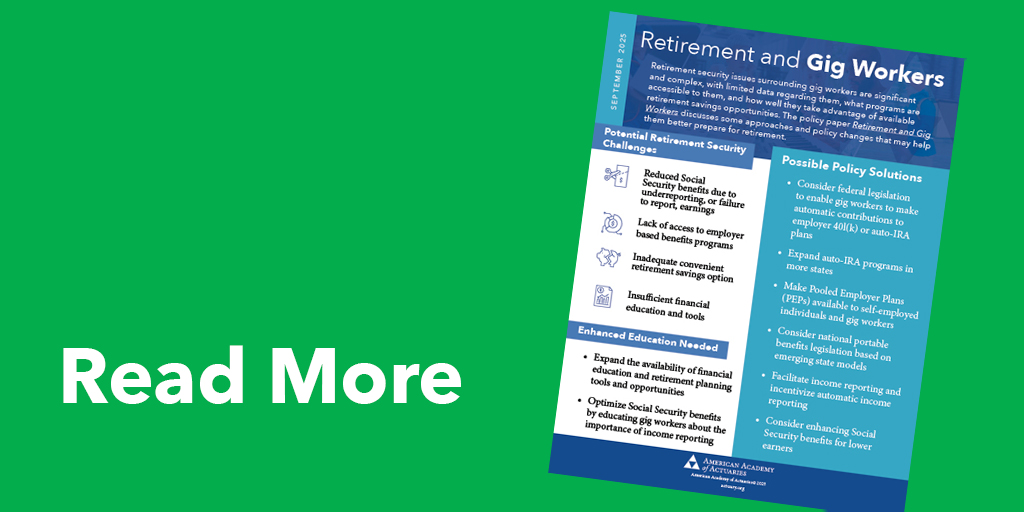
Actuaries can play a role in helping shine a light on these issues. For example, Wolkoff said, policymakers might consider enacting federal legislation that would allow gig workers to make automatic contributions to 401(k) or auto-IRA plans. They could also make Pooled Employer Plans (PEPs) “available to self-employed individuals and gig workers,” create national portable benefits legislation, and increase access to financial education and retirement planning tools.
Gold offered other potential options, including supporting changes to the Employment Retirement Income Security Act (ERISA) that would “allow more flexibility in designing lifetime income options” with defined benefit and defined contribution plans, and pushing to reduce the cost and complexity of retirement planning options.
Ultimately, there are myriad possible ways to address the retirement preparedness crisis. Wolkoff recommended that actuaries monitor changes to the gig economy and retirement landscape in order to make informed policy recommendations. In the end, “the Academy’s goal is to help policymakers and provide them unbiased information,” she said.
- An Actuarial Perspective on the 2025 Social Security Trustees Report (policy paper from the Social Security Committee)
- The Relationship Between Social Security and Federal Government Deficits and Debt (issue brief from the Social Security Committee)
- Retirement and Gig Workers (joint policy paper of the Social Security Committee & Retirement Policy Design and Evaluation Committee) and an accompanying infographic
All publications are available online at actuary.org.
The Impact of Health on Retirement Stability
As Social Security’s trust funds come under pressure, seniors are facing mounting health care bills as well.
Aaron Wright, vice chairperson of the Academy’s Long-Term Care Committee, outlined a number of striking figures. Nearly half of individuals who make it to age 65 will require paid care for long-term support and services, he said, and about 24% will need at least two years of care.
These expenditures can be immense. Assisted living and home-care services cost about $70,000 per year on average, Wright said, while nursing homes range from $110,000 to $130,000, depending on accommodations.
“It’s a significant cost that can erode that retirement nest egg,” he said, adding, “I don’t expect costs to go down.”
“Health care costs continue to outpace almost every other type of inflation,” Gold concurred. “Obviously, that creates challenges for people in retirement. Their health care costs tend to increase as they get older, and it just becomes more and more of an affordability problem.”
In its 2025 Retiree Health Care Cost Estimate, Fidelity Investments found that the average 65-year-old person who retired in 2025 will spend $172,500 on medical bills over the remainder of their lifetime. The cost of prescription drugs, out-of-pocket expenses, and long-term care all contribute to that figure.
Moreover, America’s demographic transformation is straining both individuals’ budgets and the health care system at large. Wright cited three specific trends: declining birth rates, increasing life spans, and millions of baby boomers entering retirement en masse. (Life expectancies for Americans have steadily increased for decades; the pandemic briefly eroded those gains, but estimates have since continued to climb.)
By 2040, Wright said, the number of Americans aged 65 and older is expected to grow by 42%, while those aged 85 and up will more than double.
That, of course, will incur enormous health care expenditures. National health care costs for adults over 65 are two-and-a-half times those for typical working adults, Wright noted, while the peak claim age for people seeking long-term care is during their early to mid-eighties.
Already—even before absorbing these increases—public health programs have been under stress. As of 2023, a third of Medicaid’s personal health care spending was devoted to long-term care for just 4.8% of the enrolled population, Wright said.
In other words, as the number of aging individuals grows, “the dollars [total Medicaid spending on long-term care] might grow faster.”

Addressing Affordability Gaps
Many Americans are utilizing family members as caretakers, rather than paying for assistance, Wright said. That may allow elderly individuals to save money, but it could cause their caretaker to exit the workforce early, compromising their ability to save more funds for retirement.
Considering these issues, Wright said, addressing affordability gaps will require an “integrated solution” between individual planning, product innovation, and changes to policy. Fortunately, he added, insurers and legislators are already engaging in conversations about how to tackle this problem.
Eom said that, globally, insurers have explored offering micro-coverage products that are more affordable for elderly people on fixed incomes. One example is paramedic insurance as a standalone offering for individuals concerned about possible out-of-pocket costs.
Additionally, Wright said, it has become increasingly popular to combine long-term care coverage with an annuity or life insurance product. This kind of product really emerged roughly 20 years ago, he said, and more recently, insurers have also offered shorter-term coverage, for time frames of less than a year.
“The care varies,” he cautioned. Naturally, cheaper plans typically offer more limited benefits. But retirees need “to find that balance of what they can afford versus potential care.”
Broadly, Wright said, public and private players are looking for other potential innovations that could address rising costs, particularly for long-term care, considering the financial pressure caused by demographic shifts.
In Washington state, the WA Cares Fund is using tax revenue to create a public long-term care insurance program. On a federal level, the proposed Well-Being Insurance for Seniors to be at Home (WISH) Act would also carve out funding to grant financial aid to disabled seniors who need long-term care coverage.
One key way for actuaries to participate in improvements is to push for better education of the public, Wright said, helping people both understand the risks surrounding long-term-care needs and possible solutions. Additionally, actuaries should stay active in policy conversations. “The success of these programs is greatly impacted by the setup,” he added, “and actuaries have an important role in identifying and quantifying the risks.”
Eom emphasized again that “traditional comprehensive coverage plans may not be affordable or accessible” for many policyholders. Insurance products can be redesigned and priced differently to help address this, she said. For example, pivoting from traditional indemnity plans to fixed benefit or parametric plans can reduce delays in claims processing and payment. Moreover, she added, actuaries can help design products with a “broader range of potential embedded riders” that would add value while avoiding additional agent commissions and reducing onerous financial burdens.
“It’s going to be a combined effort,” Wright said, referring to public and private innovations.
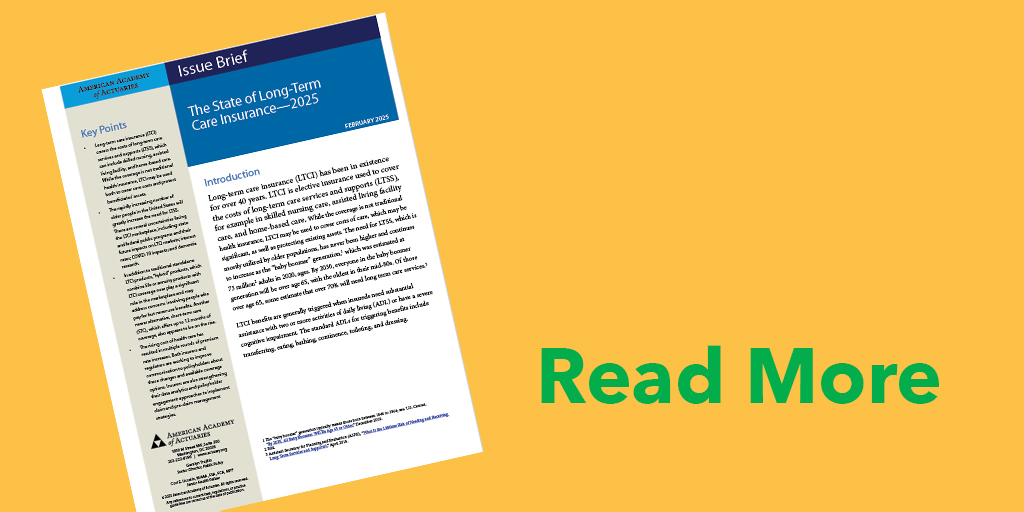
- The State of Long-Term Care Insurance (issue brief by the Long-Term Care Committee)
- Medicare’s Financial Condition: Beyond Actuarial Balance (issue brief by the Medicare Committee)
- Academy Comments to the Senate Committee on Finance’s hearing on the rising costs of health care (offered by the Individual and Small Group Markets Committee)
All publications are available online at actuary.org.
How Climate Risk Affects Retirees
The intensity of natural disasters seems to worsen each year. Over the past two years, Hurricane Helene rocked the Eastern Seaboard, wildfires ravaged southern California, and flash floods tore through central Texas. These events have affected millions of Americans, though retirees are especially vulnerable to the damage.
“Retirees tend to live in warmer climates,” Doss said. “What we continue to see … within the homeowners’ market is how catastrophic events have increased over the last several years, and those events tend to happen more frequently in some of these warmer tropical areas.”
Property insurance prices have steadily increased, especially in areas prone to flooding and wildfires. In some cases, providers have pulled out of high-risk markets entirely.
“It’s a big affordability problem,” said Naomi Ondrich, an actuary at the National Flood Insurance Program (NFIP) managed by the Federal Emergency Management Agency (FEMA). Ondrich, who was speaking in her personal capacity and not on behalf of the government, was referring to flood insurance in particular.
Specifically, retirees and others moving to places like Florida and Texas might not realize how expensive their insurance premiums will be and may struggle to afford them, she said. Separately, people who already own property in these locations might have trouble finding buyers if they wish to sell, since those individuals would then have to find and pay high costs for homeowners’ coverage.
Simultaneously, many rural, low-income communities in places like Mississippi, West Virginia, Kentucky, and Louisiana lack the resources to recover from major climate events without federal government assistance.
For many retirees, their home is their largest asset, and failing to protect it could put their nest egg at risk. As Doss noted, many older Americans purchased their homes decades ago. By definition, “those tend to be older homes,” which may have a higher risk of damage following catastrophic events (particularly if they lack risk mitigation features and haven’t been modernized). “That definitely has an impact on the insurance premium that a retiree would pay,” he said.
Eom observed that the landscape for aging Americans is radically different depending on their level of affluence. Lower-income individuals, of course, may face dire choices, she said, such as choosing between maintaining their home or paying for their car or health care.
These issues intersect with other actuarial practices, Eom said. For instance, a climate event that destroys roads and infrastructure might make it challenging for an elderly person to access health care.
“Having insurance versus it actually being accessible can be a different thing,” she said. “The fundamental infrastructure is very important, [in addition to] the financial support.”
Possible Remedies
One avenue for actuaries to address climate-caused affordability is to ensure consumers understand their full risk profile before making financial decisions, Ondrich said.
For example, retirees considering moving to warmer areas aren’t always aware of how prevalent natural disasters are in their prospective new locations. They may not realize, for instance, that they are considering buying property in an area prone to flooding, even if it is outside of a designated high-risk flood zone.
The NFIP adopted a risk-based rating approach in 2021 that informs policyholders of their full risk premiums, Ondrich said—even if they are currently paying lower rates. (Federal regulations cap annual renewal premium increases, resulting in some policyholders paying less than the full-risk premium.)
For years, Ondrich said, flood insurance premiums for structures outside of Special Flood Hazard Areas (SFHA) were on average discounted below full risk premiums. “Now people are really seeing what it costs or that they’re living in places that are only insurable with the NFIP.” The increased transparency is not always appreciated by consumers, Ondrich noted: “It’s not as though people said, ‘Oh, thank you for telling me my insurance really should be higher by $8,000 per year.’” Still, policyholders are now able to make more informed choices.
Eom offered an additional way for actuaries to make property and casualty insurance more affordable: risk mitigation that can help individuals reduce their premiums. For instance, properties in hurricane or wildfire regions could be fortified.
The benefit of this approach is twofold: increasing access to insurance and decreasing damage when natural disasters occur. These kinds of infrastructure improvements could come in the form of government subsidies, Eom said, which might yield a greater financial benefit over the long run than subsidizing premiums directly.
The Homeowners’ Insurance Task Force is working to address coverage availability and affordability, in part through these kinds of mitigation efforts, Doss said. Importantly, Eom noted, once actuaries help construct discounted plans, the public must be informed about these options, “because people may not know.”

- Climate Scenario Considerations: U.S. Own Risk and Solvency Assessment (policy paper by the Climate Related Financial Disclosures Subcommittee and the Climate Change Joint Committee)
- Attribution Science from an Actuarial Perspective (issue brief by the Climate Change Joint Committee)
All publications are available online at actuary.org.
In Ondrich’s view, raising awareness about risk—and taking steps to reduce it—is best routed through community leaders, who are positioned to relay actuarial messages in a way that people will accept. Many communities, however, require federal and state government support to get the message out, she said.
Historically, more affluent communities have been better positioned to recover from major weather events and to benefit from federal assistance programs that require cost-sharing, Ondrich continued. These communities often have the financial resources, staff, and expertise needed to secure such funding. In contrast, less affluent communities often receive less help—not due to lack of need, but because they are unable to meet cost-share requirements or navigate complex application processes. “Simply put, more affluent communities have gotten more help.”
Ultimately, Doss said, actuaries hold the power to help retirees make the most pragmatic choices for their individual circumstances. “We’re in the business of assessing risk. That’s our job,” he said. But the job also extends to educating customers, lawmakers, and the general public about their options.
The simple mission for actuaries, Doss concluded, is to ensure retirees “understand that there are things that can be done to help minimize their risk and help with the affordability of insurance coverage.”
Conclusion
From Social Security to long-term care, homeowners’ insurance to climate risk, actuaries can use their expertise to help Americans make better decisions, design more resilient products, and inform policymakers with unbiased analysis. By looking across practice areas, understanding how issues overlap, and communicating clearly with the public and decision-makers, actuaries can help ensure that retirement strategies are not only financially sound but also resilient to the uncertainties of longer lifespans, evolving work patterns, and environmental pressures. The actuarial profession has a critical role in shaping a future where Americans can retire with both security and confidence.
Noah Kirsch is a freelance writer for Contingencies.
NOAH KIRSCH is a freelance writer for Contingencies.