By William J. Michalisin
Actuaries help address some of society’s most consequential questions, from the financial security of families and the sustainability of retirement and health systems to the soundness of insurance markets. People who rely on those judgments need to know not only that actuaries are technically capable, but that they are qualified, accountable, and guided by clear professional expectations.
The foundation that the U.S. actuarial profession relies on to show its integrity is its professionalism framework. Its four interconnected elements—the Code of Professional Conduct, the Actuarial Standards of Practice, the U.S. Qualification Standards, and the counseling and discipline process—guide actuaries practicing in the U.S. and strengthen confidence in their work.
Each element provides distinct value. Together, they establish the expectations that allow actuaries to exercise professional judgment—and give the public confidence in that judgment.
Rooted in the Academy’s Founding
The American Academy of Actuaries was created in 1965, at a time when actuaries were represented primarily through organizations focused on particular practice areas. Those organizations and the broader profession recognized the need for a national body capable of establishing and maintaining standards of qualification, conduct, and practice applicable across the U.S. actuarial profession.
The Academy was also created to represent the profession in public policy matters and to provide objective actuarial expertise to government officials and others making decisions with significant financial and societal consequences.
That dual purpose remains central to the Academy’s mission today. From its beginning, the Academy has provided the framework and support necessary for credible self-regulation: shared expectations, consistent standards, appropriate qualifications, and meaningful accountability.
Four Elements, One Framework
- The Code of Professional Conduct, which has been jointly adopted by all five U.S.-based actuarial organizations, establishes the ethical responsibilities of actuaries. It sets expectations for integrity, competence, communication, disclosure of conflicts, and cooperation with the profession’s counseling and discipline process. It gives actuaries a common ethical compass and assures those who rely on their work that professional responsibilities extend beyond an individual assignment to the broader public trust.
- The Actuarial Standards of Practice, or ASOPs, guide how actuarial services should be performed. Developed through the Actuarial Standards Board’s (ASB) deliberative and transparent process, they identify what actuaries should consider, document, and disclose when performing covered assignments. The standards do not replace professional judgment; they provide a disciplined framework for exercising and communicating it. The standards also evolve as actuarial practice, risks, technologies, and stakeholder needs change. The ASB monitors and takes action as appropriate through its independent oversight of the ASOPs.
- The U.S. Qualification Standards, or USQS, establish the minimum requirements that actuaries must meet before issuing statements of actuarial opinion in the United States. They address education, experience, continuing education, and, in certain areas, specific qualifications. The USQS, which are guided by the Academy’s Committee on Qualifications with the Academy Board’s oversight, reinforce an important distinction: Holding a credential is only the starting point. An actuary must also be qualified for the specific work being performed and maintain that competence over time through continued education and professional judgment.
- The counseling and discipline process, administered through the Actuarial Board for Counseling and Discipline (ABCD), provides both guidance and accountability as an independent entity. The ABCD offers confidential guidance to actuaries facing difficult professional situations through the request for guidance process. It also reviews complaints involving possible violations of the Code. When warranted, it recommends discipline to the appropriate actuarial membership organizations, which are then responsible for disciplining their members. The purpose of this process is not simply punitive; counseling, education, remediation, due process, and accountability all contribute to stronger professional practice.
These four elements are designed to work together. The Code requires actuaries to be qualified and follow applicable standards. The USQS help determine whether an actuary has the necessary knowledge and experience to be qualified. The ASOPs guide the performance and communication of the work. The counseling and discipline process provides support when questions arise and accountability when obligations may not have been met.
No single component can carry the full weight of self-regulation. Collectively, they create an integrated system of principles, qualifications, practice standards, guidance, and accountability that supports and strengthens the U.S. actuarial profession’s ability to serve the public.
The Academy’s Unique Role
The Academy provides the institutional foundation, structure, and support that enable this framework to effectively serve the U.S. actuarial profession and the public while maintaining the U.S. actuarial profession’s self-regulatory status.
The Academy promulgates the USQS and provides the organizational home and professional support for the Actuarial Standards Board and the Actuarial Board for Counseling and Discipline. Both are independent boards within the Academy’s structure and bylaws. The Academy also helps actuaries understand and apply the Code, ASOPs, USQS, and counseling and discipline process through education, resources, and professionalism programming and continuing education.
The ASB and ABCD perform their defined responsibilities through structures designed to preserve the independence, objectivity, and credibility of their work. The Academy supports these bodies while respecting the independence essential to trusted standards-setting and counseling and discipline processes.
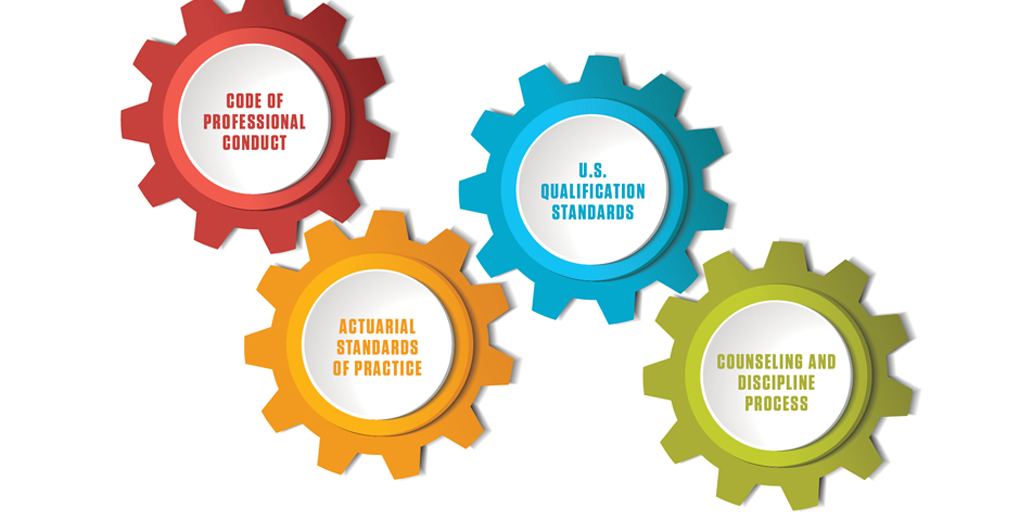
These four elements are designed to work together. No single component can carry the full weight of self-regulation. Collectively, they create an integrated system of principles, qualifications, practice standards, guidance, and accountability that supports and strengthens the U.S. actuarial profession’s ability to serve the public.
This role is a direct continuation of why the Academy was created more than six decades ago. The Academy provides the structure, expertise, continuity, and national reach needed to maintain and strengthen the profession’s professionalism framework.
Value Built on Trust
For actuaries, the framework provides clarity, guidance, and a common professional foundation across practice areas and workplaces. For employers and clients, it reinforces confidence that actuarial services are being performed by qualified professionals working within recognized ethical and practice standards.
For the public, the framework helps safeguard trust in actuarial judgments that affect financial security and essential systems. For legislators, regulators, and other public decision-makers at the state and federal levels, it provides a credible basis for relying on actuarial expertise and demonstrates that the profession has established mechanisms to maintain qualifications, define appropriate practice, and address misconduct.
Self-regulation is not simply a privilege. It is a responsibility that must be continually earned and protected through rigor, transparency, responsiveness, and accountability.
As risks grow more complex and the demand for actuarial insight increases, this professionalism framework will remain central to the value actuaries provide. By sustaining that framework, the Academy helps ensure that the U.S. actuarial profession remains prepared to serve its principals, stakeholders, and the public with competence and integrity.
William J. Michalisin is the Academy’s executive director and CEO.