Janet Fagan
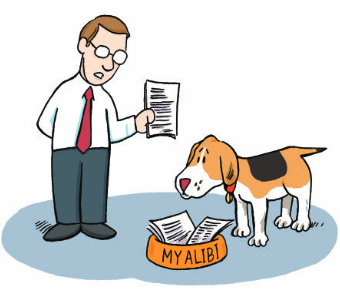
I AM A MOTHER AND GRANDMOTHER, and have served on the Actuarial Board for Counseling and Discipline (ABCD) for six years. I think I have heard everything. You may recall your childhood years and the imaginative excuses kids offer up for forgetting assignments and notes from school. As an adult, you likely have heard many justifica-tions for poor or late assignments at your workplace. The ABCD has also heard a wide array of these excuses from our colleagues.
When faced with an accusation of wrongdoing, our natural instinct is to be defensive. That response is probably uni-versal. At some point in adulthood, most people begin to own up to their mis-takes—and correct them. But even when faced with evidence of their wrongdoing, some members of the actuarial pro-fession stubbornly maintain that their actions were either correct or justifiable.
These excuses can be broadly categorized as “assumptions,” “end jus-tifies the means,” “validation by others,” and “age and continuing education.”
Assumptions
As actuaries, our regular work requires that we make many assumptions. These assumptions are most frequently made based on a thorough review of information available and determined by experience. However, this is not always the case; in such cases, actuaries are required to ap-propriately disclose reliance on others. Improper reliance can get you in trouble.
In the “assumption” category, I have heard that “it’s OK to use the as-sumptions that the client specified, without disclosure,” “that’s the number the software gave me,” or “the actuari-al standards of practice (ASOPs) aren’t clear on the point.”
While it is permissible to use assump-tions specified by others, such use must be disclosed in accordance with ASOP No. 41, Actuarial Communications. If the work product relies on a “black box,” that also requires disclosure. It is never ac-ceptable to just use output derived from an unknown set of assumptions and algo-rithms. For example, reliance on outside models is addressed in ASOP No. 38, Us-ing Models Outside the Actuary’s Area of Expertise (Property and Casualty). Selection of assumptions for pension valuations is covered in ASOPs 27 and 35. Remember, if you sign a report, you own everything in it—including the as-sumptions—unless specified otherwise in accordance with the disclosure re-quirements of the ASOPs.
The End Justifies the Means
“The end justifies the means” is a broad category I am using for the excuses that wave off the need to follow standards because everyone seems happy. Usually, this justification comes in the form of “as long as the client is happy with the re-port, following ASOPs is not necessary.” At times we have been told that the in-tended user is happy so all is well, even though the actuary knew that the report would be published and others would have access to it. Because these other readers are not the “intended users,” the reasoning goes, the report does not need to provide any more information to them. Not so—someone should be reading ASOP No. 41.
Also in this category are the excuses I find most absurd, like “that was how it was done last year.” Would you accept that ra-tionalization from someone on your staff? Frighteningly, I’ve even heard “the right way doesn’t make sense” as justification for deviation from standards, without any further explanation.
And there is the common “I’m not paid enough to do more work” as an excuse for shortcuts, lazy selection of as-sumptions, and lack of documentation. Nonsense. The appropriate degree of pro-fessionalism should never be based on your compensation.
If you are requested to justify a posi-tion or an answer, regardless of whether it is actuarially supportable, then your ex-cuse may fall into this category. Whether it means a ratemaking exercise or a reserv-ing or valuation assignment, backing into a conclusion may require you to justify your work. The end does not justify the means.
Validation by Others
There are cases where some actuaries have offered what I call “validation by others” as an excuse. These excuses range from saying that “a lawyer said it was OK,” “everybody does it,” “other folks are even worse,” or “the prior auditor let it pass.” As professionals, we are responsible for our own work, and getting approval or vali-dation from third parties does not let you off the hook for a poor work product. Re-member, if you are questioned about your work, none of these folks will be there to defend you.
Your work stands on its own and is sub-ject to the actuarial standards of practice. Even if there are others who commit simi-lar questionable acts and avoid being the subject of an ABCD inquiry, you cannot jus-tify your work by using this type of excuse.
Age and Continuing Education
As our population ages, more people are con-tinuing to work part time or intermittently after their official “retirement.” With many years of experience and a successful career un-der their belts, some actuaries have indicated that they are either too old to change or that they have been practicing for so long that they know everything in their practice area.
Simply indicating “retired” status in your organization’s directory while doing a small amount of actuarial work does not exempt you from the continuing education (CE) require-ments. If you are offering an actuarial work product, you must remain current with your CE. Actuarial practices constantly evolve, and meeting your continuing education obligations is an essential component of actuarial practice. (See the U.S. Qualification Standards, as well as Precepts 2 and 3 of the Code of Professional Conduct.) It is your responsibility to remain current on these changes. Do not assume that the laws and regulations in place 15 years ago are the same as the current ones. Standard methodology also has evolved, and your exam knowledge rapidly becomes dated as technol-ogy and data analytics improve. Continuing education is how we remain current and rel-evant in our work.
While these excuses may sound amusing, they often are indicative of an attitude that is quite dangerous. We have an obligation to our clients, employers, the public, and one another to behave in a professional manner. The ASOPs and the Code of Professional Conduct exist to ensure that all of these parties are dealing with individuals with high standards of ethics and professional integrity. Simply casting aside these requirements when they are inconve-nient—and offering immature and disrespectful excuses as your rationale—cannot be tolerated