By Josh Feldman
One would logically think that the hole-in-one challenge would have, for once and for all, ended the epic rivalry between Doc and Hoss, but over the past few weeks both rivals continued to challenge themselves in the most interesting of ways. The hatred between the two became not only a local story, but thanks to a couple of viral TikTok videos, a national (if not an international) one.
First, both Hoss and Doc attempted to complete the Oreo Power Hour. Both failed spectacularly. Then came the epic hopscotch competition; judges deemed the results too close to call. And, of course, our two heroes fought over who could amass the most money in Scritchy Scratchy, as both players scratched an insane number of lottery tickets. And who could forget that rock-paper-scissors duel? Hoss allegedly reread the rock-paper-scissors strategy guide four times to prepare. Alas, not even that produced a clear winner. The one-upmanship seemed to never end!
Finally, my friend Chef realized this needed to end, as there is more to puzzle writing than the adventures of Hoss and Doc. Chef proposed a summit at Dada Doner, known to be the best restaurant in town, where Hoss and Doc could for once and for all air out their grievances and get on with their lives. It seemed like a good idea, as who could get upset while eating Turkish street food? Everyone felt optimistic that a peaceful resolution was close at hand. Alas, not even the shawarma could calm things down. Tempers boiled. To prove their superiority, Doc and Hoss started listing what they viewed as their greatest accomplishments. Hoss completing a sub-six-minute beer mile. Doc claiming he understood Finnegans Wake. Hoss mining the Klopman Diamond. Doc performing a triple-Lindsey. Hoss claiming to know where Vermeer’s The Concert is located. And then suddenly, it all stopped. Doc made such an outlandish claim that even Hoss was taken aback. The entire restaurant—no, the entire city—hushed at even the thought of the claim.
Doc claimed he could score an 800 on the SAT math section without a calculator.
After sitting in stunned silence for what felt like minutes, Hoss finally said, “There is no way you can do that.” Hoss then told Doc, “You can even have that actuary puzzle writer as a tutor. If you can get a perfect SAT math score, you win.”
I had no idea how I got roped into all of this, but Doc quickly agreed. In two weeks, Doc would take the SAT, and whether or not he got every question correct would, for once and for all, end all of this madness.
As we walked out of the eatery, Doc said that as his tutor I had one job and one job only: Find the three toughest SAT math questions known. If Doc could solve those, he could solve anything. I told Doc I could find him some problems, but I might not be able to solve them. “Don’t worry about it,” Doc said. “Your puzzle solving friends can help you there.” Solve each of these three problems without the use of a calculator:
- If 3x + 4y = 5, what is 27x × 81y?
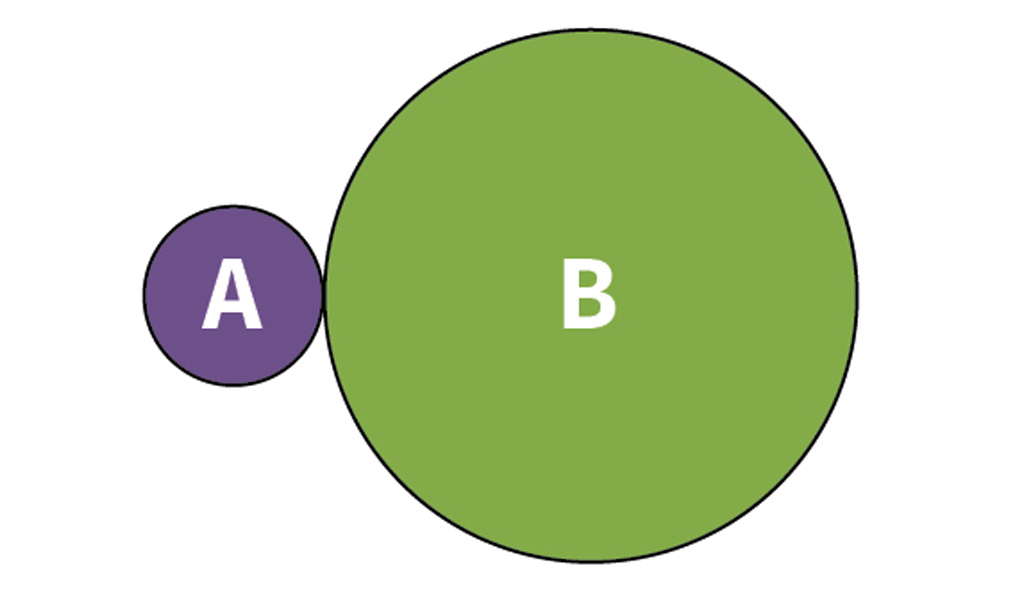
- In the picture below, the radius of Circle A is 1 and the radius of Circle B is 3. Circle A rolls around circle B, so that it rolls exactly one time around Circle B, back to its starting point. How many times will Circle A revolve in total?
- If shoppers enter a store at an average rate of r shoppers per minute and each stays in the store for an average time of T minutes, the average number of shoppers in the store, N, at any one time is given by the formula N = rT. The owner of Ernie’s Elbow-Grease Emporium estimates that every hour 168 shoppers wait in line to make a purchase, and that each shopper spends an average of five minutes in line. On average, how many shoppers are waiting in line to make a purchase?
Solutions to Last Issue’s Puzzles—Jigsaw-Puzzle Puzzles By Stephen Meskin
In puzzles 1 and 2, we assume ordinary rectangular jigsaw puzzles, with rows and columns running cleanly from one edge to the opposite edge.
Puzzle 1: A jigsaw-puzzle manufacturer wants to make puzzles with at least 1,000 pieces. Among those puzzles she wants the total number of pieces to be as small as posssible. She also wants the ratio of the number of columns to the number of rows to be as close as possible to the Golden Ratio. She agrees that minimizing the sum of the percentage deviations from her two targets would be appropriate. Select the number of rows and columns she should have in her puzzles.
- Answer: 40 columns and 25 rows.
- Solution: The hardest part of this puzzle is proving that the answer is the correct one among the million discrete possibilities. The goal is to minimize
where c = #columns ≥ r = #rows and c × r ≥ 1,000.
We calculate that T(40, 25) = 1.11%; we want to show that this is the minimum.
- Lemma: If T(C, R) is the minimum then C ≈ 1.618R and (allowing for a 2% margin) 1,000 ≤ 1.02 × 1.618R2 implying:
25 ≤ R ≤ 32 and 40 ≤ C.
- Lemma: If c > 40 and r ≥ 25 then T(c, r) > T(40, 25).
- Lemma: If c = 40 and r > 25 then T(c, r) > T(40, 25) by calculation.
- Corollary: T(40, 25) = 1.11% is the minimum.
“The most common layout for a thousand-piece
puzzle is 38 pieces by 27 pieces …”—Wikipedia
Puzzle 2: A jigsaw puzzle has n edge pieces where n is an even integer. How many pieces can the puzzle have altogether? For example, if n = 14, then the puzzle could have 14, 18 or 20 pieces. Your answers should be in terms of n.)
- Answer:
R = floor((n/4) +1)
- Solution: Assume a landscape format thus
c = #columns ≥ r = #rows (as in Puzzle 1).
- Case 1: r = 1, then number of pieces = c × r = c × 1 = n.
- Case 2: r > 1, so n = 2r + 2c – 4 (subtract 4 otherwise corners are double counted).
Thus 2 ≤ r ≤ c = n/2 + 2 – r. For each r from 2 to max r = R, the number of pieces, P, is P = r × (n/2 + 2 – r).
For r = 2, P = n (again) and for r = R, R ≤ n/2 + 2 – R so
R ≤ n/4 + 1 and R is an integer so R = floor((n/4) +1)
And P can take R – 1 values for each n.
Puzzle 3: In the original column, I wrote “jigsaw” followed by “puzzle” six times. Half the time I used a hyphen and half the time I didn’t. Provide the reasons for hyphen use and non-use.
- Answer: The hyphen was used when “jigsaw-puzzle” was used as an adjective to describe a type of puzzle or manufacturer. “Jigsaw puzzle” was used when “puzzle” was the noun described by the single word “jigsaw.”
Solvers: Bob Conger, Deb Edwards, Cindy Hu, Clive Keatinge, Scott Parker, David Promislow, Anthony Salis, Jason Shaw, John Vrysen, and Daniel Wade.