By Josh Feldman
A little over 10 years ago, I likely didn’t know what I was getting myself into writing this puzzle column. Full of optimism and naïveté, I easily figured I could come up with a few clever columns a year. Quickly, reality set in, as I struggled more and more to come up with creative ideas for puzzles. It didn’t help that Stephen Meskin set the bar incredibly high with his offerings. With some of the smartest puzzle readers around, I knew that there was no way they would let me ever phone in a column.
As my ideas have dried up, fortunately new blood has arrived to offer a fresh perspective on this column. Starting next issue, Aaron Farmer, Tony Pistilli, and Daniel Wade have graciously agreed to take over this endeavor. I have spoken to all of them, and I am confident they will create puzzles of higher quality than I can right now. I look forward to going back to solving puzzles instead of creating them, and will make sure that Aaron, Tony, and Daniel get off to a flying start writing puzzles! While I might create an encore puzzle in the future, don’t expect it!
Over these past 10-plus years, I realized a reader probably knows a heck of a lot about me through reading this column. In previous columns I have talked about my hobbies, my favorite game shows, my hometown, running, poker, social media feeds that I follow, reality TV shows that I enjoy, and of course my unique and awesome group of friends. I appreciate Contingencies giving me the opportunity to talk about so many things that I hold dear to my heart. Never once did I feel censored or discouraged from writing about any topic of interest.
Of course, I still have one more puzzle to muster up. I remember that over a decade ago I talked with Lenny Shteyman, the previous puzzle editor, about taking over this job. He asked me for a puzzle example I might use, and I realized I never used that example. It seems fitting to rectify that!
One of the quirks of living in my small town is that we have a small airport. A really small airport. And let’s just say the boarding rules are relatively lax. Not too long ago, my partner and I planned to attend a tennis tournament. Alas, we broke up before the flight, but we both wanted to attend the tournament. With no other flights available, and sitting next to each other on the flight out of the question, we came up with a plan. My partner (who had boarding priority) would be the first person to board the flight and take a random window seat on the plane. If the person who later boards the flight happens to be in the seat my partner chose, he/she would just take a random open seat, as here in the Midwest no one would dare raise a fuss about someone sitting in their seat. This process would continue throughout the entire flight, until I would be the final one to board, and would take the last available seat no matter where it is. Assuming a full flight of 100 passengers, and that if your seat is occupied the passenger will randomly select one of the remaining unoccupied seats, what is the probability that I end up sitting next to my ex?
Of course, the drama didn’t end on the flight; there was drama at the tennis tournament as well. As the tournament sold itself as “old school,” there was no electronic calling of balls in or out. They instead had old-fashioned linespeople make the calls. On one heavily contested point, a player made a tirade worthy of Jeff Tarango, claiming a serve that was clearly out was called in. During the ensuing discussion, you could clearly hear one linesman say that it was his responsibility to determine if the ball was long or not, and he was 100% confident that the ball was indeed not long. And another lineswoman said it was her responsibility to tell if the ball was wide or not, and she would swear on her life that the ball was not wide. Is it possible that all three people heard are correct: that the ball was not wide, not long, and yet still the correct call should have been that the ball was ruled out? How so? Note that in tennis, if any part of the ball hits any part of the line, it’s considered in.
Solutions to Last Issue’s Puzzles—Bingo!
1. What is the probability of getting Bingo in exactly four balls? There are four ways to get Bingo using exactly four balls: two diagonals and horizontal and vertical through the center square. This is just (75 nCr 4)* 4, or 1 in about 303,862.
2. What is the probability of getting Bingo in exactly five balls? There are two ways to do this. One is to not use the ‘free’ square. There are eight ways to do this (four vertically and four horizontally), so this is just 75 nCr 5) * 8 = 8/17,259,390. You can also use four drawn balls and the free ball to do this. This is similar to question 1, except that before the 1st, 2nd, 3rd or 4th ball there will be one ‘miss’ with a probability occurring of 71/75. The probability of this is = 0.00132%. As these are independent, the sum of these two numbers is our answer, at about 0.00136%.
3. What is the greatest number one can draw with no Bingo? You can draw 70 balls without a Bingo. See this drawing by solver Rui Guo to illustrate how five open spaces can lead to a player not getting a Bingo.
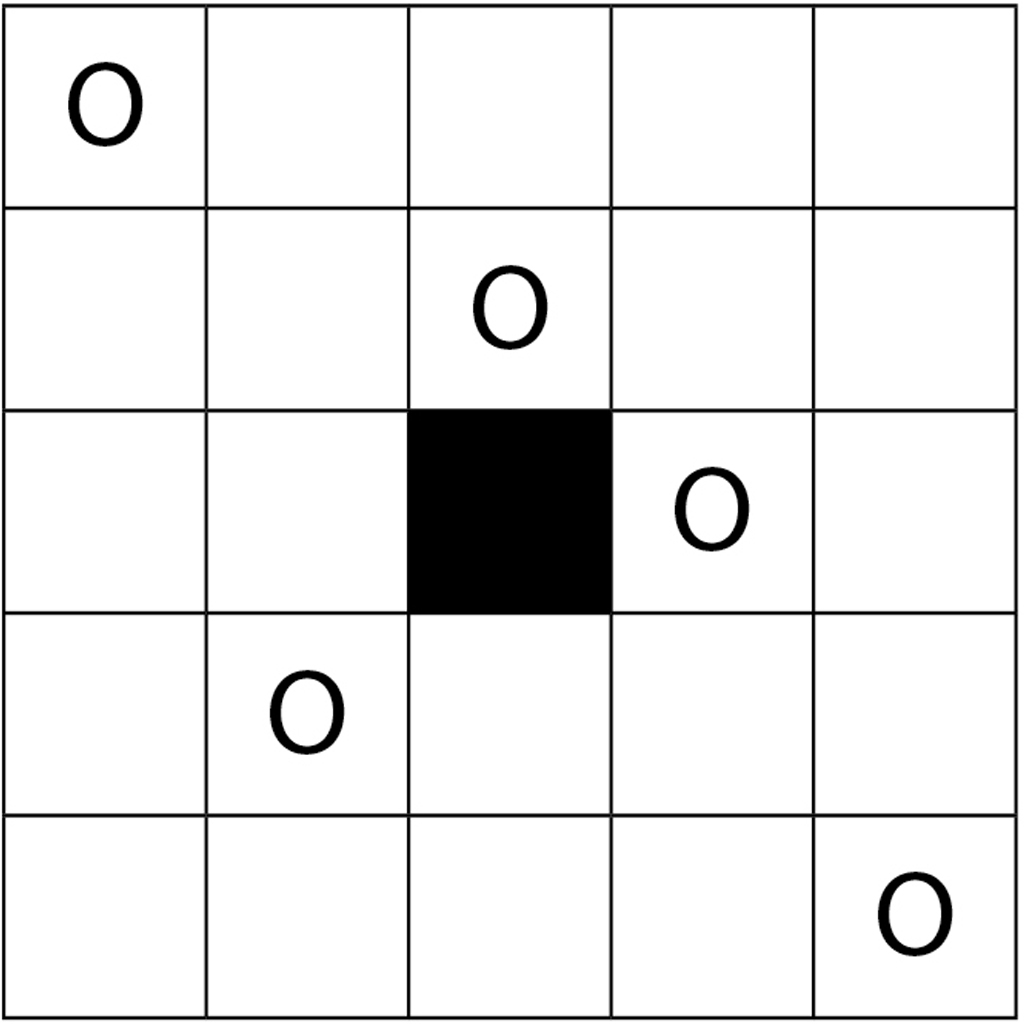
4. What is the probability of covering all four corners with the first four balls? That is just (4/75) * (3/74) * (2/73) * (1/72) = 0.00000082
5. What is the probability of getting a blackout by the 60th ball if 10 people play? In order to get a blackout by ball 60, the last 15 balls must be ‘misses’. The probability of the first ball missing is (51/75). The second is (50/74), the third is (49/73)…. Multiplying these together leads to a probability of 0.14%. If 10 people play, then (1-.0014)10 = 0.986. So about a 1.4% chance one of the 10 players has a blackout.
Solvers: Rui Guo, Bob Conger, David Promislow, Daniel Wade, Anthony Salis, Clive Keatinge, and Jason Shaw.