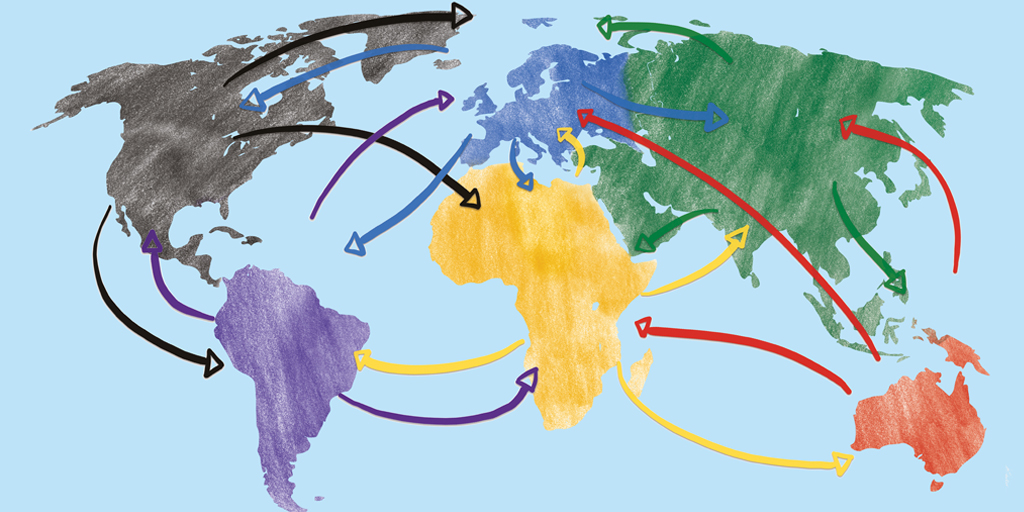
While the Academy remains the U.S.-focused public policy and professionalism membership association for actuaries, we don’t exist in a vacuum. Remaining aware of the issues and conversations that take place on the international stage has been a priority throughout our history.
In the past year, the Board established a new International Committee—which works in conjunction with the Prudential Regulation Committee—to ensure that we appropriately monitor and engage with our international partners. This November, the Academy will take center stage with several presentations at the International Congress of Actuaries (ICA) in Tokyo.
The committee, chaired by former Academy President Lisa Slotznick, recognizes the importance of engaging on key industry topics beyond the nation’s borders. While the Academy is focused on serving its U.S. membership, it also recognizes that many members are employed by insurers or consulting firms with a global presence, and that their work intersects with international issues.
“There could be trends outside the U.S. that come to the U.S. that we want to be aware of,” Slotznick said. “We want to influence those trends so that, if it’s a professionalism issue, something isn’t done internationally that has an unintended consequence either on our work in other countries or in the U.S.”
Additionally, there are issues that transcend borders and are of interest to the Academy. Topics such as artificial intelligence (AI), the impact of climate events, and the governance of financial systems are among the “mega-issues” prioritized by the Academy that are global in nature, regardless of nation or language.
The International Committee is responsible for ensuring that the Academy’s focus on global issues is well coordinated and is strategically directed. Previously, Academy volunteers in key committees monitored relevant issues, while Academy leadership maintained relationships with other associations such as the North American Actuarial Council and the Actuarial Association of Europe, holding bilaterial meetings with various actuarial groups and sharing information and best practices. The International Committee is composed of experienced Academy volunteers and members, representing each practice area and focused on both professionalism and public policy matters.
Academy volunteers and invited speakers will present at the upcoming ICA on several topics, including professionalism and its relationship to self-regulation in the U.S.; AI from a professionalism, climate, and regulation perspective; and research related to capital standards. In the lead-up to the ICA, the International Committee will host webinars in which members will highlight these topics and discuss opportunities for increasing engagement.
Slotznick said these ICA presentations are part of a concerted effort by the Academy to increase its involvement at the event. “This is a new thing for us to formally do as part of the Academy,” she said. “We are very excited that a good number of our sessions got selected.”
Specifics about the Academy’s presentations are detailed in the abstracts submitted to the ICA. The three AI-themed sessions, while separate, will be held consecutively. Individually, each session delivers insights into the implications of AI for actuarial practice and the ongoing evolution of risks related to the rapid adoption and use of technology. Together, the presentations create a cohesive program that allows participants to assess global methods, evaluate challenges, and consider future directions in AI regulation.
- Generative AI and Professionalism will encourage actuaries to consider the Academy’s 2024 Actuarial Professionalism Considerations for Generative AI paper as an approach to professionalism considerations when evaluating the use of generative AI in assignments. The session is led by Kathy Wong, who served on the Academy’s Artificial Intelligence Task Force that helped draft the paper.
- The U.S. Regulatory Environment for AI will examine National Association of Insurance Commissioners’ (NAIC) initiatives and state-specific regulatory actions aimed at ensuring companies implement AI systems responsibly, maintain effective governance frameworks to monitor their performance, and protect consumers from undue harm. The session is being presented by Roberto Perez Santiago, an Academy member and a NAIC P&C rate modeling actuary.
- Generative AI and Climate, led by Joint Climate Change Committee member Dorothy Andrews, will explore the consequences of data centers on climate, actuarial pricing assumptions, environmental resources, and host communities, while also asking the question, “Is this just a background issue or does it have direct implications for the actuary beyond the pricing of the property and liability coverages for utilities?”
Meanwhile, three connected professionalism presentations offered by Academy President Tricia Matson, Academy President-Elect Frank Todisco, and International Committee member Tom Terry will enable participants to compare global professionalism approaches; understand how U.S. actuarial standards of practice, counseling, and disciplinary processes were developed; and consider the implications of self-regulation in a world that frequently looks to government licensure to ensure professional standards.
- Self-regulation of the U.S. Actuarial Profession will explore how the U.S. actuarial profession has responded to the challenge of self-regulation, while also describing Academy-led efforts to offer objective contributions to public policy development and provide balanced analysis and actuarial perspective to American policymakers.
- Accountability in the U.S. Actuarial Profession will describe the ways in which the U.S. actuarial profession’s disciplinary infrastructure contributes to actuaries’ accountability in the United States. It will detail the U.S. disciplinary process, highlighting what has worked to unite the actuarial profession and maintain its standing as a self-regulated profession.
- Practice Standards: Evolution in the U.S. will compare global professionalism approaches; explain how U.S. actuarial standards of practice, counseling, and disciplinary processes were developed; and examine the implications of self-regulation in a world that frequently looks to government licensure to ensure professional standards.
Finally, Academy Research Director Steve Jackson will present an Academy research paper addressing scalars in the International Association of Insurance Supervisors aggregation method. Scalars are amounts by which solvency calculations of U.S.-owned entities operating internationally are multiplied to make them comparable to the calculations of U.S.-based entities before they are combined. The paper will assess the AM and the Group Capital Calculation, as implemented by the NAIC in the United States, and will examine existing scalars in light of empirically derived scalars, finding a use for a data-driven approach to scalars beyond their use for regulatory purposes.
Beyond the ICA, the International Committee will continue to focus on identifying opportunities to engage and share the Academy’s expertise with the global community, while highlighting our leadership within the profession to ensure that our members and all U.S.-practicing actuaries remain aware of the global policy and professionalism issues that influence our work. While we remain fully focused on the U.S.—ensuring that the actuarial voice is a strong and consistent presence within our borders—the Academy will continue to be a voice and resource for those beyond them.
Ted Gotsch is policy content and publications manager at the Academy.