
By Tom Toce
I’ve been seeing a lot of lists of occupations that are likely (and not likely) to be replaced by artificial intelligence (AI). On the likely list are mathematicians, statistical assistants, writers and authors, and personal financial advisers. On the other hand, a Google search (which is now run by AI, I believe) tells us:
“Occupations least likely to be replaced by AI generally involve complex human interaction, creativity, or hands-on tasks that require adaptability and real-time problem-solving. Examples include roles in health care, education, creative fields, skilled trades, and leadership positions.”
Contingencies readers will be interested in knowing how the actuarial profession fits in. Are we more like mathematicians and personal financial advisers? Or does our work involve complex human interaction, creativity, and real-time problem solving?
Setting aside that conundrum for a while, I wanted to see how AI would do on cryptic puzzles. Not filling in the grids. Crossword puzzle software, which is AI-like, is already pretty good at that, and most constructors do use software to fill out grids. I was more interested in how AI would tackle clue writing.
Cryptic clues are weird. Good ones are funny, which isn’t something AI is known for. There are a lot of rules, and I think most solvers are only vaguely aware of them. Some rules are nearly inviolable. For example, you will never (maybe almost never?) see an anagram clue that does not explicitly include the letters needed for the anagram. If you want TEAR to be anagrammed into RATE, you have to actually put the word “tear” into the clue. It’s a no-no in cryptic land to expect a solver to first derive “tear” from “rip” and then make the anagram. Other rules are less strict, and different constructors and editors have varying requirements.
Based on my research, cryptic puzzle constructors are safe—for now. The first set of clues came from AI prompts. I asked an AI program to give me three possible cryptic puzzle clues for each entry. Some of them were OK. Most were terrible. Not idiotically terrible, though. The straight definition parts were usually fine, but the wordplay was generally awful. I got back anagrams that violated the rule mentioned above or that had extraneous letters, skips that didn’t quite work, homophones that just hung there awkwardly. Each clue came back with an explanation, and they were usually just wrong—like calling something an anagram when it clearly wasn’t. I call these clues “hallucinations.” Again, from Google:
“AI hallucinations occur when large language models (LLMs) generate inaccurate, nonsensical, or fabricated information in response to user prompts, despite appearing confident and coherent. These “hallucinations” can range from minor errors to complete fabrications and are a significant challenge for generative AI systems.”
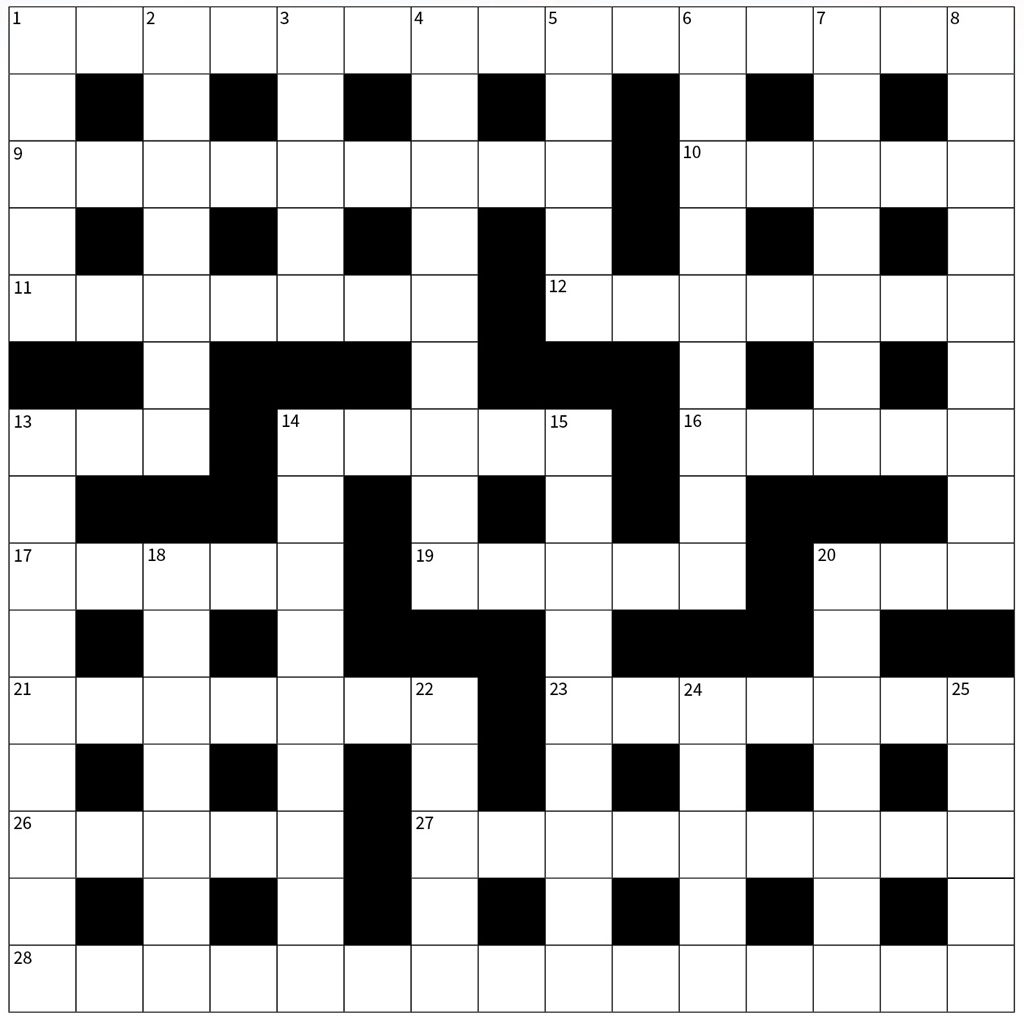
I encourage everyone to try solving this puzzle using the hallucinations. It’ll be frustrating—or challenging—depending on how you look at it. Just remember that the clues are flawed. (I didn’t include any of the decent AI clues.) There are four proper nouns as they are clued.
Let me know if you solve the puzzle using only the hallucinations. If you find them too difficult to work with, try the regular clues. They work the same as in any other cryptic puzzle. There are five proper nouns as clued (one entry is clued as a proper noun in the regular clues but as a common noun in the hallucinations). Everything else is playable in Scrabble. Ignore punctuation—it’s often included to deceive.
The long unclued entries at 1A and 28A are both two-word phrases related to the theme. The solver has to work them out from the down entries.
Thanks to Jerry Miccolis for test-solving and editorial suggestions.
Hallucinations
Across
1. See instructions (7, 8)
9. Filter through performance by feline
10. A doctor’s favorite fruit, reportedly
11. Painter caught in capricious soap opera
12. Menaces that test rashness
13. King of beasts, oddly eloquent
14. Interprets clues, as solver does
16. Fuel additive not in rotation oddly
17. Blended fuel used strangely
19. Remove error, as edited
20. Hardwood seen in a koala’s kingdom
21. Talk about mine’s rare contents
23. Striking thing in tight gin mix
26. South American leaf found in nearby
27. Link between systems, initially in net café
28. See instructions (11, 4)
Down
1. Finish off messy soup, perhaps
2. Tropical spirit found in accurate cocktail
3. Notable images, oddly in coins
4. Developed a rebel to act out
5. Occasion when vet’s in trouble
6. Alter layout, gear near chaos
7. Insert limb, tap adjusted
8. Speculation from rogue skews?
13. Habits of elf yet is transformed
14. No longer needed, turned under and red
15. Noodles seen in this page, twisted
18. Sword master seen in samurai films
20. Paper art that folds into animals, maybe
22. Control seen in genre I twisted
24. Alpine land where royalty turns
25. Ancient tongue that sounds like a geek?
Regular Clues
Across
1. See instructions (7, 8)
9. Better to replace what you might call “coffee”
10. Extremely appealing single by three-time Grammy winner
11. He made collages from priapic associations?
12. Mad hatters issue warnings
13. Constellation of stars–DiCaprio, for instance
14. Follows the sheet music, with oboes and bassoons blaring
16. Intro re-orchestrated, it can be good for the heart
17. Coupled after feuds got settled
19. Swift tour with a bit of eroticism as takeaway
20. Mighty tree with steep top cut off
21. Remains unfocused in class
23. At bat and after losing opener, apt to chase Pittsburgh’s closer
26. Mate occurs when player badly relinquishes the middle
27. Collaborate to bury Brook
28. See instructions (11, 4)
Down
1. Finish off a hopeless fight against Missouri dog (two words)
2. Heal a pig some would say with blue liqueur
3. Champions are flipping coins
4. Are oblate patterns intricate?
5. “Special occasion” is just Thursday
6. Line up again behind Ken
7. Limp lantana needs pruning or a graft
8. Estimates of attendees (not including those at the opening performance)
13. Way of being silly: feet flying
14. Under-baked? Alternatively, dear, not overdone
15. It improved the gaps showing up in many an Italian dish
18. One first-class rum as taken up by Japanese warrior class
20. On the other hand, I ultimately bag a thousand with a little bit of ingenious paperwork?
22. Storms sounding in Queens administration
24. Pretty rollicking inside a region in the Alps? Just the opposite!
25. General stink is nonsense, metaphorically
TOM TOCE is an FCAS and a seasonal director at KPMG. He is a member of the Jeopardy Hall of Fame. Solutions may be emailed to [email protected]. In order to make the solver list, you should send him your solutions by Dec. 1, 2025.
Solution to Previous Issue’s Puzzle—Are We on the Same Wavelength?
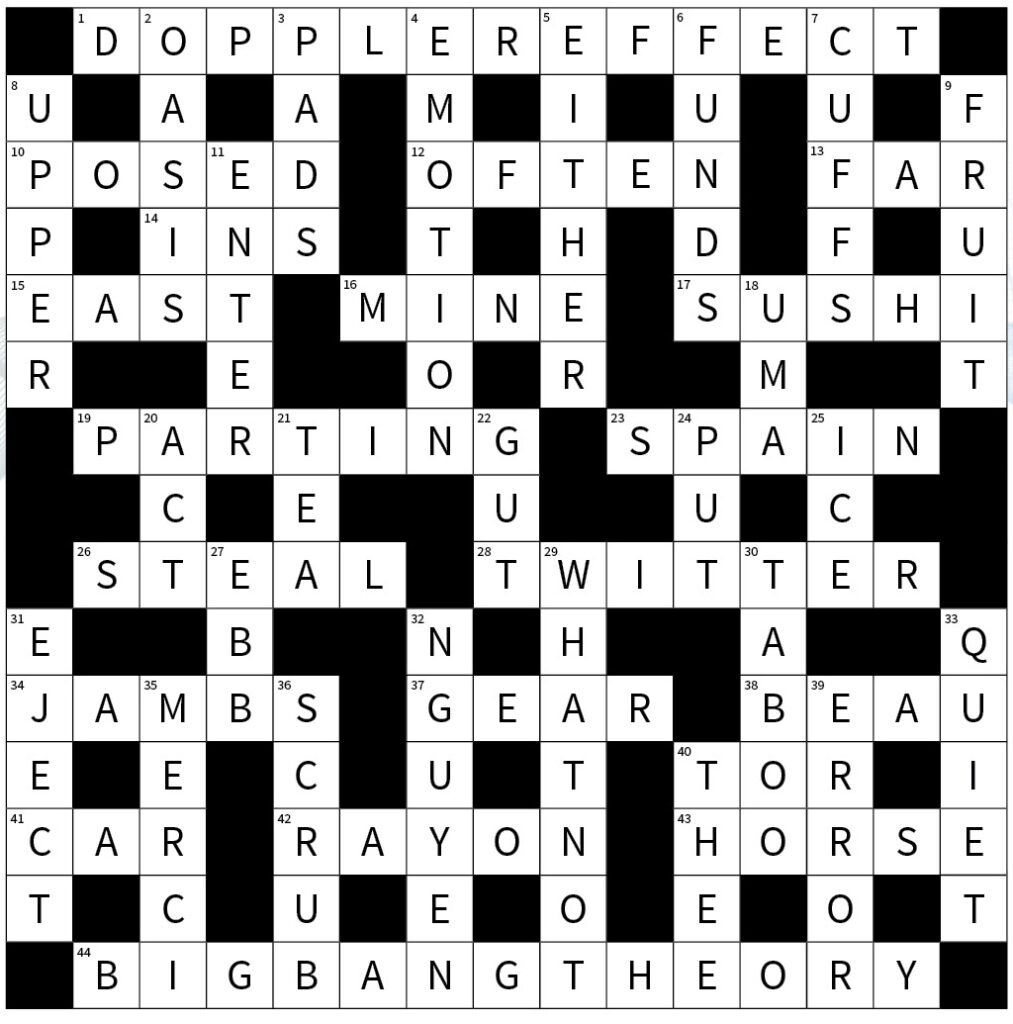
RED SHIFT is spelled out from the exchanged letters in the pertinent across entries. It is an example of 1 Across, as explained by 41 Across.
Across
1. DOPPLER EFFECT
10. POSED from PORED—Homophone of POURED (“streamed”), yielding R
12. OFTEN—Double definition (OF TEN)
13. FAR from EAR—Anagram of “era,” yielding E
14. INS—Homophone of INNS (“retreats”)
15. EAST—Alternating letters in “we may sit”
16. MINE from MIND (MI + ND, “two states”), yielding D
17. SUSHI—Anagram of “us, his”
19. PARTING from PARSING—PAR “a standard” + SING “tattletale,” yielding S
23. SPAIN from SPAHN—SPA (“Hot Springs, for example”) + HN (“New Hampshire” reversed), with reference to Warren Spahn, a “Brave superstar” and “sometime Met”), yielding H
26. STEAL—Homophone of STEEL “rally”
28. TWITTER—TITTER (“Laugh self-consciously”) around W (“what at first”)
34. JAMBS from IAMBS—I AM (scramble “Am I”) + BS (“crazy”), yielding I
37. GEAR from FEAR—Hidden in “supersafe arboretum,” yielding F
38. BEAU from BEAT—Double definition, yielding T
40. TOR—Unclued. My mistake. “Left to decompose on a craggy hill,” courtesy of Betsy Uzzell.
41. CAR—CARtilage, with reference to the Corvette Stingray
42. RAYON—(C)RAYON—“pastel for the most part”
43. HORSE—Anagram of “or she”
44. BIG BANG THEORY
Down
2. OASIS—OAS (“Western Hemisphere assembly”) + IS
3. PADS—AD (“some admiration”) inside PS (“a postscript”)
4. EMOTION—Anagram of “Noontime” without one N (“with no new”)
5. EITHER—Anagram of “there, I”
6. FUNDS—FUN (“Joy”) + first letters of “Desdemona” and “Siobhan”
7. CUFFS—CU (“copper”) + FFS (“43% tariffs”)
8. UPPER—(S)UPPER (“Dinner’s starting a little late”)
9. FRUIT—Outside of “Frivolous pursuit”
11. ENTER—ENT + ER (“Two kinds of doctors”)
18. UMA—UM (“Hesitation in speaking”) + A with reference to Uma Thurman
20. ACT—Anagram of “cat”
21. TEA—Double definition
22. GUT—Reversal of TUG (“a tower”)
24. PUT—PUT(T), “a short golf shot”
25. ICE—Double definition
27. EBB—Double definition, with reference to Fred Ebb (“Cabaret lyricist”)
29. WHATNOT—Anagram of “Want hot”
30. TABOO—TA (“at upset”) + BOO (“to express displeasure”)
31. EJECT—EJ (“easy junk at first”) + ECT (“finally the music equipment”)
32. NGUYEN—NG (“No good”) + U (“you” homophone) + YEN (“Japanese bank notes”)
33. QUIET—QUI (“Who in Paris”) + ET (“and in Marseilles”)
35. MERCI—Anagram of “Crime”
36. SCRUB—SC (first two letters of “Scour”) + RUB (“polish”)
39. ERROR—ERR (“Make a mistake”) + OR
40. THEE—THE + first letter of “essence”
Solvers: Steve Alpert, Dean Apps, Bob Campbell, Lois Cappellano, Laura Cremerius, Jared Dashoff, Todd Dashoff, Christopher Dickens, Mick Diede, Deb Edwards, Jason Helbraun, Pete Hepokoski, Catharine Hornby, Max Jackson, Ruth Johnson, Paul Kolell, Mike Kosciuk, Ken Kudrak, George Levine, Tim Luker, Ben Lynch, Michael Manos, Dave McGarry, Jon Michelson, Jim Muza, David and Corinne Promislow, Ram Raman, Chase Rawlins, Jay Ripps, Bill Scott, Andrew Shewan, Bob and Shannon Schriver, Sally Smith, Zig Swistunowicz, T. O. C. E. (Josh DenHartog and Sean Donohoe), James and Betsy Uzzell, and Bonnie Veenschoten