The confluence of severe convective storms, rising costs, and evolving hazards is changing how actuaries measure and manage risk.
By Michael G. Malloy
Fifteen years ago, on May 22, 2011, the enormous tornado that tore through the city of Joplin, Mo., was so large that survivors described a 300-yard-wide “eye,” similar to the center of a hurricane, in the 2025 Netflix documentary The Twister: Caught in the Storm. The EF5 tornado—the highest rating on the Enhanced Fujita (EF) scale—killed 161 people and caused an estimated $2.8 billion in insured losses. Total damages, including uninsured losses factored, reached as much as $3.18 billion overall, according to Guinness World Records.
Tornadoes develop from mesocyclones—rotating drafts that form within severe convective storms (SCS). Unlike tropical cyclones—called hurricanes in the U.S., and typhoons or cyclones elsewhere in the world—mesocyclones are a critical ingredient in tornado formation. These rotating updrafts feed into supercell thunderstorms, which can produce high winds and hail, and spawn tornadoes.
As with electricity, there is an element of mystery in exactly how tornadoes form. Even tornado experts with a keen sense of how to chase them, as portrayed in the 1996 movie Twister (and its 2024 sequel, Twisters), acknowledge that some parts of the process are not fully understood. It’s generally accepted that tornadoes require a collision of cold and warm air, which can create supercells capable of producing funnel clouds and, ultimately, tornadic activity.
Around 1,200 tornadoes form annually in the United States, according to the National Severe Storms Laboratory (NSSL), a division of the National Oceanic and Atmospheric Administration (NOAA). While the U.S. accounts for the majority of the world’s tornadoes, they also occur across Europe, Africa, Asia, South America, Australia, and New Zealand.
Since 2007, tornadoes have been measured by the EF scale. Like the categories used for hurricanes, EF ratings range from EF0 (the weakest, with maximum 65 mph gusts) to EF5 (the strongest, with winds exceeding 200 mph).
Growing Costs
Several large global reinsurance companies, including Allianz, Aon, and Swiss Re, have pointed to rising costs in recent years due to SCS activity.
“Unlike hurricanes, SCS events can strike with little or no warning, unleashing significant localized damage and triggering knock-on effects such as flash flooding,” Allianz said in its March 2026 report on SCS activity and costs. “The U.S. is the No. 1 SCS hotspot, accounting for more than 80% of the value of insured losses globally.”
SCS events “have emerged as a major annual loss driver for the insurance industry, accounting for nearly half of all insured natural catastrophe losses last year, totaling over $60 billion,” Allianz said, adding that between 2023 and 2025, losses added up to more than $200 billion, citing data from reinsurer Gallagher Re.
SCS events “have surpassed tropical cyclones to become the costliest insured peril of the 21st century,” according to Aon’s 2026 Climate and Catastrophe Insight report, released in January. The report noted that while global economic losses from natural disasters reached $260 billion in 2025—the lowest since 2015—insured losses remained elevated at $127 billion, marking the sixth consecutive year in which such insurance payouts exceeded $100 billion.
“This divergence reflects how concentrated, high-severity frequency peril events—particularly in the United States—continue to drive substantial insured loss even in below-average hazard years,” the report stated. “In many regions, especially emerging markets, more than half of economic losses remained uninsured, leaving millions exposed to financial risk.”
Tornado Alley
Through mid-March 2026, the United States had recorded 331 tornadoes, with activity concentrated across the South and extending east of the traditional boundaries of Tornado Alley, which stretches from Texas and Oklahoma through the central United States, said Victor Gensini, a professor of meteorology at Northern Illinois University (NIU) and director of the Center for Interdisciplinary Research on Convective Storms (CIRCS), a research center operated by NIU and the University of Wisconsin-Madison.
“I think why you’re seeing the [SCS] mandate coming from on high, so to speak, is that they are no longer thought of by many companies, especially reinsurance companies, as secondary perils—to the tune of $160 billion” in losses in 2024, Gensini said. He added that SCS events are very different from catastrophic events like hurricanes and major wildfires—the larger “Black Swan” events that catastrophe models were originally designed to analyze.
“These events don’t generally reach the level of magnitude of a hurricane loss, or a major wildfire loss. Instead, it’s more like $10 million here, $5 million there—death by a thousand paper cuts,” with losses piling up. “It can be the most important peril on your balance sheet.”
—Victor Gensini
Severe storms happen on hundreds of days each year, “so, more often than not there’s somewhere in the U.S. that’s experiencing convective storms,” Gensini said. “These events don’t generally reach the level of magnitude of a hurricane loss, or a major wildfire loss. Instead, it’s more like $10 million here, $5 million there—death by a thousand paper cuts,” with losses piling up. “It can be the most important peril on your balance sheet.”
The American Academy of Actuaries became a CIRCS “in-kind member” in 2025. “It will have the ability to help shape and guide projects, and give very important insight” from an actuarial point of view on “the broader landscape of what’s happening across their membership and the pain point, so to speak, it feels with respect to convective storms,” Gensini said.
Funky Perils
The confluence of increasing costs and challenges in forecasting and modeling is keeping actuaries, climate modelers, and insurers busy year-round.
“SCS were previously considered more of a secondary peril, compared to lower-frequency, higher-damage events such as hurricanes or earthquakes,” said Howard Kunst, chief actuary and an extreme-events catastrophe modeler with Cotality, which rebranded from CoreLogic in 2025.
“We’re seeing growth in population and exposures in areas that are prone [to SCS] that maybe weren’t in the past,” Kunst said. “So using historical loss data—similar to wildfires—is not sufficient to really look at where these events can and will occur.
“More insurers are starting to pay attention” to SCS, he added. “When I was working in the insurance world 15 years ago, we found that convective storm models were still a little bit raw … but over the last 15 years, we’ve seen them improve and become much more useful and predictive.”
SCS are challenging for several reasons, said Rade Musulin, a former Academy casualty vice president. Now based in Australia, Musulin currently chairs the International Actuarial Association’s Climate & Sustainability Committee.
“For one thing, they’re a collection of perils,” he said. “Hailstorms, tornadoes, straight-line winds, thunderstorms—they all have relatively small footprints” often of a mile or two or less, compared with tropical cyclones, which can span hundreds of miles. And unlike hurricanes—which have records going back centuries, including ship logs and historical reports—SCS have more recent, and more uncertain, track records, he added.
SCS have “historically occurred in uninhabited places, like forests, we didn’t observe,” Musulin said. “And then once people start moving in there, all of a sudden we think the number of SCS events goes up. Well, no, actually, they didn’t. We’re just observing them more now … so you have kind of a funky peril that’s a collection of things, with a wobbly historical record.”
Musulin noted the challenges posed by modeling such events. “With hurricanes, a model might use 5,000 or 10,000 simulated years or seasons of activity. With severe convective storms, the event set may need to be much larger due to the localized nature of the peril. [SCS are] a lot smaller in scale—but often higher in severity, like when a tornado comes through and blows a town down. So, you also have a computational challenge because of all of the above.”
Modeling Matters
“There’s no formal official scientific definition of an SCS event,” said Karen Clark, CEO and co-founder of Boston-based Karen Clark & Co. (KCC). Clark founded the first catastrophe modeling company, AIR, in 1987 and launched KCC, a climate modeling firm, in 2007.
SCS models aren’t novel—KCC’s SCS model was first developed around 2015—but they are relatively new compared to other models, such as those for hurricanes, which have been around for more than three decades, Clark said.
“After Hurricane Andrew [in 1992], the modeling industry really took off, because that’s when the insurance industry got religion and said, okay, we really need to use these models,” she said. Andrew was the costliest hurricane on record at the time and, according to NOAA, remains the ninth-costliest U.S. hurricane, causing an estimated $60.5 billion in damage in inflation-adjusted 2024 dollars.
Because of their irregular nature, “it’s more challenging to estimate industry losses for [SCS] events than for a hurricane,” Clark said. “Severe weather happens every day, and insurance companies get hail and wind [damage] claims almost every day of the year.”
Because of these factors, SCS are much more difficult to model, she said, pointing to the familiar hurricane graphics seen during hurricane season, while severe storms often look like blotchy radar images on a weather map.
Spatial Heterogeneity
“One of the biggest challenges in predicting property losses from [SCS] is their highly localized nature,” said Lisa Gao, a professor of actuarial science at the University of Waterloo in Ontario, Canada. “There is substantial spatial heterogeneity within a storm—for example, one homeowner’s experience during a hailstorm may be very different from another’s,” even a short distance away, she said.
“Not only within a storm, but there is also huge variation across storms,” she added. “Most of the time, severe thunderstorms might not do much damage, but there could also be multiple days of downpours leading to flash flooding,” she said.
Gao co-authored a 2025 paper on risk modeling of property insurance claims from weather events—an update to a 2023 paper on modeling of hail-related property insurance claims that was a finalist for the Academy’s annual Award for Research.
Clark also noted the more elusive nature of categorizing SCS. Severe storms “don’t have predictable shapes and forms,” she said. “They’re amorphous. They’re dynamic. They change over time. So the statistical approach that’s been the traditional approach in the modeling world just does not work for severe convective storms.”
While tornadoes get the bulk of the attention in the news, “you get a lot of claims just from 50 mph winds, trees falling on houses,” she said. KCC scientists have developed a physical model, as opposed to a statistical model, based on atmospheric physics, giving insurers daily downloadable hail and tornado wind footprints that they can use to estimate where claims are going to be, how large they’ll be, and what the losses could potentially be, she said. Then six or nine months after each event, they can compare actual losses to the model’s estimates.
“We’ve archived over 100 terabytes of high-resolution atmospheric data,” Clark said. “It’s actually four-dimensional data, because it’s three-dimensional in space, and then it’s [modeled] over time.” And, “even if some companies don’t want to share all of their claims data, they’ll still give us a lot of feedback as to how the model performed,” she added.
Actuaries also use the model for reserving, Clark said. “When there is a large SCS event, actuaries have ways to estimate what the ultimate losses will be [and] the model helps with that process … because we estimate the losses for every event.”
“You want to make sure that you’re up to date on what’s going on with hazards and that you’re using the most current information and staying on top of what the real risk is today, and accounting for that in your rates and your underwriting.”
—Howard Kunst
Pooling Risks
Gao said that traditionally, actuarial loss models often assume that individual policyholders’ losses are relatively independent of one another. For example, a car accident in one state would generally be considered unrelated to a crash in another state. But when it comes to climate-related events, SCS can affect an entire region, with many simultaneous losses, which reduces the diversification benefit and makes insurance pooling less effective, she said.
“My research is in developing methods to incorporate very rich data to predict individual losses, and, more importantly, characterizing the underlying dependence structure [among losses] so we can better predict when multiple losses might happen together,” Gao said. “Basically, the main idea behind how well insurance functions has to do with how relatively independent those losses can be,” she said. “When things start happening at the same time—and you have this sort of extreme positive correlation—that’s when the pooling benefit of insurance starts to fall apart.
“More and more, especially with these climate-related risks, an entire area might be susceptible to similar kinds of risk,” she added. “From a data perspective, that’s promising for actuaries, because the increasing availability and granularity of data can allow actuaries to model some of that localized heterogeneity … with things like high-resolution radar data and satellite imagery, and detailed information on the underlying property exposures.”
Spawning Storms
Category 4 or 5 hurricanes (the strongest of the five categories) can approach or exceed 150 mph sustained wind speeds, such as Hurricane Michael, which hit the Florida panhandle in 2018 as a Category 5 storm with winds topping 160 mph.
“You’ll see that occasionally with tornadoes, though with a much smaller footprint than a hurricane,” Kunst said, adding that hurricanes can often spawn tornadoes around their edges as they move inland from open water. “Most people don’t realize that Florida has more tornadoes per square mile than any other state—just a little bit above Oklahoma and Kansas. Not the most tornadoes overall, but per square mile,” he said.
“You want to make sure that you’re up to date on what’s going on with hazards and that you’re using the most current information and staying on top of what the real risk is today, and accounting for that in your rates and your underwriting,” he added. “The flip side is, if you make too many changes and account for every little change, you’re having to do [rate] filings all the time … so there’s always that push and pull.”
Kunst noted that meteorology has come a long way in the past 25 years, including more accurate forecasting of hailstorms. “The things that are harder to model are large, multiday events” like the big system that came from Texas up Tornado Alley and into the upper Midwest in early March, culminating in snow in Wisconsin and large tornadoes in Michigan that killed several people.
One of those outbreaks produced unusually strong tornadoes near Kalamazoo, Mich., in early March, killing at least four people in two counties after temperatures rose 20 degrees in five hours, helping to fuel severe thunderstorms, according to the Washington Post.
“We see these shifts all the time—storms will shift a little farther east, then go back and kind of waver through Tornado Alley,” he said, adding that “over the last five years we’ve seen a tremendous increase in construction costs” that has driven rebuilding costs higher.
For actuaries, “in the past, your PMLs [probable maximum losses] for weather were driven by hurricanes, depending on your geographic location … now, for a lot of companies, they’re driven by severe-storm losses,” Kunst said. “Understanding how big they can be is important in allocating capital and where to put your money to work, and what type of risk charges you need [and] whether you have to allocate more reinsurance costs” in high-SCS areas.
Billion-Dollar Database
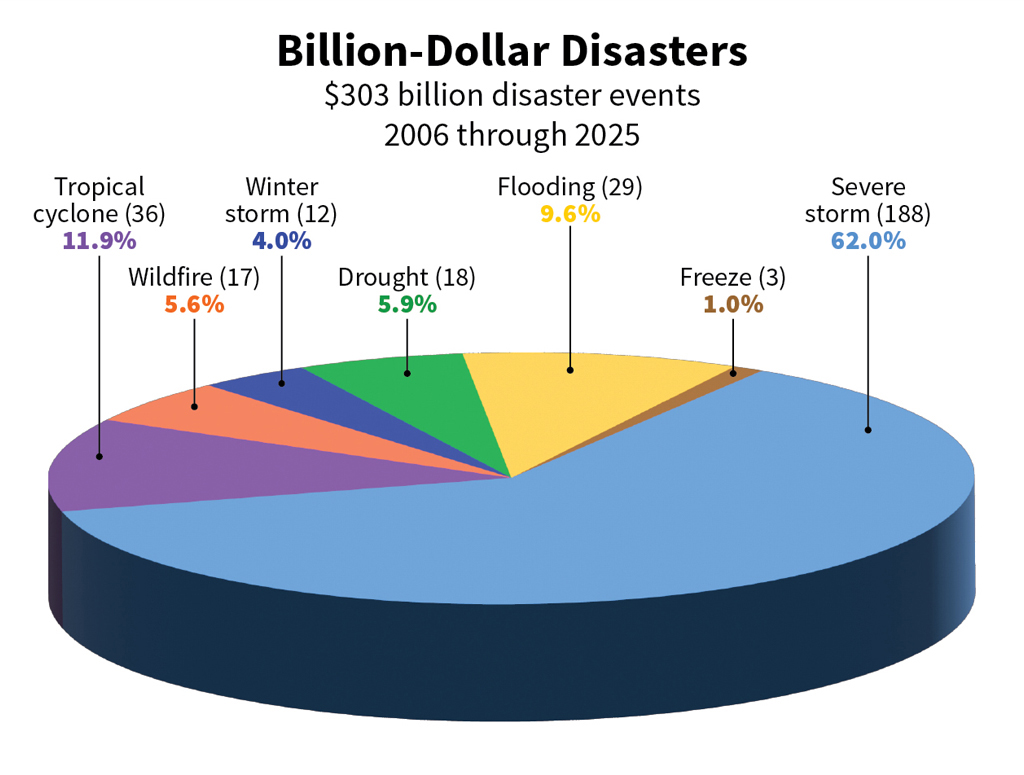
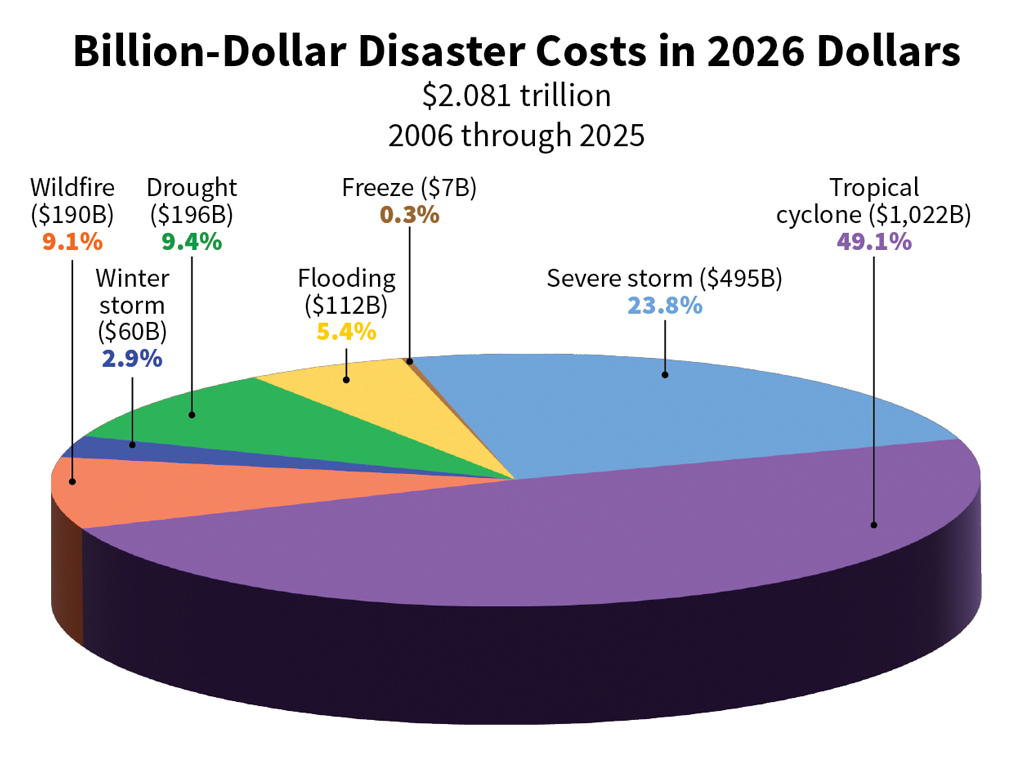
“Flood risk and climate-modeling data are becoming more available at a granular level,” said actuary Steve Kolk, CEO of Michigan-based Kolkulations, who helped draft a June 2025 Academy letter urging NOAA to preserve its Billion-Dollar Weather and Climate Disasters database. The letter said that the information helps actuaries, academics, and insurance companies inform public policy actions directly impacting consumers and communities.
After the database was eliminated in 2025 as part of Trump administration budget cuts, the nonprofit Climate Central assumed responsibility for maintaining it. The database tracks U.S. weather and climate disasters that have caused more than $1 billion in damage since 1980 and, as of March 2026, included 431 such events with total losses exceeding $3.1 trillion.
Kolk, who has chaired the Academy’s P/C Extreme Events and Property Lines Committee, has compiled pie charts from the database showing that the $303-billion weather and climate disasters occurred between 2006 and 2025, causing nearly $2.1 trillion in losses. — MGM
Shifting Footprints
SCS footprints are also shifting, Musulin said, with parts of the Midwest and Southeast experiencing more severe convective storms beyond the traditional Tornado Alley, which runs north from Texas and Oklahoma through the middle of the country.
“I think that creates some actuarial challenges, because we’re seeing more storms in places and at times of the year we didn’t used to,” he said. “And this is where the regulatory system comes in—regulators want evidence and solid numbers around these things. From an actuarial angle, we have to understand that uncertainty.”
He added that “compound events” also factor into storm-related reconstruction costs. These include high energy prices this year stemming from the Iran war, tariffs, and other geopolitical and economic factors. “That’s just another thing actuaries have got to get on their risk management radar and pay attention to,” Musulin said. (Read also, “Managing Risk in a World of Polycrisis” in the July/August 2026 issue of Contingencies.)
Regulatory Lens
For state insurance regulators, there are important financial and actuarial issues to consider with respect to SCS.
“For severe convective storms, it’s about how the actuarial community uses cat [catastrophe] models in pricing for rate adequacy and in reserving for capital adequacy,” said Wanchin Chou, chief actuary and assistant deputy commissioner of the Connecticut Insurance Department.
Chou—who chairs the National Association of Insurance Commissioners’ (NAIC) Catastrophe Risk Subgroup and is vice chair of the NAIC’s Property/Casualty (P/C) Risk-Based Capital (RBC) Working Group—said the subgroup has been reviewing SCS catastrophe models since 2023. “If everything’s running smoothly by the end of this year, we can feel comfortable adding SCS to RCAT in the 2027 RBC report,” he said.
RCAT—or the risk capital adjustment tool that reflects capital needs arising from natural catastrophes—refers to catastrophe modeling used in the insurance and finance sectors. Previous RCAT models have included hurricanes and earthquakes, and the NAIC is likely to include wildfires by the end of 2026 before potentially adding SCS next year, Chou said.
RBC is used to identify potentially undercapitalized insurers, given their overall business operations with respect to their size and risk profile. It provides a uniform capital adequacy standard across states and gives regulators a basis for timely action while reflecting the unique risks of operating an insurance company.
Chou said that state insurance regulators “review and evaluate all the popular catastrophe models from the major vendors … for different perils, including earthquakes, hurricanes, wildfires, and severe convective storms.”
Based on 100-year events—extreme events with an estimated 1% annual chance of occurring—regulators want carriers to ensure they have enough capital to prevent solvency problems if such events happen, he said.
Chou, who has served in multiple volunteer roles with the Academy—including on its Climate Change Joint Committee and the P/C Extreme Events and Property Lines and P/C RBC committees—noted that actuaries involved in SCS work need to pay particular attention to the Actuarial Standard of Practice (ASOP) No. 39, which addresses catastrophe or extreme-event losses with respect to future cost estimates.
“For SCS, it’s about how the actuarial community uses all these factors in pricing, reserving, and [assessing] capital adequacy,” he said.
Reinsurance Concerns
Reinsurance—essentially insurance for insurance companies, allowing primary insurers to transfer some of their risk exposure to a reinsurer for a premium—is also a factor, Cotality’s Kunst noted. “A lot of that is driven around by what a multiyear loss is going to be and by looking at the various layers of say, a 50-year, 100-year, or 250-year loss, and what those losses could cost,” he said. “As the return period and the number of years go up, you’re talking about more severe but less frequent events, and PMLs at various year return periods.”
Musulin also noted that reinsurance is becoming a larger part of the SCS landscape. “If you’ve got massive tornado outbreaks tearing up a lot of property in the Midwest, for example, reinsurance markets will react to that, and that could create price pressures for consumers at the end of the day,” he said.
A company operating in the Midwest probably didn’t have to consider a large reinsurance program for severe convective storms 20 years ago, Musulin said. “Now they might have to go buy a bunch of reinsurance for it, and that cost has got to get passed on to their policyholders somehow. So the reinsurance markets are relevant here—reinsurers didn’t use to pay a lot of attention to these perils, because they were focused on the big stuff, like earthquakes.”
No Longer Secondary
The experts interviewed for this article agreed that severe convective storms have outgrown their status as a secondary peril, rivaling hurricanes as the costliest insured peril of the century while remaining among the hardest to pin down. They are a collection of hazards with small footprints, short historical records, and shifting geography—compounded by rising construction costs and growing exposure in storm-prone areas.
Actuaries will play an increasingly important role in helping insurers measure risk, price products, and build resilience. Historical loss data alone no longer suffices for pricing in storm-prone regions, and PMLs once driven by hurricanes are, for many companies, now driven by severe-storm losses, with consequences for capital allocation and reinsurance costs.
As regulators move toward incorporating SCS into capital adequacy frameworks, the demand for credible modeling—and for actuaries who can interpret it—will only grow.
Understanding Your Homeowner’s Insurance Policy
While most homeowners have insurance for their dwellings, many may not understand exactly what is covered, what they’re paying for, or how to qualify for discounts on certain types of coverage.
Roof damage caused by hail is a common expense for homeowners, according to a March 2026 issue brief from the American Academy of Actuaries’ Homeowners’ Insurance Task Force. Wind and hail damage account for 45.5% of homeowner claims nationwide, the issue brief states, citing Experian. The two perils are the leading cause of roof damage claims, and the risk is rising.
It also notes that under actual cash value (ACV) coverage, insurance companies pay replacement costs minus depreciation for a roof ’s age and condition. Because losses associated with roof damage are increasing, many insurers are transitioning to ACV coverage for roofs older than 10 years, adding that “such restrictions must be clearly disclosed in the policy.”
With more use of ACV, many homeowners may not realize what they’re signing up for when they shop for the best value in homeowners insurance, said Ian Giammanco, managing director for atmospheric science and lead research meteorologist with the Insurance Institute for Business & Home Safety (IBHS), an independent, nonprofit scientific research organization supported by property insurers, reinsurers, and affiliated companies.
“We are starting to see higher deductibles, which can put more pressure on homeowners when they experience damages,” Giammanco said. “For severe convective storms, a lot of that damage involves roofs,” whether it’s hail or wind.
“The growing issue is in places where you’re having to do roof replacements two and three times within a 10-year period—those dollars are adding up,” he said. “With all the other cost pressures that homeowners deal with, it’s important to make sure you understand what’s in your policy, whether it’s ACV or if the deductible has gone up.”
Inflation Pressures
Karen Clark, CEO and co-founder of climate modeling firm Karen Clark & Co., said the onset of COVID-19 in the early 2020s “caused a lot of labor supply shortages in the construction industry.” Since then, the cost of building the same single-family home has almost doubled because of higher construction costs. combined with more development, she said, those higher costs have “been a key driver in rising claims costs, and I think many people miss that.”
Severe storm damage has also been compounded by more development in newer areas, exposing more homes to risks, said Victor Gensini, director of the Center for Interdisciplinary Research on Convective Storms and a professor of meteorology at Northern Illinois University. “There’s more societal exposure—what I call increases in the human build environment about how we build and where we build,” he said, pointing to growing development in the Interstate 25 corridor near Denver, in an area affected by severe storms. Colorado Public Radio reported that Adams County, near Denver, ranks among the top 10 U.S. counties for tornado reports, with 192 since 1950, and the state averages 45 to 50 tornadoes a year, though many are brief and relatively weak in nature.
Giammanco noted that typical homeowner insurance policies cover wind and hail damage, with flood insurance in its own special, separate category. “Most people who get flood insurance [get it] through the National Flood Insurance Program (NFIP),” he said, adding that his own home in Maryland has a basement. “I could absolutely see a big rainfall event causing some flooding in the basement, so we carry an NFIP policy.”
According to the Federal Emergency Management Agency (FEMA), flood insurance is available to anyone living in one of more than 22,000 participating NFIP communities, and homes and businesses in high-risk flood areas with mortgages from government-backed lenders are required to have flood insurance. It’s been widely reported by insurance companies and others that many FEMA flood maps are out of date.
“We’re seeing more insurers use roof age as a key indicator of future performance, because research shows it’s one of the strongest predictors of how a roof will perform in wind and hail,” Giammanco added. “On the positive side, many homeowners may not realize that when you have a higher-performing roof material like an impact-rated roof or a fortified-roof designation through IBHS’s program, in many places that qualifies you for an insurance discount … so homeowners should make sure they talk to their agent and don’t miss out on any savings they could get.”
Building materials, particularly for roofs, are key factors in home policies. “From a hail standpoint, there are good performing materials across the board,” Giammanco said. “We’ve seen really good performance from some of the new synthetic composite shingles. In IBHS hail impact testing, we have not observed metal roofing crack under hail impacts, though it can dent … A modern code metal roof is a very high-performing system,” particularly in hurricane-prone coastal areas, he added.
Tile has also come a long way as a roofing material, Giammanco said. “It’s both wind- and hail-resistant,” though it will reach its limit at very large hailstones (e.g., 2.5–3 inches). Asphalt is generally the lowest-cost roofing material, with metal about twice as expensive and tile two to three times the cost, he said. “There’s good performance across the range of costs and material types.”
Through IBHS’s fortified program, homeowners receive a digital certificate verifying that their homes meet the program’s standards, which can help them qualify for insurance discounts, “and in many places, those discounts are becoming really meaningful,” Giammanco said. “They’ve proven their worth in reducing not only claims frequency, but the total amount of claims if you have to file one.They’ll pay for themselves really quickly.”
Modeling Data
In addition to factoring in construction materials and other hazards, catastrophe modeling gives insurance carriers “that big picture of risk and vulnerability,” Giammanco said. As models become more sophisticated, insurers are collecting increasingly detailed information about individual properties. “Homes don’t have VIN numbers, but we’re starting to gather that type of data trying to know everything we can about these structures.”
In the past several decades, residential construction was considered more uniform, “but we’ve learned it’s not as cookie-cutter as we thought,” he added. Homes now incorporate a wider range of materials and structural features, in part because of evolving building codes and the choices that homeowners and builders make.
“That’s one of the critical data points for the next 10 or 20 years,” Giammanco said. “For consumers, that’s going to help across the board. One, it’s about recognizing the reduction in vulnerability for all the good materials you’ve got. And also, identifying more risk than [was] previously known.” — MGM
Climate Concerns—and Uncertainties
Several experts interviewed for this article noted the uncertainties about how climate change affects severe convective storms (SCS).
The relationship between climate change and severe convective storms is less clear-cut than it is for hurricanes, said Rade Musulin, a former Academy casualty vice president, who currently chairs the International Actuarial Association’s Climate & Sustainability Committee.
“With hurricanes, it’s quite clear that you’re seeing [stronger storms] … the scientific consensus is high. There’s a lot of uncertainty around tornadoes, hail, lightning—all those perils. They’re tricky to climate-model, because there’s a lot of opposing forces there that are confusing the issue,” Musulin said. Those forces include changes in the polar vortex—colder air that flows down from Canada into the U.S. and may spawn twisters—or, conversely, drought conditions that can suppress thunderstorm development by limiting atmospheric moisture, he added
Victor Gensini, a professor of meteorology at Northern Illinois University (NIU) and director of the Center for Interdisciplinary Research on Convective Storms (CIRCS), said that ongoing and future changes in the world’s climate may suggest stronger thunderstorm updrafts, with more heat, humidity, and energy that could lead to events like larger hailstones.
He likened hail formation—in which water droplets get kicked higher into colder parts of the atmosphere, where they freeze and often refreeze—to balancing a ping pong ball over a hair dryer. “It’s pretty easy to balance that ping-pong ball over a hair dryer,” he said. “But if you do that with a softball, you’re going to need a much bigger hair dryer.”
The analogy underscores why researchers are paying close attention to the conditions that produce larger hailstones. A CIRCS report released this summer included an image of a softball-sized hailstone that fell in March and measured 6.6 inches—a record for the state of Illinois.
“One of our research thrusts is trying to identify these ‘climate knobs,’ for lack of a better word,” Gensini said. “What’s happening with climate change that could possibly either augment or mitigate these types of events.”
Karen Clark, CEO and co-founder of climate modeling firm Karen Clark & Co., said that the Intergovernmental Panel on Climate Change (IPCC), established by the United Nations and the World Meteorological Organization in 1988, publishes periodic reports on climate issues and based on the IPCC’s latest report, there is no scientific consensus on climate change’s impact on SCS. Such a correlation would be “highly uncertain… [and] would not be supported by the scientific consensus,” she said.
“SCS activity is influenced by cyclical factors,” such as El Niño, she said. “So you could go two or three years with losses decreasing” as was the case in the early 2020s, “and then 2024 and 2025 were more active. So, if you’re just looking at a few years of data, it can look like a trend, but in reality, it’s really cyclical.”
El Niño, a naturally occurring climate pattern that typically develops every two to seven years, starts with warmer-than-average Pacific Ocean waters and can influence global weather patterns and trends, including temperatures, rainfall, and drought conditions. The most recent event occurred in 2023–2024, and NOAA’s 2026 hurricane outlook suggests conditions that El Niño could return this year.
MICHAEL G. MALLOY is managing editor for member content at the Academy.