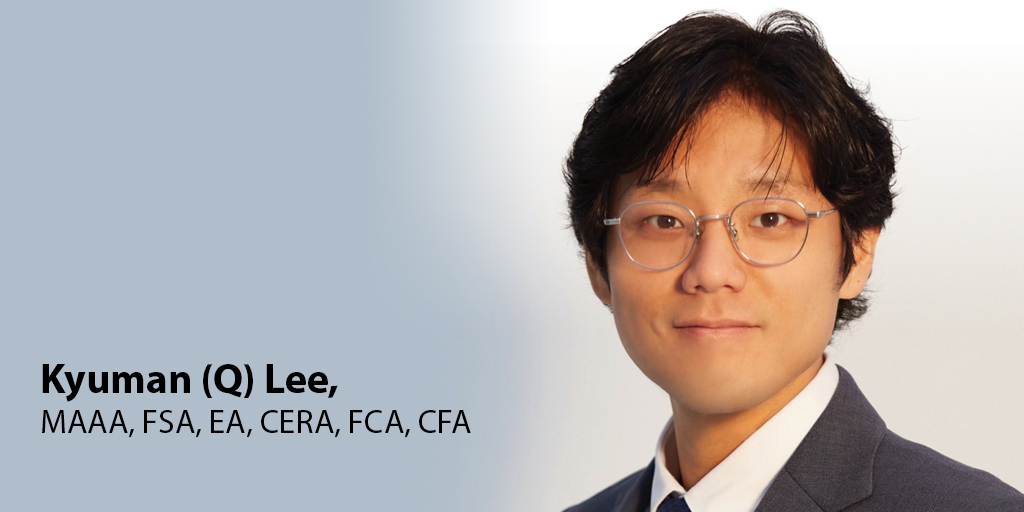
For retirement actuary Kyuman (Q) Lee, MAAA, FSA, EA, CERA, FCA, CFA, the finish line is never really the end of the race. Whether it’s earning actuarial credentials, taking on new responsibilities at work, volunteering for the Academy, or training for the World Marathon Majors, each milestone is a starting point for the next challenge. Lee didn’t set out to become an actuary. A computer science major with a knack for mathematics, he discovered a profession that combined technical rigor with business problem-solving—and never looked back. Today, as vice president of actuarial services at Hackensack Meridian Health, he applies actuarial principles to everything from retirement benefits to mergers and acquisitions while encouraging the next generation of actuaries to keep learning, embrace new challenges, and seize opportunities when they arise.
What led you to become an actuary, and what attracted you to the profession?
I often joke that I’m not sure whether I discovered the actuarial profession or if it discovered me. I started college as a computer science major at the University of Waterloo, often known as Canada’s MIT. While I found the coursework challenging, math and statistics came quite naturally to me. A few close friends suggested I look into the actuarial field, and the prospect of blending business, economics, risk management, and statistics in my daily work was incredibly appealing. I passed my first exam (Course 1) during my sophomore year, balanced both majors through my junior year, and eventually switched completely to actuarial science. Ultimately, the strong technical foundation I built in computer science has been a driving force in my career.
Describe a time when your professionalism training helped you in your career.
The concept of a self-policing profession—operating without direct legislative or administrative intervention—is both attractive and an immense responsibility. It demands a consistent, day-to-day commitment to ethical behavior. Making a habit of evaluating my own work through this ethical and quality lens is something rare in other professions, and it has undeniably made me a better professional. In addition, understanding the core purpose of these professional guides empowered me to establish similar practical frameworks for the teams I’ve led. By setting clear operational standards that required a strong rationale for any deviation, we significantly reduced the risk of rogue behaviors, such as lowballing or overpromising to clients.
Tell us about a time when your actuarial expertise influenced an important decision in your workplace.
This happens regularly. As an in-house actuary, I oversee all actuarial matters related to our benefit programs. But I’m frequently called upon for nontraditional areas, like M&A or facilities investments, for data analysis and business profitability forecasting. ASOP [Actuarial Standard of Practice] No. 23, Data Quality, in my view, is the premium standard for data quality assessment; no other profession performs data validation quite like an actuary following this standard. Similarly, the actuarial discipline of rigorously validating assumptions and producing comprehensive, well-documented reports isn’t the norm outside our profession. By simply following what actuaries consider baseline practice, I’ve earned the trust of peers and executive leadership alike and have expanded my impact well beyond traditional actuarial roles.
What’s one of the biggest lessons you’ve learned in your career?
A career is full of highs and lows, but a crisis often masks a great opportunity. I started strong as a junior consulting associate, driven by technical skills and a curiosity for reading laws and regulations. When my mentors left the firm, taking much of the client work with them, it felt like a setback. But the clients who stayed needed more from me, and my responsibilities expanded significantly. Having completed my EA [enrolled actuary] exams in my first year, and earning the designation as soon as I met the experience requirements, meant I was ready when that opportunity arrived. The lesson: Endure the process, pursue growth. But more importantly, prepare yourself so that when opportunity comes, you’re ready to take it.
“The MAAA is a symbol of professional qualification—a key to an expansive library
of actuarial resources, and a membership in
an organization that champions meaningful actuarial causes across the country.“
What advice do you wish you were given at the beginning of your career?
Keep your technical skills broader than Excel and VBA [Visual Basic Applications]. Losing touch with other tools is my biggest professional regret, and it would have helped me stay ahead of the AI [artificial intelligence] wave. And explore beyond retirement! Health actuarial work is dynamic and full of potential. Strive to become a well-rounded benefits expert rather than confining yourself strictly to retirement. You can learn about much more than just retirement!
What do you value most about your Academy membership or volunteer work?
I am incredibly thankful to serve as a volunteer on the Academy’s Retirement Policy and Design Evaluation (RPADE) Committee. Every moment spent with the RPADE committee has been a profound learning experience. The depth, breadth, and sheer diversity of viewpoints among the committee members constantly fascinate and inspire me.
What is the value of your MAAA?
The MAAA is a symbol of professional qualification—a key to an expansive library of actuarial resources, and a membership in an organization that champions meaningful actuarial causes across the country.
Would you like to share anything else with aspiring or new actuaries, or those interested in volunteering for the Academy?
To aspiring and new actuaries: Take your exams seriously, not just because you have to. I’ve seen too many actuaries treat sponsored exam time as an obligation rather than a privilege, and let work quality slip in the process. Juggling competing priorities is hard, but everyone does it. Also, earning your FSA or MAAA is not a finish line. It opens a door to opportunities that require skills your exam journey never covered. Keep the learning momentum going, especially around business acumen and emerging tools.
To those considering volunteering for the Academy: I was on the fence, and I’m glad I took the leap. You won’t regret it. Just do it!
Beyond work—what are your hobbies or personal interests?
I’m a runner. Every morning, I’m out the door, and throughout the year, I race everything from 5Ks to marathons. Running has become such a core part of my life that I’ve convinced my wife to plan our family vacations around the World Marathon Majors. We’re heading to Berlin this fall and Tokyo next spring—with London, Sydney, Boston, and Chicago still on the list.
Help Us Highlight Exceptional Members
Do you know a talented Academy member we should profile? We’re looking for members who are making an impact in their practice areas, contributing to the profession, or inspiring others through their work or volunteer activities. Tell us about them at [email protected].