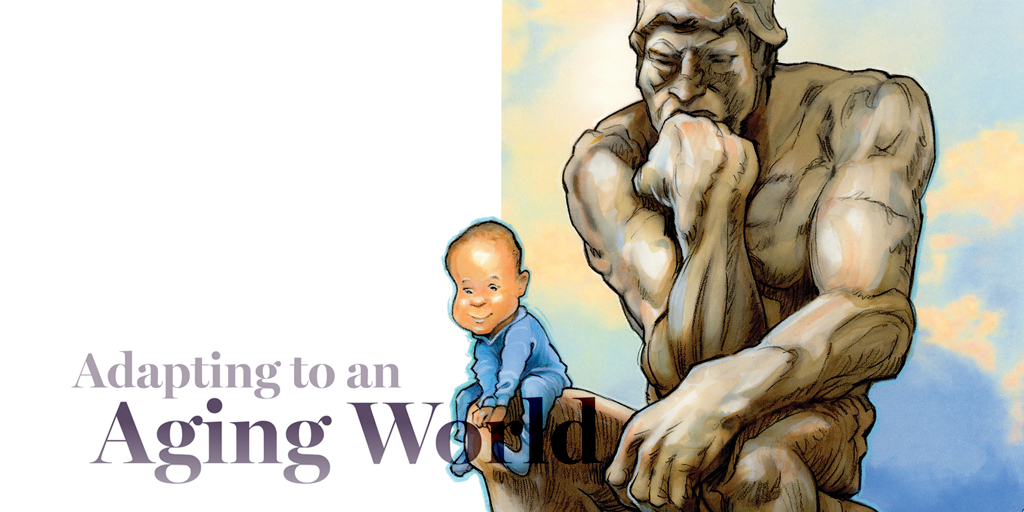
Low fertility may be harder to reverse than policymakers hope. Aging societies need to build systems resilient enough for the demographic future that is taking shape.
By Xinyi (Cindy) Hu
On a recent trip back to China, I noticed something that seemed minor at first glance but hinted at a much larger story: empty kindergartens. Some were quiet; others appeared underused, as if built for a future that had already been revised downward.
For actuaries, that is not just a social observation. It is a leading indicator.
Low birth rates first show up in maternity wards, then daycare centers, then kindergartens. A few years later, the pressure reaches K–12 schools. Then universities. Then employers. Eventually, it reaches pension systems, health care, long-term care, public finance, and the assumptions sitting inside models that were designed for a very different age structure.
For decades, governments have tended to treat low fertility as a trend to reverse1, largely because a shrinking future workforce can strain pay-as-you-go retirement systems, reduce economic dynamism, intensify fiscal pressure, and change the social contract between generations. But the evidence increasingly suggests that higher birth rates may be much harder to engineer than policymakers hope.2
It may be time to borrow a concept from another global risk: climate adaptation. Climate policy has not abandoned mitigation. But as the odds of avoiding significant warming have narrowed, the world has increasingly accepted that reducing emissions must be paired with adaptation3: sea walls, heat-resilient cities, drought planning, insurance redesign, and climate-resilient infrastructure. According to United Nations Environment Programme’s 2025 Emissions Gap Report, current pledges still leave the world on course for roughly 2.3°C to 2.5°C of warming this century, while current policies point toward as much as 2.8°C. The report also says that exceeding 1.5°C is very likely within the next decade.4
Demographics deserve a similar shift in mindset. Pro-natal policy can still have a role. But aging societies should no longer be treated as a temporary deviation from a normal path. In many countries, aging is the path.
The Limits of Buying Births
Around the world, governments are trying to make parenthood more affordable through policies such as child care subsidies, child benefits, paid parental leave, and direct support for childbirth and child-rearing.5 These policies are valuable. They reduce hardship, recognize caregiving’s economic contribution, and may help families who already want children have them sooner or reach their intended family size.6
But the more important public policy question is this: Can these incentives raise fertility enough to change the demographic trajectory?
The answer is far from clear.
Hungary offers one of the clearest tests of whether generous pro-natalist policy can reverse demographic decline.7 Over the past decade, the government has introduced an expansive package of family supports, including tax exemptions, subsidized loans, housing assistance, and other benefits aimed at encouraging larger families.8 Yet after earlier gains, Hungary’s fertility rate fell again in 2024, to roughly 1.38 children per woman, down from 1.51 in 2023, according to Hungary’s statistical data and demographic analysis.9 The reversal is important because Hungary is often cited as one of the world’s most ambitious experiments in financial pro-natalism. If such an extensive package struggles to produce a durable rebound, it raises doubts about whether less generous programs elsewhere can meaningfully change long-term fertility.
Such programs may help many households. But a benefit that supports families is not the same as a benefit that reverses national fertility decline.
One reason is that cash incentives often reach families who were likely to have children anyway.10 These policies may shift the timing of births, ease some of the direct costs of raising children, or encourage second and third births at the margin.11 Those are meaningful outcomes. Yet they are not necessarily enough to push fertility back toward replacement level, especially when the underlying reasons for remaining childless or having fewer children are not purely financial.
Pew Research Center’s 2024 survey of U.S. adults without children illustrates the point.12 Among adults under 50 who do not have children and say they are unlikely to ever have them, 57% said a major reason is that they simply do not want children. Other leading reasons included wanting to focus on other things, concerns about the state of the world, and affordability. Affordability matters—but it ranked behind several reasons that are far more difficult for policymakers to influence.
None of this means economics is irrelevant. Housing, child care, job insecurity, health care costs, and work-life balance all shape family decisions. A society that makes parenting easier may be more effective than one that simply offers cash transfers.13 But even generous support runs up against a deeper reality: Parenthood is increasingly viewed as a personal choice, rather than a default life stage.14
That is a profound cultural shift. It cannot be reversed by a tax credit alone.
A demographic adaptation agenda would not mean giving up on families. Quite the opposite. It would mean reframing family policy to support choice, opportunity, and dignity rather than treating every birth as a unit of national production.
The Trend Is No Longer Limited to Developed Countries
Low fertility was once discussed mainly as a problem of rich countries: Japan, Italy, Germany, South Korea. That framing is now outdated.
India, long associated with concerns about overpopulation, has seen fertility fall to roughly two children per woman, with UNFPA India emphasizing the country’s sharp decline from nearly five children per woman in 1970 to about two today.15 China, once the world’s most populous country, is now shrinking. Reuters reported that China’s population fell for a fourth consecutive year in 2025, as births dropped to 7.92 million and fertility remained among the world’s lowest, at around one birth per woman.16 South Korea shows how far the trend can go. Its fertility rate rose from 0.75 in 2024 to 0.80 in 2025, but that still leaves it far below replacement and among the lowest in the world.17
The United States is somewhat different because immigration has helped sustain population growth despite below-replacement fertility. The U.S. Census Bureau reported that net international migration accounted for 84% of U.S. population growth between 2023 and 2024, accounting for 2.8 million of the nation’s total population increase of 3.3 million.18 But immigration cannot be a universal solution. If many countries plan to import younger workers to offset aging, the obvious question is: Where will they come from?
As far as I know, we are not receiving immigrants from other planets.
Jokes aside, the global picture is one of widespread fertility decline. Pew Research Center, summarizing UN data, notes that fertility rates have declined in every world region since 1950, and that Asia, Latin America and the Caribbean, Northern America, and Europe are already below replacement level.19
Some theories suggest fertility may rebound at very high levels of human development.20 That remains possible in some places. But the world’s richest societies do not yet provide much evidence that prosperity alone restores replacement-level fertility. Across the OECD, fertility averaged only 1.5 children per woman in 2022, well below replacement level, and Israel was the only OECD country above replacement fertility.21
From Reversal to Resilience
A demographic adaptation agenda would not mean giving up on families. Quite the opposite. It would mean reframing family policy to support choice, opportunity, and dignity rather than treating every birth as a unit of national production.
Paid leave, child care, maternal health care, fertility treatment access, flexible work, and housing affordability are worth pursuing because they improve people’s lives and make it easier for those who want children to have them under healthier, more secure, and more supportive conditions.22 They may raise fertility somewhat. But they should not be the only pillar of demographic strategy.
The larger task is to redesign institutions for an older age structure.
That begins with pension reform. Many retirement systems were built for eras with more workers per retiree, shorter retirements, and faster labor-force growth.23 Those assumptions are weakening, and rapidly aging populations are expected to continue putting pressure on pension systems.24 Policymakers will need to consider automatic stabilizers, later and more flexible retirement ages, better coverage for nontraditional workers, and benefit formulas that are sustainable across generations.
It also means keeping older adults in the workforce longer—but not simply by asking them to work longer. Longer working lives require age-friendly workplaces, retraining, ergonomic design, phased retirement, enforcement of age-discrimination laws, and health systems that preserve functional capacity rather than merely treating illness after it appears.25
Health care and long-term care may be the most urgent adaptation frontier. Aging societies will need more caregivers, more home- and community-based care, better dementia planning, improved chronic disease management, and financing models that recognize long-term care as a predictable social risk.26 This is an area where actuarial expertise is especially important: the liabilities are long-duration, correlated, politically sensitive, and highly exposed to morbidity trends.
Cities and housing will also need to change. An aging society needs more accessible housing, safer sidewalks, reliable public transportation, mixed-use neighborhoods, and designs that reduce isolation.27 Many countries built suburbs for young families with cars. Today, they need communities that work for older adults living alone, older couples, multigenerational households, and caregivers moving between work and family obligations.
Technology will matter, but it should not be treated as magic. China offers one example: As its workforce ages, Beijing is investing heavily in AI and robotics, including plans to use robots in sectors facing labor shortages and to expand industrial automation.28 Automation, artificial intelligence, robotics, and productivity-enhancing tools can help societies cope with fewer young workers by raising output per worker and supporting overstretched sectors.29 But productivity gains do not distribute themselves evenly30, and technology cannot replace every human function. This is especially true in care work, where trust, judgment, emotional presence, and intimate knowledge of individual needs remain central.31
Immigration should remain part of the toolkit, particularly for countries able to integrate newcomers successfully and ethically. The United States is a useful example: Despite recurring political backlash, it has historically been unusually successful at absorbing immigrants and their children into its economy, schools, and civic life.32 Recent U.S. policy, however, has moved in a more restrictionist direction, with the Trump administration expanding immigration enforcement, limiting asylum access, and threatening action against local officials who resist federal immigration measures.33
That tension illustrates why migration policy must be strategic rather than merely reactive. Immigration can help aging societies buy time by adding workers and slowing population decline, but it also intersects with housing, education, labor markets, credential recognition, and social cohesion.34 And because fertility decline is becoming more widespread globally, migration cannot by itself solve aging; it can ease demographic pressure in receiving countries, but it must be paired with broader reforms in work, care, housing, productivity, and integration policy.35
Finally, demographic adaptation must include intergenerational fairness.36 Younger workers cannot be expected indefinitely to finance promises made under outdated demographic assumptions. Older adults cannot be treated as a burden after contributing for decades. Families with children should be supported without stigmatizing those without children. And people without children will still need care networks, financial security, and social belonging in old age.
An Actuarial Problem Hiding in Plain Sight

Actuaries are trained to think in long horizons, adverse scenarios, compounding effects, and systems under stress. Demographic change is exactly that kind of problem. The risk is not that one year’s fertility rate disappoints. The risk is that institutions continue to price, fund, and govern themselves as if the traditional population pyramid will reappear on its own.
Aging is not a shock in the conventional sense. It is slow, visible, and measurable. That makes inaction harder to excuse. We can see the kindergarten closures before the university consolidations. We can see the smaller incoming labor cohorts before the pension strain peaks. We can see the future dependency ratios long before they arrive.
Climate adaptation teaches a useful lesson: mitigation and adaptation are not opposites. They are complements. Likewise, supporting families and adapting to aging should not be opposing camps. Governments can help people have the children they want while also preparing for a future in which fertility remains low.
The uncomfortable truth is that a population rebound may not arrive on schedule. Some countries may experience modest recoveries. Some policies may work better than expected. Cultural norms may shift again. But hope is not a funding strategy, and optimism is not a demographic model.
An aging society is not necessarily a failing society. It can be healthy, productive, innovative, and fair. But it will not become those things automatically.
The next stage of demographic policy should start with a simple premise: Low fertility may be partially responsive to policy, but aging is already here. The task is not only to ask how many children might be born tomorrow. It is to build systems capable of serving the people who are alive today—and the smaller generations already moving through the pipeline.
In other words, it is time to move from demographic reversal to demographic resilience.
XINYI (CINDY) HU, MAAA, ASA, is an actuarial associate at Mutual of Omaha specializing in Medicare Supplement and Group Insurance. She can be reached at [email protected].
Endnotes
- “World Population Policies 2021: Policies Related to Fertility”; United Nations Department of Economic and Social Affairs, Population Division; 2021.
- “Why Paying Women to Have More Babies Won’t Work”; The Economist; May 23, 2024.
- “Climate Change 2023: Synthesis Report”; Intergovernmental Panel on Climate Change; 2023.
- “Emissions Gap Report 2025: Off Target—Continued Collective Inaction Puts Global Temperature Goal at Risk”; United Nations Environment Programme; 2025.
- “Society at a Glance 2024: OECD Social Indicators”; OECD Publishing; 2024.
- Ibid.
- “Viktor Orbán’s Pro-Natalist Policies Are Not Working”; The Economist; March 19, 2026.
- “Vital Events, December 2024”; Hungarian Central Statistical Office; Jan. 31, 2025.
- Ibid.
- “Policy Responses to Low Fertility: How Effective Are They?”; United Nations Population Fund; 2019.
- Ibid.
- “The Experiences of U.S. Adults Who Don’t Have Children”; Pew Research Center; July 25, 2024.
- “Can Policies Stall the Fertility Fall? A Systematic Review of the (Quasi-)Experimental Literature”; Population and Development Review; 2021.
- “The Experiences of U.S. Adults Who Don’t Have Children”; Pew Research Center; July 25, 2024.
- “UNFPA India Press Release | State of World Population Report 2025”; United Nations Population Fund India; June 10, 2025.
- “China’s Population Drops for Fourth Year as Fewer Babies Born”; Reuters; Jan. 18, 2026.
- “South Korea’s Birthrate, the World’s Lowest, Rises Again Amid Signs of Easing Demographic Crisis”; Reuters; Feb. 24, 2026.
- “Net International Migration Drives Highest U.S. Population Growth in Decades”; U.S. Census Bureau; Dec. 19, 2024.
- “5 Facts About Global Fertility Trends”; Pew Research Center; Aug. 15, 2025.
- “Advances in Development Reverse Fertility Declines”; Nature; 2009.
- “Society at a Glance 2024: OECD Social Indicators”; OECD Publishing; 2024.
- “The Real Fertility Crisis: The Pursuit of Reproductive Agency in a Changing World”; United Nations Population Fund; 2025.
- “Pensions at a Glance 2025: OECD and G20 Indicators”; OECD Publishing; 2025.
- “Rapidly Ageing Populations Will Continue to Put Pressure on Pension Systems”; OECD; Nov. 27, 2025.
- “OECD Employment Outlook 2025: Can We Get Through the Demographic Crunch?”; OECD Publishing; 2025.
- “Ageing and Long-Term Care”; OECD.
- “Global Age-Friendly Cities: A Guide”; World Health Organization; 2007.
- “China’s New Five-Year Plan Calls for AI Throughout Its Economy, Tech Breakthroughs”; Reuters; March 4, 2026.
- “G20 Background Note on the Implications of Aging and Migration on Growth and Productivity”; International Monetary Fund; July 2025.
- “The Impact of Artificial Intelligence on Productivity, Distribution and Growth: Key Mechanisms, Initial Evidence and Policy Challenges”; OECD Publishing; 2024.
- “What Are the Most Pressing Challenges and Significant Opportunities in the Use of Artificial Intelligence to Provide Physical and Emotional Care to People in Need?”; Stanford University, One Hundred Year Study on Artificial Intelligence; 2021.
- “The Integration of Immigrants into American Society”; National Academies Press; 2015.
- “Trump Steps Up Immigration Crackdown, Warns City, State Officials Against Interference”; Reuters; Jan. 22, 2025.
- “Indicators of Immigrant Integration 2023: Settling In”; OECD Publishing; 2023.
- “The Fiscal Impact of Population Ageing: How Can We Afford Getting Older?”; OECD ECOSCOPE; Nov. 7, 2025.
- “Setting the Scene: Demographic Change, Economic Growth and Intergenerational Inequalities”; In OECD Employment Outlook 2025: Can We Get Through the Demographic Crunch? OECD Publishing; 2025.