Retirement Symposium Spotlights What’s Ahead

The Academy’s Retirement Practice Council (RPC) held a successful symposium on Sept. 23 in Washington, D.C., covering a wide range of retirement-related issues, including Social Security’s solvency, gaps in access to retirement savings and lifetime income, and options for sustaining employer defined benefit (DB) plans.
Toward a Sustainable Retirement System: Choices That Shape the Future brought together federal policymakers, retirement experts, and actuaries to explore public policy options.
“Election Day is less than six weeks away, and promises to re-shape dialogues on retirement and other policy issues over the coming months and years,” said Academy Retirement Vice President Bruce Cadenhead, opening the event. “The 120th Congress and new state legislatures will bring fresh opportunities to advance work on the many pressing needs of the public, employers, plans and public programs, and other retirement stakeholders.”
EBSA’s Szapiro Offers Perspective on Retirement Policy
Aron Szapiro, senior ERISA program advisor in the Labor Department’s Employee Benefits Security Administration (EBSA), delivered the opening keynote address, discussing retirement plan sponsorship, efforts to promote in-plan lifetime income, and EBSA’s 2027 priorities. He discussed EBSA’s role in the retirement system, its role in the current administration, and encouraged actuaries “to keep giving us thoughtful comments on rulemakings.”
Sessions included:
▶ Employer retirement programs—How policy frameworks help balance retirement programs retirement security objectives with employer cost constraints. This panel, moderated by RPC Pension Committee Chairperson Grace Lattyak, featured Chantel Sheaks, principal, Mindset; Anne Henderson, participant and plan sponsor advocate, Pension Benefit Guaranty Corporation (PBGC); and RPC Multiemployer Plans Committee Vice Chairperson Susan Boyle.

▶ Addressing the retirement gap—Who is doing well in the current system, who is being left behind, and what solutions can better support workers and retirees? This panel was moderated by RPC Co-Vice Chairperson Connie Rydberg and featured Barbara Marder, CEO of the Employee Benefit Research Institute; and RPC Defined Contribution Subcommittee Chairperson Spencer Look and Vice Chairperson Jay Hines.
▶ Social Security’s durability—What options could help sustain the program as its trust funds face projected depletion between 2032 and 2034? The session was moderated by RPC Social Security Committee Chairperson Sam Gutterman and featured Ron Gebhardtsbauer and Richard Jackson, president of the Global Aging Institute.
▶ Research and retirement policy—What can research tell us about why more retirees do not choose lifetime income options? Academy Director of Research Steve Jackson and Lattyak presented preliminary Academy research and discussed its policy implications, with Cadenhead serving as moderator.
The symposium was followed by a reception for attendees to mingle, network, and recap the day’s highlights. See more photos on the Academy’s LinkedIn page.

VP Corner
Symposium, Papers Address Key Issues
Bruce Cadenhead
Vice President, Retirement
As noted in this issue’s lead story, the RPC retirement symposium was a success—offering insight into the current retirement landscape, who it’s working well for and who may be falling short, and examining policy options for improving retirement outcomes.
As mentioned above, the symposium touched on several RPC top priorities—spanning a focus on federal programs and initiatives from Aron Szapiro to concerns that employers and employees continue to wrestle with to the very real problem of solvency in the Social Security program. As the Academy continues to engage on all of these fronts and looks to emphasize our role in tying research and academics with policy solutions, there is a lot to do as we head into another presidential election cycle.
In line with the RPC’s top priorities for 2026, the Social Security Committee has been actively highlighting the state of the program as well as policy options to avert the system’s projected insolvency, with a new paper released this month on evolving family structures (see story, this issue). Earlier this year the committee released an update to our popular issue brief on the need to reform Social Security sooner rather than later. The committee has produced a number of papers in recent years—some in conjunction with other RPC committees—including on noncovered workers, retirement and gig workers, the significance of the Social Security Trust Fund, Social Security and the financially disadvantaged, and individual equity and social adequacy. Another paper examined immigration and Social Security. As policymakers are increasing their focus on Social Security, all these papers are intended to serve as valuable resources.
Our other committees have also been hard at work influencing the understanding of and the likely evolution of the retirement system here in the U.S. For example, another new policy paper examines whether there is a “retirement crisis” and for whom, which was a major focus of the symposium (see story, this issue). Look for a webinar later this year that will continue the Academy’s conversation around the options for reforming PBGC premiums in support of revitalizing the role of defined benefits plans. As the population ages, while many Americans are simultaneously feeling financially less secure, the RPC will continue to examine the various policy choices that attempt to address these challenges.
Understanding the U.S. Retirement ‘Crisis’ Debate
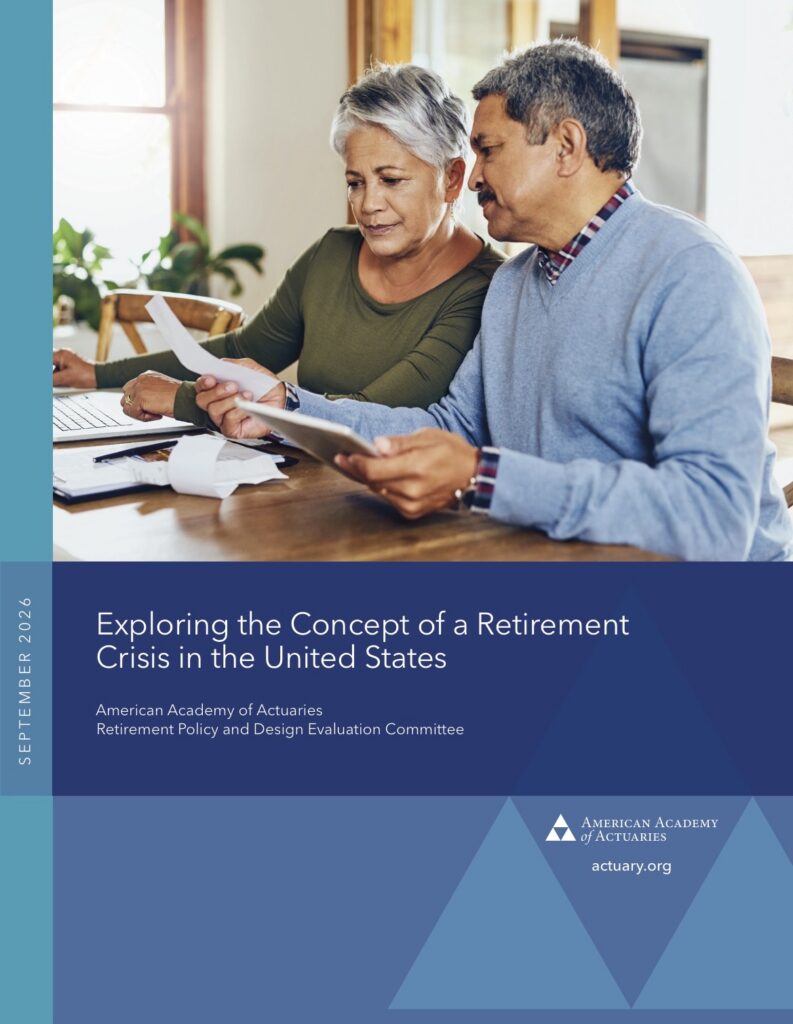
A new retirement policy paper, Exploring the Concept of a Retirement Crisis in the United States, covers the issue of whether Americans are financially prepared for retirement—a topic of ongoing debate and discussion among policymakers, stakeholders, and researchers. An executive summary of the paper is also available.
Many believe that a concerning percentage of workers and households are not on track for a financially secure retirement, labeling the current state of retirement in the U.S. a “retirement crisis.” Others argue that the word “crisis” is a misnomer, contending that while some identifiable groups are at risk of financial insecurity in retirement, the current retirement system—including existing safety nets—is generally working well and is better than ever in many respects.
It also covers:
▶ Potential depletion of the Social Security Old-Age and Survivors Insurance (OASI) Trust Fund by 2032, which could result in sharp reductions in Social Security benefits;
▶ The long-term shift in private-sector plans from traditional defined benefit (DB) pension plans to defined contribution (DC) plans, which has transferred much of the responsibility for saving, investing, managing longevity risk, and drawing down assets from employers to individuals; and
▶ Gaps in workplace plan access and participation, especially among part-time workers, gig workers and other nontraditional workers, small-business employees, lower-paid workers, and workers of color.
What Actuaries Should Know About the Social Security Trustees Report
The 2026 Social Security Trustees Report was released in June, and an Academy alert (member login required) offers insights and an overview.
The report stated the Old-Age and Survivors Insurance (OASI) Trust Fund will be able to pay 100% of scheduled benefits until the fourth quarter of 2032, one quarter earlier than projected in last year’s report. Reserves will then become depleted, and continuing program income will be sufficient to pay 78% of scheduled benefits. Social Security’s Disability Insurance (DI) Trust Fund is projected to be able to pay 100% of scheduled benefits through at least 2100.
SSA Officials Discuss Trustees Report
The RPC hosted a webinar featuring senior Social Security Administration actuaries discussing the 2026 Trustees Report and the program’s financial outlook. Presenters included SSA Chief Actuary Karen Glenn; Daniel Nickerson, head of trust fund operations and proposal estimates in SSA’s actuarial services division; and Jason Schultz, SSA head of actuarial operations. RPC Social Security Committee Chairperson Sam Gutterman moderated. Watch a replay on Academy Learning.
Get the 2026 Social Security Trustees Report at a Glance
The Social Security Committee released a one-page infographic highlighting key findings from the Trustees Report, including information on the program’s financials and economics, impacts on the public and what can be done going forward to keep the popular program solvent. Look for an issue brief on the report coming soon.
The committee also submitted comments in August to the Senate Finance Committee in response to its request for comments on establishing a nonpartisan commission to develop recommendations for Social Security reform to address the program’s long-term solvency.
What Evolving Family Structures Mean for Social Security
A September policy paper from the Social Security Committee, Evolving Family Structures and Social Security, covers key demographic and social trends since the inception of the program in 1935, including declining marriage and rising divorce rates, growing cohabitation, more unpartnered individuals, and a widespread shift to two-income households.
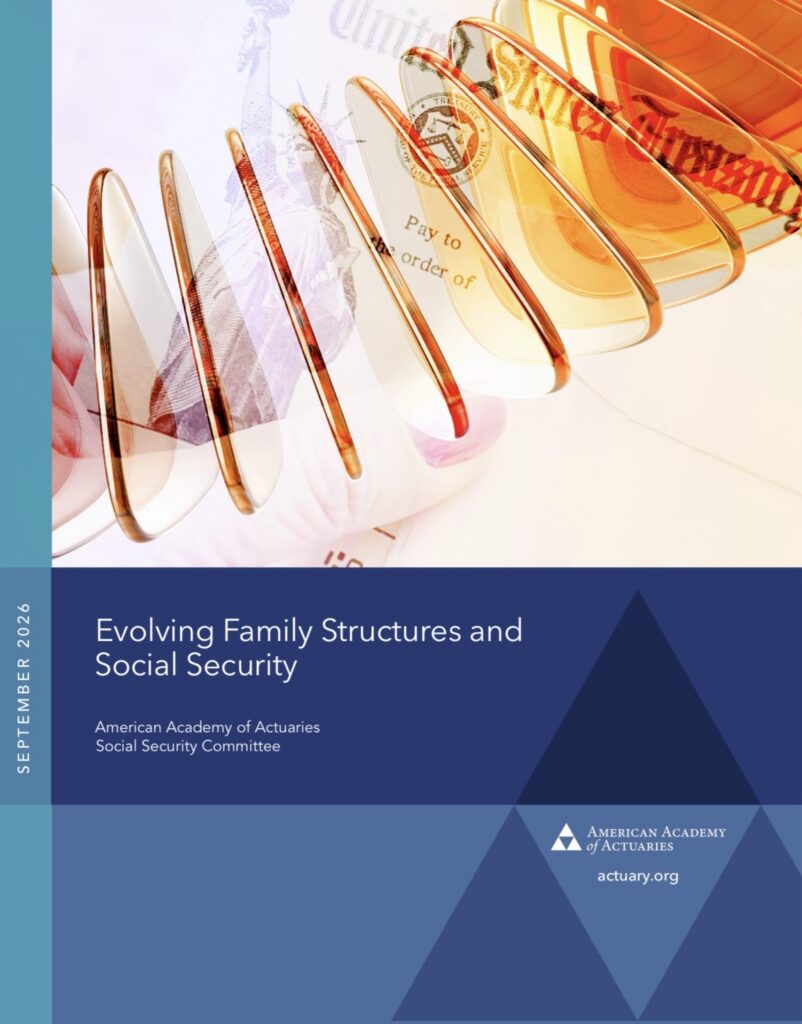
Noting the shifts have significant implications for equity within the Social Security program, the paper also notes that caregiving responsibilities—particularly for children and aging parents—continue to fall disproportionately on women, often reducing their lifetime earnings and Social Security benefits. Additionally, while life expectancy has increased, gains in healthy life expectancy have lagged, leaving many retirees with longer periods of illness and greater healthcare costs, which can make benefits increasingly inadequate for many older retirees.
It examines various approaches to address concerns regarding some of the significant evolving family structures that have been proposed, noting that in any reform, both current and future family structures should be considered.
JBEA Seeks Applications for Actuarial Examinations Advisory Committee
The Joint Board for the Enrollment of Actuaries (JBEA) is seeking applications for the next term of its Advisory Committee on Actuarial Examinations, which will run from March 1, 2027, through Feb. 28, 2029. The committee plays an integral role in the JBEA’s examination program by assisting in offering examinations that enable examination candidates to demonstrate the knowledge necessary to qualify for enrollment.
Applications are being accepted through Dec. 4—interested individuals can find application instructions in the IRS webpage notice.
RPC Agency Visit With CRS
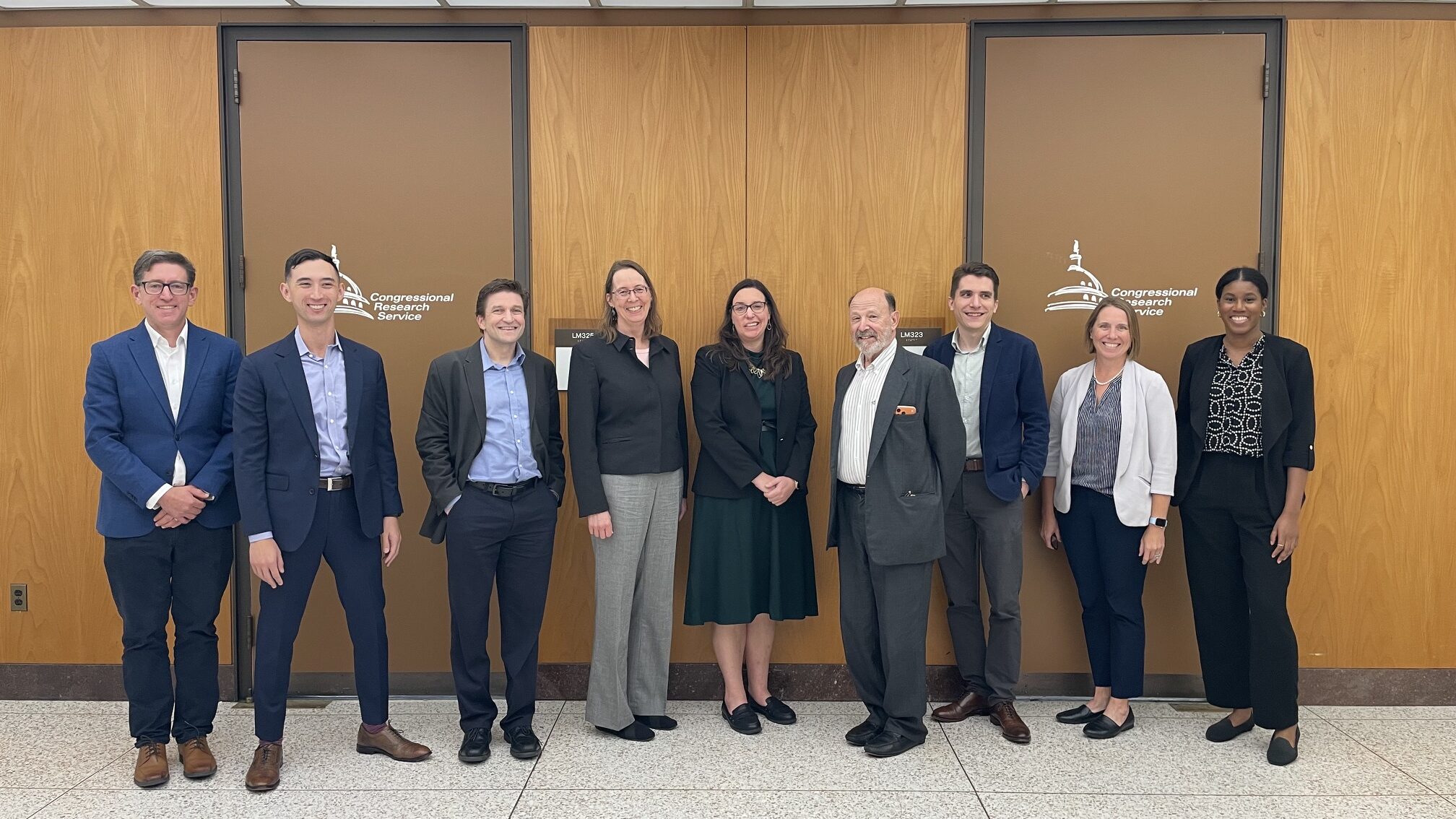
RPC volunteers and Academy staff met with Congressional Research Service (CRS) officials on Sept. 22, discussing retirement policy issues including defined benefit and defined contribution plans, multiemployer plans, lifetime income issues, and Social Security solvency.
Highlights From
Retirement Report

Prefer watching the news? Check out this “Highlights From Retirement Report” video for a quick recap of what you need to know.
Retirement Actuaries—
Join the Academy Team
The Academy is currently recruiting for two senior actuary roles, including a retirement actuary as well as a casualty & risk management actuary. The role supports the Academy’s public policy efforts, deepens on-staff actuarial knowledge, and enhances professionalism and member-value initiatives. If you’re interested in joining the Academy team or have a recommendation, please check out the listing. Or, if you have questions, feel free to reach out to Academy Senior Director for Public Policy Geralyn Trujillo ([email protected]).
Insights on Gig Workers and Retirement Security
An Actuarially Sound blog post highlighted the issue brief on gig workers and retirement security, drawing on the joint policy paper from the Social Security Committee and the Retirement Policy Design and Evaluation Committee, sharing how the Academy is informing public policymakers about the issue.
Retirement News in Brief
The Retirement Policy and Design Evaluation Committee and the Defined Contribution Subcommittee submitted comments to EBSA on the agency’s proposed rule on fiduciary duties.
The Pension Committee submitted comments to the IRS on the 2026–2027 Priority Guidance Plan suggesting areas of focus that include the Employee Plan Compliance Resolution System.
Academy in the News
A retirement planning discussion on talk radio station KSL-AM (Salt Lake City) used data from the Actuaries Longevity Illustrator, sponsored jointly by the Academy and the Society of Actuaries, to illustrate longevity risk. The discussion drew on a New York Times story that also ran in the Seattle Times. The illustrator was also featured in a USA TODAY personal finance column and a Barron’s story on retirement planning.
Radio station KGO-AM (San Francisco) pointed listeners to the Academy’s website for information on Social Security reform options, and a WZRR-FM (Birmingham, Ala.) talk radio segment on Social Security’s financing challenges extensively cited the Academy’s work in this area.
Yahoo! Finance’s reporting on an estimate of the annual Social Security cost-of-living adjustment includes a link to the Academy’s Social Security Challenge.
A guest discussing public pension plan funding ratios on WIND-AM (Chicago) noted the Academy’s The 80% Pension Funding Standard Myth issue brief.
A Plan Sponsor article on managing retirement spending in the defined-contribution environment cited annuity payout options described by the Academy.
Legislative/
Regulatory Activity
Federal
President Trump issued an executive order creating the “Trump IRA,” a portable retirement option that includes a $1,000 matching contribution for eligible workers. It is aimed at independent contractors and self-employed workers without access to a retirement savings plan.
The House approved HR 8884, legislation that reauthorizes the Social Security Administration’s (SSA’s) authority to carry out demonstration projects within the Social Security Disability Insurance program through 2031. The bill also imposes requirements related to beneficiary income, project funding, and SSA reporting.
The PBGC issued a notice of proposed rulemaking (NPRM) regarding policies for calculating, imposing, and waiving monetary penalties to pension plans for failure to provide certain required notices.
The PBGC released an NPRM proposing to improve its rules on recoupment of benefit overpayments under PBGC’s insurance program for single-employer terminated plans overseen by PBGC. It proposes changing the recoupment methodology to a flat rate of 5% of a participant’s monthly benefit. The comment period closed on Sept. 4.
Sen. Richard Durbin of Illinois introduced S 4979, legislation that calls on the Social Security Advisory Board to develop recommendations and legislative language to ensure the solvency of Social Security.
Sen. Ron Wyden of Oregon sponsored S 5040, a measure that imposes limitations on high-income taxpayers with retirement account balances in excess of $10 million.
Rep. Lateefah Simon of California sponsored HR 9415, legislation that increases Social Security benefits for current and future beneficiaries.
Rep. Scott Perry of Pennsylvania introduced HR 9792, a bill that allows employee stock ownership plan participants to benefit from the full amount of beneficial ownership in their plan while also saving for retirement in a defined contribution plan.
Rep. Mike Lawler of New York introduced HR 9750, legislation establishing a cap on income taxes on certain pensions. Individual filers will pay no more than $10,000 in federal taxes each year, while joint returns would be limited to $20,000.
Rep. Mary Gay Scanlon of Pennsylvania sponsored HR 9763, which amends title II of the Social Security Act to increase survivors benefits for disabled widows, widowers, and surviving divorced spouses.
State
Illinois Gov. JB Pritzker signed the following retirement savings-related bills into law:
▶ SB 1454, requiring Illinois municipalities with populations of 500,000 or more to automatically enroll eligible employees in eligible deferred compensation plans by Jan. 1, 2027.
▶ SB 2872, amending the Illinois Insurance Code to require insurers to include updated nonforfeiture contract provisions and disclosures for individual deferred annuities when payments cease.
Colorado Gov. Jared Polis signed HB 26-1026, requiring the state’s public employees’ retirement association to include options for employees to make tax-deferred voluntary contributions and Roth voluntary contributions.
South Carolina Gov. Henry McMaster signed S 420, authorizing political subdivisions’ qualified retiree post-employment benefits trusts to invest in U.S. corporate debt only if instruments hold an investment-grade rating by at least two nationally recognized rating organizations.
Louisiana Gov. Jeff Landry signed SB 10, updating the Louisiana State Police Retirement System’s employer contribution framework and the Permanent Benefit Increase funding account mechanics.