
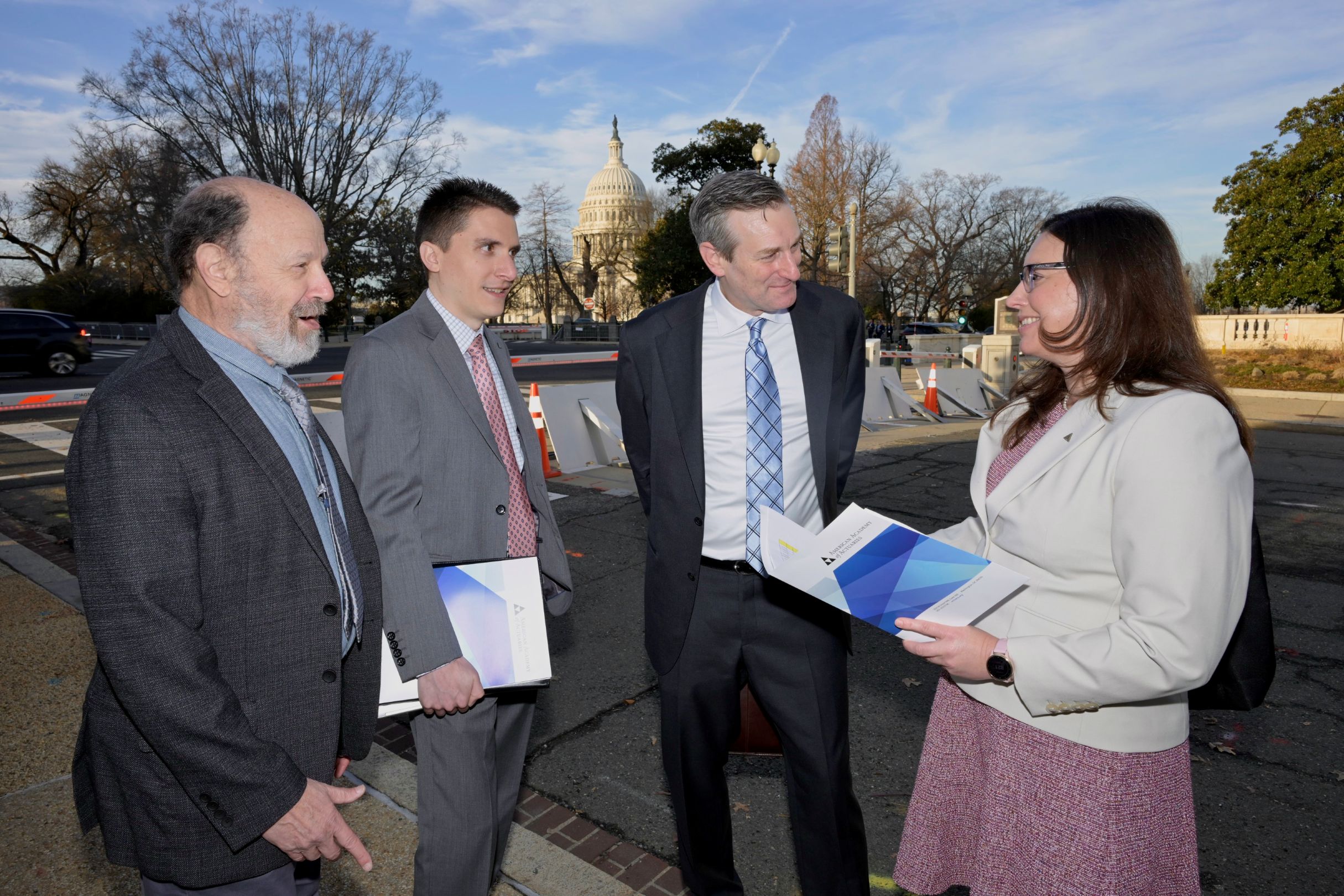
A panel from last year’s symposium, including Retirement VP Bruce Cadenhead (second from left)
Retirement Symposium Set for September
Mark your calendar to join the Academy and the Retirement Practice Council (RPC) for Toward a Sustainable Retirement System: Choices That Shape the Future, a retirement symposium set for Sept. 23 in Washington, D.C.
The event will showcase Academy thought leadership while bringing together federal policymakers, retirement experts, and actuaries to collaborate and explore public policy options. Topics include Social Security solvency beyond 2033, how individuals are impacted
when they lack access to retirement savings and lifetime income opportunities, and options to sustain employer defined benefit (DB) plans.
Keep an eye on the event page, which will be updated with additional details, including the keynote speaker. The afternoon symposium (1 to 4:30 p.m. EDT, followed by a reception), will once again be held on the 12th floor of the National Association of Realtors, 500 New Jersey
Avenue NW, Washington, D.C.
Join the Academy for this annual event, which focuses on public policy choices that could enhance the sustainability of the U.S. retirement system. Register today.

VP Corner
RPC Looks Forward to Retirement Symposium, More Work Products
Bruce Cadenhead
Vice President, Retirement
The RPC is having a busy 2026! Following our participation in the Academy Hill visits this spring, we’re continuing to look at retirement security in the context of a changing retirement landscape.
In this issue, you’ll see a preview of the RPC’s fall retirement symposium, which will explore ways to improve the sustainability of our retirement system. Also, an upcoming issue brief on the question of whether there is a retirement crisis, and for whom, will highlight some key opportunities for reforming the U.S. retirement system.
Key RPC issues include:
▶ Social Security Trust Fund reserve depletion and program reform. The program’s projected insolvency date is approaching and has moved even closer following some recent legislative and policy changes—encouraging policymakers to engage more substantively on this topic is a top priority, and the Social Security Committee has put out a number of issue briefs on this and related topics, including the updated the “Sooner Rather Than Later” issue brief and infographic.
▶ Engagement with the Pension Benefit Guaranty Corporation (PBGC) and policymakers and stakeholders on PBGC-related topics. The high level of premiums for single-employer plans is a significant impediment to employers’ willingness to continue to sponsor these plans—the RPC has highlighted the PBGC’s strong surplus position in a recent press release and press briefing, issue briefs have covered reform options, and recent discussions with policymakers have highlighted these reform options and ways to address the challenges of Congress’ budget scoring rules which would treat a reduction in PBGC premiums as a reduction in federal tax revenue.
Read more — For more on these and other key issues, see the Actuarially Sound blog posts on the updated Social Security Challenge and the Academy Hill visits—and a Contingencies web exclusive on the Spring Policy Summit.
Academy Holds Spring Policy Summit, Annual Hill Visits
The Academy held its inaugural Spring Policy Summit and annual “Hill visits” with federal lawmakers and policymakers in March.
The summit featured multiple sessions with legislative, regulatory, and stakeholder speakers and panels, all of whom reinforced the value received through the Academy’s objective and nonpartisan information on important public policy issues. A key theme across sessions was delivering the profession’s expertise and insights through the Academy by “meeting stakeholders where they are”—whether through short bullet-point highlights, infographics, issue briefs, or more detailed comment letters, papers, and monographs.
In the Hill visits, RPC and other practice-area volunteers and Academy staff fanned out across Capitol Hill in Washington, meeting with staff members from congressional offices, committees, and federal agencies.
At the summit, “we had great discussions with about a number of topics related to retirement security and identified some important areas where near-term reform may be possible,” said Retirement Vice President Bruce Cadenhead. Key Hill visits areas in retirement were led by Social Security. “That’s definitely number one—the Academy has a lot of expertise in that area, and has produced a number of issue briefs that will help move the discussion forward on how to address the trust fund’s impending shortfall,” he said.
During the summit and Hill visits, the Social Security Committee released an updated issue brief, Reforming Social Security Sooner Rather Than Later, which included updated projections of the program’s combined trust fund reserves. (See story, below.)
In addition to social security, the RPC volunteers also talked about reforms to §401(h) Accounts, the retirement crisis, gig workers, PBGC premium reform ideas for single-employer plans and lifetime incomes within defined contribution plans. The team met with staff from the House Ways and Means Committee and Education and Workforce Committee, the Senate Finance Committee, and staff of Sens. Mike Crapo, Chuck Grassley, Maggie Hassan, John Hickenlooper, Tim Kaine, Tim Scott, Elizabeth Warren and Rep. Donald Norcross.
‘Sooner Than Later’ Social Security Issue Brief Updated
An update to the retirement issue brief, Reforming Social Security Sooner Rather Than Later, includes updated projections of Social Security’s combined trust fund reserves, which are now projected be depleted around 2034. At that time, its income would be able to pay only about 80% of the benefits scheduled for its anticipated 81 million beneficiaries. The issue brief notes that it is important that Congress focus sooner rather than later on solvency, as delay narrows the viable solvency-directed policy options to those that rely primarily on significant tax increases.
Infographic, News Release
The RPC also released an infographic that outlines options for keeping the popular program solvent.
“Ensuring that Social Security can sustainably serve future generations with manageable reforms is a ‘now’ issue, not a ‘later’ issue,” Social Security Committee Chairperson Sam Gutterman said in a news release. “More gradual reforms can meaningfully reduce Social Security’s shortfall, but legislative activity on them would need to start soon. The better pathway of more gradual phase-ins of changes, with costs spread more broadly, and smaller tax or benefit adjustments, is narrowing. This 2026 election year is an opportunity for candidates for office to discuss the tradeoffs involved in sustaining this vital program that serves tens of millions of Americans.
Volunteer Video Explains Academy’s Peer Review Process
Interested in the peer-review process for work products developed by Academy volunteers? A new video moderated by Director of Public Policy Matthew Sonduck features longtime Academy volunteers from the casualty, life, and health practice councils, as well as the RPC—including former Pension Committee Chairperson Ellen Kleinstuber—who offer an overview of the Academy’s public policy peer-review process, its role and importance, practice and cross-practice considerations, examples and reconciliation, as well as FAQs and resources. This new resource for Academy volunteers is available on Academy Connect.
Academy Presents at NCOIL Spring Meeting
Claire Wolkoff, a member of the Retirement Policy and Design Evaluation Committee presented in mid-April at the National Council of Insurance Legislators (NCOIL) Spring Meeting in Louisville, Ky., on retirement and gig workers, drawing from the Academy public policy paper of the same name released last September.
Webinar Covers Retirement Security
An April 28 Academy webinar, The Role of the Employer in Improving Retirement Security, examined how retirement plans can serve as effective tools for generating lifetime income through risk pooling. Presenters included Retirement Vice President Bruce Cadenhead, Retirement Policy and Design Evaluation Committee Chairperson Lee Gold, and Defined Contribution Subcommittee Chairperson Spencer Look. Pension Committee Vice Chairperson Lloyd Katz moderated. Watch a replay on Academy Learning.
Highlights From
Retirement Report
Prefer watching the news? Check out this “Highlights From Retirement Report” video for a quick recap of what you need to know.
ASOPs—Your Feedback Wanted
The Academy and the Actuarial Standards Board (ASB) would like your feedback on how you use and access actuarial standards of practice (ASOPs).
Click here to take a five-question survey about how you access ASOPs.
RPC Comments on ASOP Nos. 6, 41
Several RPC committees—the Pension Committee, Multiemployer Plans Committee, and Public Plans Committee—sent comment letters to the ASB on exposure drafts of ASOP No. 6, Measuring Retiree Group Benefits Obligations and Determining Retiree Group Benefits Program Periodic Costs or Actuarially Determined Contributions, and ASOP No. 41, Actuarial Communications. Comments for ASOP No. 6 were due May 15 and ASOP No. 41 comments are due by June 1.
Academy in the News
A Morningstar “The Long View” podcast guest, retirement researcher Wade Pfau, recommended the Academy’s jointly sponsored Actuaries Longevity Illustrator as a tool for the public to better understand longevity risk when planning for retirement. MSN also cited the illustrator, as did a New York Times personal finance column on longevity risk and retirement planning.
The Academy’s analysis of Social Security’s projected shortfall, the need for legislative action to address it, and reform options was featured in Yahoo! Finance.
Think Advisor reported on the Academy’s updated Social Security Challenge, noting the increased difficulty of addressing Social Security’s future projected financial shortfall absent reforms. WealthUp Editor-in-Chief Kyle Woodley dedicated a column to exploring the value of the challenge.
Academy material noting the consequences of delayed congressional action on Social Security’s projected financial shortfall was included in a USA TODAY column on recent trust fund depletion date projections. The national video Big Biz Show (at the 7:15 mark) also covered reform options described by the Academy.
Chief Investment Officer cited and linked to an Academy 2024 issue brief on public pension plan surpluses in a story about current challenges facing financially healthy plans.
An Oklahoma Voice column discussing a legislative proposal’s effects on the state’s Teachers Retirement System funding cited Academy analysis of the 80 percent funding standard myth.
Financial Planning’s coverage of discussions surrounding spousal rules for 401(k) plans cited last year’s issue brief, Improving Spousal Retirement Plan Protections—Gaps and Policy Proposals.
Legislative/
Regulatory Activity
Federal
The Department of Labor’s Employee Benefits Security Administration (EBSA) issued a notice of proposed rulemaking (NPRM) on April 2 that seeks to implement an August 2025 executive order from President Trump. The rulemaking provides a safe harbor for a fiduciary in connection with selecting designated investment alternatives for a participant-directed individual account plan, including asset allocation funds that include alternative assets. Comments are due by June 1.
The Internal Revenue Service released an NPRM regarding proposed regulations relating to “Trump accounts”—a type of traditional IRA established for the exclusive benefit of children and were established within HR 1, commonly referred to as “The Big, Beautiful Bill.” The proposed regulations provide guidance on making an election to open a Trump account and reserve additional sections for further guidance on Trump accounts.
Sen. Rick Scott of Florida introduced S 4186, which would repeal the Social Security retirement earnings test and allow beneficiaries to earn income without reductions to their Social Security benefits.
Sen. Chris Van Hollen of Maryland is sponsoring S 4196, which would consolidate the federal Old-Age and Survivors Insurance Trust Fund and the Disability Insurance Trust Fund into a single “Social Security Trust Fund,” effective Jan. 1, 2027.
Companion House and Senate bills—HR 7828 by Rep. Adelita Grijalva of Arizona, and S 4001, by Sen. Elizabeth Warren of Massachusetts— would modernize and expand the eligibility criteria and benefit amounts for the Supplemental Security Income program.
State
Kentucky Gov. Andy Beshear signed HB 220, which clarifies and specifies exemptions and procedures related to overtime compensation and creditable compensation increases for retirement system purposes.
Kansas Gov. Laura Kelly signed HB 2602, which introduces new regulations related to independent contractors and portable benefit plans in Kansas. It clarifies that contributions to portable benefit accounts, which may fund health, income replacement, disability, life insurance, or retirement benefits, are voluntary and can be funded by the contractor, the hiring party, or through voluntary withholding with opt-in and opt-out options.
Oregon Gov. Tina Kotek signed SB 1507, which among other things updates rules related to public employee retirement benefits, including salary calculations, benefit caps, and service credits. It also revises rules governing pension distributions, death benefits, and contribution limits, impacting public employers, employees, and pension administrators.
Mississippi Gov. Tate Reeves signed HB 4073, establishing the Mississippi Work and Save Program, a state-sponsored retirement savings initiative allowing eligible employees and employers to voluntarily contribute to Roth IRAs via payroll deductions, with provisions for automatic enrollment and benefit portability.
Virginia Gov. Abigail Spanberger signed HB 176, which amends the state-facilitated IRA savings program by reducing the minimum number of eligible workers an organization must employ from 25 to five and ending a requirement that they work at least 30 hours a week.
Washington Gov. Bob Ferguson signed HB 2034, establishing and amending various retirement system funds, such as those for school employees, public safety employees, and higher education retirement plans, with detailed provisions for fund management, asset transfers, and expense payments.
Indiana Gov. Mike Braun signed SB 14, allowing individuals retiring after 2027 in the state’s public pension program to base their benefit on the highest five years of earnings, rather than basing the benefit on the final five years of service.
Braun also signed HB 1145, modifying Indiana’s pension system by introducing a joint and survivor option for retirement allowances. It also allows those taking benefits for the first time in 2025 to receive a one-time supplemental check in 2026.
The California House approved AB 1054, legislation that would establish a Deferred Retirement Option Program (DROP) within the Public Employees’ Retirement System for state highway patrol and firefighters. DROP allows eligible members to receive a lump sum or monthly payments in addition to their retirement allowance upon service retirement.