Leadership Summit & Governance Transition
Health VP Annette James Outlines Key HPC Priorities

In a panel discussion moderated by incoming Academy President Tricia Matson at the 60th anniversary Leadership Summit and Governance Transition held on Nov. 21 in Washington, the Academy’s six vice presidents outlined some of their key priorities heading into 2026.
Health Vice President Annette James cited Health Practice Council (HPC) priorities including health spending and the cost of care; informing stakeholders about how policy decisions impact other markets; and longer term, emerging topics that may become important in the next year or more.
The first focuses on the drivers of health spending and the value of care, and informing legislators and policymakers about the drivers and how to control them.
James said the HPC met with several stakeholders shortly before the summit—including representatives of Georgetown University’s O’Neill Institute Center for Health Policy and the Law, and the Senate Health, Education, Labor and Pension (HELP) Committee—to find out what’s important to them, which the HPC will include as one of the factors to consider when deciding on projects for 2026. The Academy’s perspective was well-received, and the parties suggested going “back to basics” in conveying information to stakeholders.
Matson asked James a hypothetical question—if she could sit down with a stakeholder for an hour, who would it be and what topics would she discuss? James said she would like to have a variety of stakeholders in the room, to help break through “separate silos” that people often operate in.
“I would like to have a room full of regulators—members of Congress, governors” and other key policymakers to talk about drivers of health care costs and the “implications across markets and across different parts of the health ecosystem,” she said, which could include issues like policies intended to impact Medicaid that can affect the individual insurance market, and that impact providers, including rural hospitals. “I would like to have a forum to sit and talk to people about what their policy really does across the whole health ecosystem,” she said.
Cross-practice issues also affect affordability—most notably in the case of health and property/casualty insurance—and informing policymakers and legislators about that is also important, panelists said.
“The cost of health care is top of mind for a lot of people,” James said. “I was very gratified this year to see a lot of stakeholders reach out to us for our input on health care bills” and related key issues.
Academy Award Recipients
Also at the summit, the Academy gave out its annual service and recognition awards. Read more about the recipients.
OVA—Health volunteer Derek Skoog was among four recipients of an Outstanding Volunteerism Award (OVA). Skoog was recognized for his recent tenure as chairperson of the Medicare Committee and the Health Underwriting Risk Factors Analysis Work Group.
Rising Actuary Awards—Health volunteers Zhe “Gigi” Li (EY) and Andrew Larocque (Risk & Regulatory Consulting) were among the seven Rising Actuary Award recipients. Read more about the Rising Actuary Award recipients in the December Contingencies web exclusive, Movin’ on Up.
Life and Health Law Valuation Manual Available for Preorder

The 2026 Life and Health Valuation Law Manual, updated annually, contains information to help appointed actuaries stay up-to-date with any changes and remain aware of the current requirements of the NAIC model Standard Valuation Law and the model Actuarial Opinion and Memorandum Regulation. Preorders are now available for the 2026 edition—place your order today.
HPC Presents at NAIC Fall Meeting

The HPC presented to the NAIC’s Health Actuarial (A) Task Force (HATF) meeting on Dec. 8, as part of the NAIC Fall National Meeting in Hollywood, Fla. Public Policy State Outreach Director Katie Dzurec provided a year-end roundup of some major initiatives that have been at the top of the HPC priority list this year.
In addition to cross-practice support for the RBC Model Governance (EX) Task Force, health actuaries (notably, the Health Solvency Subcommittee) have been working with NAIC staff to finalize the H2 Underwriting Risk and Managed Care Credit Report on income line adjustments and managed care credit expansions.
Expanding on previous work included in the HPC’s Health Insurance Market Dynamics resource guide released earlier this year, staff highlighted recent work identifying considerations for state regulators on marketplace stability and for federal legislators on proposals related to account-based health plans.
Briefing, Blog—For more, watch a post-NAIC briefing video and read an Actuarially Sound blog post on the meeting.
HEC Releases First ‘Broadening the Focus’ Issue Brief
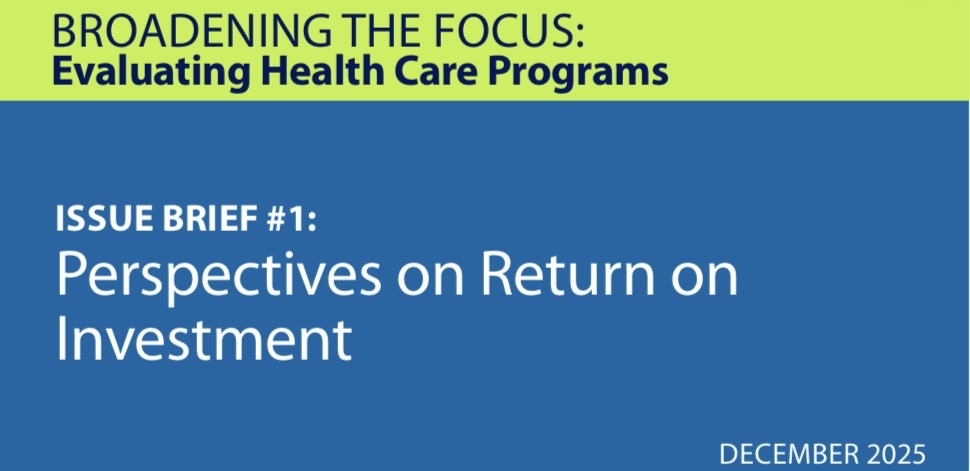
The Health Equity Committee released Perspectives on Return on Investment, the first issue brief in its “Broadening the Focus: Evaluating Health Care Programs” series. The issue brief provides results from interviews conducted with subject matter experts related to health care program evaluations, with a focus on advantages and disadvantages of traditional financial return on investment (ROI) metrics. Using outputs from these interviews, stakeholder discussions, and other feedback, the committee will draft a holistic principles-based framework to support evaluating health care programs for release in spring 2026.
Work Group Releases Medicare Advantage Practice Note
The MA Cost Projections Practice Note Work Group a practice note, Medicare Advantage Plan Cost Projections for Retiree Group Health Benefit Valuations, which provides background and examples on how to project the cost of Medicare Advantage products as part of a valuation for a retiree group health benefit plan that covers Medicare-eligible retirees.
Actuary Voices—Academy and the NAIC
A recent Actuary Voices episode features Public Policy State Outreach Director Katie Dzurec and NAIC Chief Government Affairs Officer Ethan Sonnichsen—formerly the Academy’s inaugural Risk Management and Financial Reporting Council policy analyst—who discuss the relationship between the Academy and the NAIC. Subscribe to Actuary Voices wherever you get your favorite podcasts.
AHIP State Issues Retreat
Dzurec also presented Commercial and Individual Markets: What Goes Into the Premium Soup? at the 2025 AHIP State Issues Retreat in Nashville in October, highlighting the HPC’s health market resource guide, 2026 health insurance premium drivers, premium rate development, and the interconnectedness among various health insurance markets.
Academy Holds Successful, Sold-Out LHQ Seminar
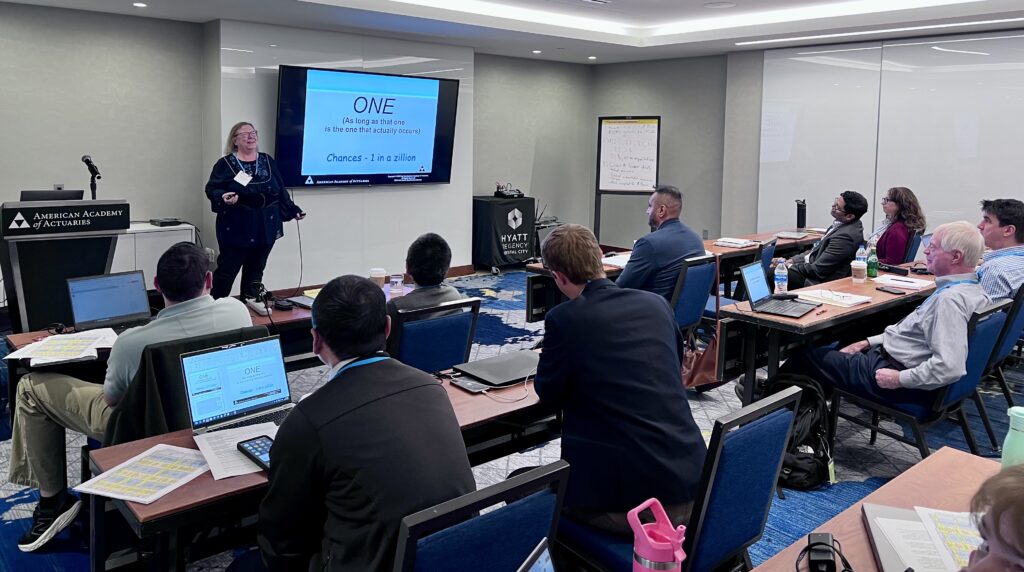
The Academy’s sold-out 2025 Life and Health Qualifications Seminar was held Nov. 17–20 in Arlington, Va. New this year were separate life and health tracks, following a day of general education and a three-hour exam on the fourth day. Outgoing Academy President Darrell Knapp, who heads the seminar subcommittee, said the format change was based on previous seminar attendees’ input.
“We’re still trying to give the health actuaries some life education, and the life actuaries some health education, because that’s part of being a well-rounded actuary—being a professional and understanding the questions that need to be addressed,” Knapp said.
Health Members Join Academy Board
Two health members began their three-year terms as member-selected directors on the Academy Board—Ron Ogborne, a member of the Health Care Delivery Committee; and Becky Sheppard, chairperson of the Health Equity Committee (HEC).
In addition, Joyce Bohl, a member-selected director since 2022, continues her Board service as a two-year term Board-selected director. Bohl is a past chairperson of the Individual and Small Group Markets Committee and a member of the Strategic Planning Committee.
Health Town Hall Webinar Covers Key Issues
HEC Chairperson Becky Sheppard and Vice Chairperson Sara Teppema led the virtual Broadening the Focus: Town Hall Discussion on Nov. 12, examining the current use of financial return-on-investment when evaluating health care programs or benefits. Using discussion questions that effectively encouraged interaction with attendees, it also offered a first look at the Broadening the Focus project. Watch a replay on Academy Learning.
CCA webinar—Sheppard and Teppema presented Nov. 17 on the “Broadening the Focus” initiative in a Conference of Consulting Actuaries (CCA) webinar.
Academy Presents at NAMD on Market Dynamics
Health Vice President Annette James and HPC Vice Chairperson Julia Lerche joined the National Association of Medicaid Directors’ (NAMD) CFO/Finance Affinity Group to offer their input on health insurance market dynamics.
NASHP Panel
James also participated on a panel at the National Academy for State Health Policy’s (NASHP) Annual State Health Policy Conference in San Diego. The presentation, Managing the Undertow of Shifting Health Insurance Markets, included a discussion of 2026 health insurance premium drivers and market stability. James was joined on the panel by Oklahoma Insurance Commissioner Glenn Mulready and California Health Exchange Director Jessica Altman.
Dues Reminder—Is Your Academy Profile Up to Date?
Before the end-of-year rush, please take a few minutes to make sure your Academy member information is up to date. Here are a few things to check in your member profile:
Dues—Have you paid your 2026 member dues? Dues need to be paid by Jan. 1 to start the new year as a fully paid-up Academy member. Read Academy President Tricia Matson’s letter to members.
Employment—Have you changed jobs? Check that your contact information reflects your new role and any addresses (email and/or mailing address) are accurate.
Credentials—Have you gained a new credential? Congratulations! Please take a few minutes to update your profile to reflect your achievement. Log in to your member profile today.
ICYMI: Membership Webinar—In case you missed it, the Dec. 17 webinar, Maximize Your Membership: A Comprehensive Guide to Making the Most of Your Academy Experience, featured Academy staff who highlighted the value of your membership. Watch a replay on Academy Learning.
Academy Professionalism Education Reaches Health Actuaries via Employers
The Academy’s outreach to employers continued with Committee on Education Chairperson Al Bingham virtually presenting the session “Actuarial Professionalism from Code to Culture” to Elevance’s Actuarial Conference. The presentation reviewed the professionalism framework housed and maintained within the Academy, with special focus on qualifications and continuing education, and the broad self-regulatory activities and culture that advance U.S. actuarial professionalism.
Other presentations included:
ASB Past Chairperson Rob Damler presented a two-part professionalism session in Chicago to Blue Cross and Blue Shield chief and senior actuaries from the association and local plans. The first part offered a professionalism review followed by audience polling and discussion of three health-practice area case studies. The second explored the definition and impacts of data bias in the context of actuarial standards of practice.
ASB Health Committee Chairperson Audrey Halvorson presented “ASOPs for Rating Actuaries” to Cambia Health Solutions actuaries and related staff in Portland, Ore.
Medicaid Committee Chairperson Marlene Howard spoke to actuaries at Humana’s Dec. 10 Actuarial Community Summit in Louisville, Ky., covering Medicaid trends, challenges, and future considerations.
Highlights From
HealthCheck

Prefer to watch your news? Check out this “Highlights From HealthCheck” video for a quick recap of what you need to know.
Health News in Brief
A discussion brief, Health Insurance Marketplace Stability Considerations for States, explores potential options that state regulators and other policymakers may pursue to help improve access to affordable individual market coverage.
The Individual and Small Group Markets Committee submitted a statement for the record to the Senate Committee on Finance following the committee’s Nov. 19 hearing, The Rising Cost of Health Care: Considering Meaningful Solutions for all Americans. The statement identifies several key questions for the committee to consider as it evaluates potential solutions that rely on account-based plans for health insurance.
Academy in the News
JD Supra’s coverage of a U.S. district court decision on the Centers for Medicare and Medicaid Services’ payment methodology in Medicare Advantage noted the Academy’s related public comments.
InsuranceNewsNet covered remarks by keynote speaker Jeff Bush, principal of Washington Update, on the policy and political landscape, including for health care, at the Academy’s Leadership Summit and Governance Transition event in Washington, D.C., on Nov. 21.
A story on the potential expiration of Affordable Care Act (ACA) enhanced subsidies in the revenue-management trade publication Rev Cycle Management used July’s Drivers of 2026 Premium Changes issue brief as a source.
The HPC discussion brief Strategies to Achieve Market Stability in the Individual Health Insurance Market was cited in the Journal of the San Juan Islands (Wash.) coverage of the impact of an insurer market withdrawal.
Coverage of the Academy’s Medicare webinar was featured as a top story by InsuranceNewsNet—including comments from Academy Medicare Committee Chairperson Derek Skoog and guest panelists.
Best’s Review’s annual actuaries and auditors issue featured comments by Senior Health Fellow Cori Uccello on the individual health insurance market.
Modern Healthcare (subscriber-only) quoted Health Equity Committee member Becky Sheppard in a story about vaccine insurance coverage.
The Ludington Daily News (Mich.) reported on a state representative’s discussion of health care legislation, noting Academy analysis regarding related ERISA considerations.
A subscriber-only Politico Pro story cited the Academy’s discussion brief on the interconnectedness of health coverage sources for the under-65 population.
Legislative/Regulatory Activity
Federal
President Trump announced an agreement in November with pharmaceutical companies Eli Lilly and Novo Nordisk that would lower prescription drug prices on several popular diabetes and weight loss drugs, including Ozempic, Wegovy, Zepbound, and Orforglipron. The reduced price makes them eligible for coverage by Medicare and Medicaid.
The Centers for Medicare & Medicaid Services (CMS) announced on Nov. 5 that all 50 states submitted applications for the $50 billion Rural Health Transformation Program. The new program invited every state to design a plan for transforming its rural health care system, outlining how they intend to expand access, enhance quality, and improve outcomes for patients through sustainable, state-driven innovation.
President Trump issued an executive order, calling on the Make America Healthy Again Commission to identify how to use advanced technologies such as AI to unlock improved diagnoses, treatments, cures, and prevention strategies for pediatric cancer.
Sen. Josh Hawley of Missouri introduced S 3011, barring insurance plans offered through the Affordable Care Act marketplaces from covering abortion procedures or gender transition services for minors.
Sen. Lisa Murkowski of Alaska introduced S 2903, amending the Employee Retirement Income Security Act of 1974 to require a group health plan or health insurance coverage offered in connection with such a plan to provide an exceptions process for any step therapy protocol.
Sen. Ron Wyden of Oregon introduced S 2857, requiring certain approved immunizations to be covered under Medicare, Medicaid, the Children’s Health Insurance Program, group health plans, and other health insurance.
Sen. Kirsten Gillibrand of New York introduced S 2825, amending the Public Health Service Act to authorize the Secretary of Health and Human Services (HHS) to award grants to faith- or community-based organizations to address persistent health inequities and chronic disease challenges.
State
In September and October, California Gov. Gavin Newsom signed the following health care-related bills:
- AB 224/SB 62, which mandates new benefit coverages in the individual and small group markets, including comprehensive fertility services, durable medical equipment like mobility and communication devices, and pediatric vision and oral care benefits.
- SB 40, which caps patients’ out-of-pocket costs for insulin by prohibiting cost-sharing that exceeds $35 for a 30-day supply of insulin as of Jan. 1, 2026, in the large group insurance market and in the individual and small group market in 2027.
- AB 1415, which adds private equity groups, hedge funds, and management services organizations to the types of entities required to report to the Office of Health Care Affordability on pending health care transactions.
- SB 41, which requires that as of Jan. 1, 2026, health insurance contracts must ensure that enrollees’ cost sharing does not exceed the actual rate paid for prescription drugs while also prohibiting pharmacy benefit managers (PBMs) from using spread pricing in their contracts.
- SB 306, which requires health care service plans and insurers to report statistics on prior authorization, including approval rates and relevant data on requested services.
- SB 402, which mandates that health care service plans publish and maintain accurate online directories with detailed information about contracting providers.
- AB 543, which requires Medi-Cal managed care plans to reimburse field medicine providers for services rendered to homeless beneficiaries.
- AB 594, which states that student health insurance will be classified as individual health insurance, requiring compliance with essential health benefits and annual out-of-pocket expense limits, while being exempt from certain health insurer requirements.
- SB 862, establishing the Behavioral Health Services Oversight and Accountability Commission, which will oversee new mental health initiatives aimed at improving access and outcomes for various populations, including youth and individuals experiencing homelessness.
- AB 50, which authorizes pharmacists to furnish over-the-counter contraceptives without the standardized procedures required for prescription-only hormonal contraceptives, as well as provide up to a 12-month supply of both prescription and over-the-counter contraceptives at the patient’s request.
- AB 260, which enhances access to sexual and reproductive health care, particularly focusing on medication abortion and the use of mifepristone.
New Mexico Gov. Michelle Lujan Grisham signed SB 3, which prohibits health insurance plans from imposing cost-sharing for childhood immunizations and requiring the Department of Health to recommend immunizations for children and adults based on guidance from the American Academy of Pediatrics, American Academy of Family Physicians, the American College of Obstetricians and Gynecologists, the American College of Physicians, or the Department of Health.
Grisham also signed HB 2, establishing the Health Care Affordability Fund to reduce health care premiums and cost sharing for those participating in the New Mexico health insurance exchange or the fully insured small group market, provide resources for coverage initiatives for the uninsured, cover a portion or all of the net premium health benefit contributions for state employees who do not qualify for Medicaid, and cover a portion or all of the new premiums for members of the New Mexico national guard who qualify for a federal TRICARE reserve select policy.