Q&A-Issue Brief Examines Spousal Protections

The Retirement Policy and Design Evaluation (RPADE) Committee published an issue brief, Improving Spousal Retirement Plan Protections-Gaps and Policy Proposals, examining employer-sponsored retirement plans’ protections for spouses in cases such as a divorce or a participant’s death and identified potential gaps in those protections. An accompanying infographic highlights key gaps and policy proposals to address them.
“Challenges and gaps in spousal benefit protections vary by plan type but range from the transparency and consent requirements regarding the disposition of retirement assets, to different coverage and administrative hurdles,” Committee Vice Chairperson Connie Rydberg, who co-authored the issue brief, said in an Academy news release.
Retirement Report did a Q&A with Rydberg, who expounded on some of the issue brief’s key points.
What was the impetus for this issue brief and the accompanying infographic, which seems to have been well-received?
It’s been more than 40 years since any significant legislation has been passed to enhance spousal protections in retirement plans. (The most recent one was the Retirement Equity Act of 1984.) We wanted to explore what gaps in spousal protections still remain, including the impact of retirement plan and demographic changes that have occurred over the last 40+ years.
We’re glad the infographic was well-received. This is something new that we decided to try for this paper. People are busy and may not have time to read a 10+ page issue brief. The one-page infographic visually summarizes the key points, which we hope will bring the core proposals to the forefront, and be helpful to one of the key audiences for this issue brief, congressional staff members. .
The issue brief summarizes spousal protections as spelled out in ERISA. Very briefly, what spousal protections are currently provided under ERISA [the Employee Retirement Income Security Act of 1974], which marked its 50th anniversary last year?
ERISA, as amended, requires that both defined benefit (DB) and defined contribution (DC) plans provide certain benefits for spouses in the event of a participant’s death and that spouses have the ability to access a portion of the participant’s benefit in case of divorce. ERISA also requires spousal consent for a distribution from a DB plan but does not require spousal consent for a distribution from a DC plan. This difference between DB and DC plans is one of the gaps noted in the issue brief, along with a proposal to close this gap.
Yes. We looked particularly at three changes that have occurred over the past 50 years:
First, while the gap between men’s and women’s pay has decreased and the number of dual-income families has increased, wives in opposite-sex marriages are still likely to rely significantly on their husbands’ retirement plan savings. Therefore, strong spousal protections in retirement plans are still needed.
Second, divorce rates have increased. As a result, about a third of adults who have ever been married have experienced divorce (according to the Census Bureau). Even though divorce is relatively common, the process a couple must go through to split up their retirement plan assets is still very complex, and frustrating for many-so much so that they may avoid the process altogether.
Third, DC plans have surpassed DB plans as the main source of retirement income for most people. However, despite their growing significance, DC plans lack a crucial safeguard that is present in DB plans: the requirement of spousal consent before a distribution is made.
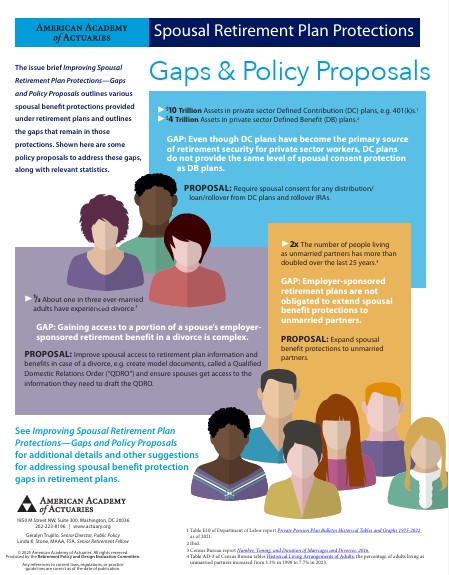
The infographic notes the number of people living as unmarried partners has more than doubled over the last 25 years, leading to a related “gap” in employer-sponsored retirement plans, which are not obligated to extend spousal benefit protections to unmarried partners. It suggests a proposal to expand those protections to unmarried partners. Has there been any action in this area, and/or what are the possible hurdles?
While the number of adults living as unmarried partners is still relatively small (about 8% of all adults in 2023), it was surprising to see magnitude of change – with the percentage doubling over the last 25 years. In terms of action in this area, we have seen some employers voluntarily extended spousal benefits to unmarried, committed partners. Hurdles to doing so include the cost of the expanded coverage, the additional administrative processes needed to determine who is eligible for the coverage, and the philosophy that unmarried partners who want spousal benefit protections can obtain them by getting married. These shifts in the social demographics remind us why we continue to discuss the evolving needs and public policy interests in the future of retirement.
With respect to the Qualified Domestic Relations Order (“QDROs”) in cases of divorce, what, if anything, more can be done with respect to providing plan information for spouses in those situations?
There are many hurdles to a spouse getting a QDRO to be qualified and accepted by a plan administrator, including, as you noted, a lack of information about their spouse’s retirement plan benefits. When you think about it, it is nearly impossible to draft a valid QDRO if you don’t have this basic information. One of the ideas for consideration we outlined is for Congress to clarify that spouses, or at least those going through a divorce, have the right to certain information about their spouses’ retirement plan benefits. Establishing this baseline would address one of the challenges and potentially relieve some of the frustrations that individuals face when going through a divorce.
You took part in the Academy’s Hill visits with federal lawmakers this spring. Did any of the issue brief’s points come up or draw interest?
Yes, key points in the issue brief generated significant interest during the Hill visits. Thankfully, improving retirement security is one issue that, generally, has had a high level of bipartisan support. Several ideas mentioned above, such as requiring spousal consent for any payments from a DC plan and affirming a spouse’s right to certain information about their spouse’s retirement plan benefits, are low-cost, high-impact ideas for consideration that we hope appeal across party lines.
Are there plans for an upcoming webinar?
Yes, a webinar is in the works, targeted for this fall. We intend to invite some outside speakers from advocacy groups with direct experience in these issues to share their own perspective on the challenges and ideas outlined in this issue brief, which will complement our actuarial perspectives and policy recommendations. Stay tuned for more details on how to register!
Interested in volunteering? The committee wants your input! Contact the committee via the online Volunteer Contact Form.
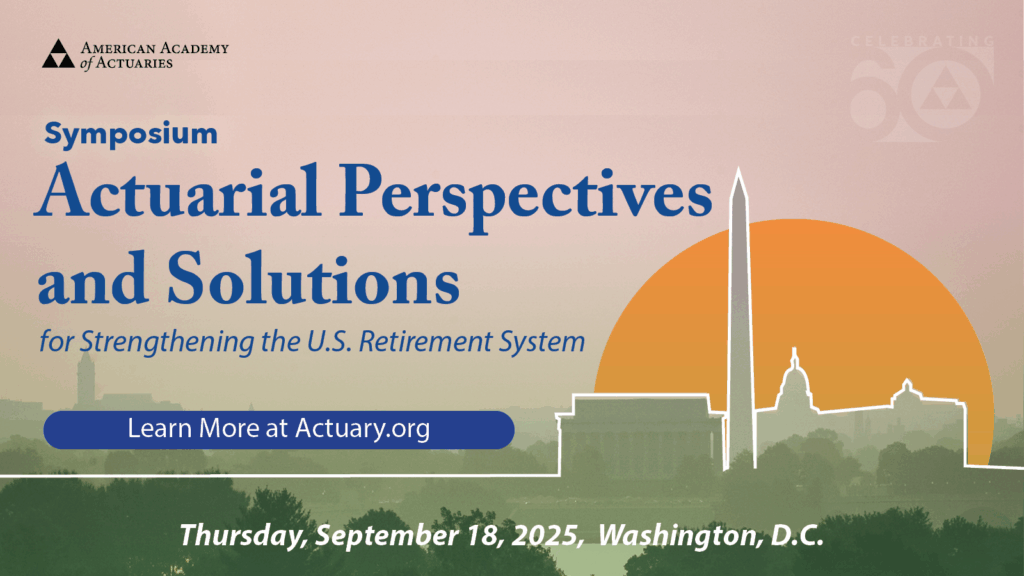
Retirement Symposium Set for September
Coming next month-the Retirement Practice Council’s Actuarial Perspectives and Solutions for Strengthening the U.S. Retirement System symposium will be held Sept. 18 in Washington, D.C. Following last year’s successful “ERISA at 50” retirement symposium, the event will bring together federal policymakers, retirement experts, and actuaries to discuss and share actionable solutions aimed at strengthening the U.S. retirement system and improving retirement outcomes for Americans, including examining Social Security in its 90th year. U.S. Comptroller General Gene Dodaro will give the opening keynote address. Register today.
Frank Todisco Nominated to Be Academy President-Elect

Frank Todisco was selected by the Nominating Committee to be the Academy’s next president-elect. Todisco, a past member-selected director and past vice chairperson of the Actuarial Standards Board, has been an active volunteer since 2004, and was also the Academy’s senior pension fellow from 2006 to 2008.
“I am deeply honored by this selection,” Todisco said. “In my experiences as a long-time volunteer, Academy senior pension fellow, and voracious user of Academy expertise and publications in my work, I have developed an enormous appreciation of the value of the Academy to the actuarial profession and to policymakers and the public in the United States. I will give my very best to help lead the Academy to continued excellence in carrying out its important mission.”
Todisco received the Robert J. Myers Public Service Award in 2023, given to an Academy member for a single noteworthy public service achievement or a career devoted to public service. He received the award for enhancing the value of actuarial information and risk analyses provided to Congress in his job as chief actuary of the U.S. Government Accountability Office (GAO).
Throughout his GAO service, Todisco has transformed and expanded the role and exemplified the spirit of the Myers Award with outstanding leadership and vision, including through the creation of GAO’s Center for Actuarial Science. The GAO provides Congress, executive branch agencies, and the public with fact-based, non-partisan information that can be used to improve government and save taxpayers billions of dollars.
Bruce Cadenhead Nominated as Next Retirement VP

The Academy Nominating Committee named Bruce Cadenhead to be the next retirement vice president, succeeding current VP Jason Russell. Cadenhead is a former Academy Board member-selected director, during which time he also served as a member of the Board’s Budget and Finance Committee, the Strategic Planning Committee, and the Audit Committee. He is a past chairperson of the Pension Committee, a past member and current interested party of the Retirement Practice Council, and a member of the U.S.-based actuarial organizations’ collaborative Intersector Group.
Joseph Hicks Nominated as Member-Selected Director

Retirement volunteer Joseph Hicks is among three nominees to be Academy member-selected directors, starting three-year terms in November. Hicks is chairperson of the Multiemployer Plans Committee and received an Outstanding Volunteerism Award in 2021, in part for being instrumental in relating the Academy’s perspective on retirement issues. He has also participated in the Academy’s Hill visits, meeting with federal legislators and staff. Academy members will select three new directors in an online process in early September. For more, see the Board Selection Center.
Issue Brief Examines Social Security and Disadvantaged Populations
The Social Security Committee published an issue brief that explores why benefits have not lifted more older Americans out of poverty and potential ways to address the issue. While Social Security has been instrumental in reducing poverty among those 65 and older, about 9% of retirees remain in poverty, many of whom rely on the program for most or all of their income.
Highlights From
Retirement Report

Prefer to watch your news? Check out this “Highlights From Retirement Report” video for a quick recap of what you need to know.
ABCD Seeking Retirement Volunteer-Deadline Sept. 5
The Actuarial Board for Counseling and Discipline (ABCD) is seeking a retirement volunteer with extensive experience working with pension plans for a variety of small and large employers that contain participants with diverse compensation levels. The ABCD role is for a three-year term that begins on Jan. 1, 2026. Please review the selection criteria and submit your name and contact information by Sept. 5 here, or to abcd@actuary.org.
ABCD Presents at EA Conference
ABCD Director of Professionalism Ed Lee co-presented a professionalism session, “Actuarial Crime and Punishment (JBEA & ABCD Systems),” at the Conference of Consulting Actuaries’ Enrolled Actuaries Conference on May 7.
Academy in the News
BenefitsPro reported on the issue brief examining potential gaps in retirement plans’ spousal protections and options for addressing them.
Kiplinger cited speaker comments from the Academy’s July 1 free webinar on the Social Security Trustees Report in a story on early retirement benefit claiming.
The Academy’s Social Security Challenge was highlighted in a MarketWatch story on options for addressing Social Security financing challenges.
The Reason Foundation’s Pension Reform Newsletter highlighted the issue brief, Decumulation Strategies: Creating Lifetime Income from Defined Contribution Plans.
An NTD News retirement planning column drew on longevity discussions in the 2022 issue brief, Raising the Social Security Retirement Age.
A GoBankingRates retirement planning article, also published by AOL and Yahoo! Finance, also discusses the Actuaries Longevity Illustrator in connection with setting a planning horizon. MSN also cited the illustrator.
Retirement News in Brief
A new practice note, Gain/Loss Analysis for Pension Plans, provides information to actuaries on current practices relevant to the performance of an analysis of gains and losses in connection with the actuarial valuation of pension plans (gain/loss analysis).
A May webinar examined the Defined Contribution Subcommittee’s issue brief on decumulation strategies and the accompanying executive summary released earlier this year. A replay is available on Academy Learning.
Legislative/Regulatory Activity
Federal
President Trump signed H.R. 1, the reconciliation budget bill, titled the One Big Beautiful Bill Act, on July 4. Included in the law is a provision that creates a temporary senior tax deduction of $6,000 through 2028 for anyone 65 and older making less than $75,000 (as a single filer) or making less than $150,000 (for joint filers). It replaces the proposed elimination of taxes on Social Security. The law also creates a pilot program for a new type of tax-favored account for newborns, providing $1,000 to eligible children born between 2025 and 2028, as well as re-establishes the $20,000 reporting threshold for gig workers, beginning tax year 2025, with subsequent thresholds increased with inflation starting in 2027.
The Department of Labor’s Employee Benefits Security Administration (EBSA) published a direct final rule on July 1, eliminating the regulatory safe harbor for selecting annuity providers from the Code of Federal Regulations. A statutory safe harbor introduced in 2019 remains in place.
Sens. Bill Cassidy of Louisiana and Tim Kaine of Virginia introduced S. 1831, proposed legislation that would amend the Internal Revenue Code of 1986 and ERISA to allow for the periodic automatic reenrollment under qualified automatic contribution arrangements. Cassidy also introduced S. 1727 and S. 1728, both related to defined contribution plans.
Sens. Maggie Hassan of New Hampshire and Ted Budd of North Carolina introduced S 1840, which would amend the Internal Revenue Code to provide for a micro-employer pension plan startup credit.
Sens. Thom Tillis of North Carolina and John Hickenlooper of Colorado introduced S 1526, which proposes the creation of an American Worker Retirement Fund. This fund would be a federal program that offers retirement savings to employees whose employer does not offer an individual retirement plan with an automatic enrollment payroll deduction option, are not eligible for their employer’s retirement plan, or are independent, self-employed contractors.
Sens. Josh Hawley of Missouri and Dick Durbin of Illinois introduced S 1381, which proposes to improve protections for employees and retirees in business bankruptcies.
State
New York Gov. Kathy Hochul signed A7428, extending for four fiscal years the current 7% annual statutory rate of interest used in valuing retirement system liabilities for the purpose of computing the amount of employer contributions.
North Carolina Gov. Josh Stein signed HB 477, which enhances the clarity and efficiency of death benefit provisions for state employees, ensuring sufficient funding for line of duty death benefits while streamlining the legal framework.
Stein also signed HB 506, establishing the North Carolina Investment Authority, a new body that oversees various retirement systems and funds in an effort to improve efficiency and financial outcomes in the state’s investment management practices.
Texas Gov. Greg Abbott signed HB 3474, modifying the evaluation and reporting requirements for public retirement systems in Texas. Public retirement systems with total assets of at least $100 million are now required to conduct evaluations every three years, while those with assets between $30 million and $100 million must conduct evaluations every six years.
Minnesota Gov. Tim Walz signed SF 2884, which includes an increase in the retirement annuity formula for employees with service after June 30, and introduces refund repayment options for certain retirement plan members.
Washington Gov. Bob Ferguson signed SB 5357, revising the normal cost contribution rates for the 2025-2027 fiscal biennium to reflect updated projections regarding the funded status of each pension plan and the expectation that contribution rates will decline over the next six years.
Ferguson also signed HB 1270, authorizing local governments operating deferred compensation programs to automatically enroll new employees in accordance with plan rules, unless employees affirmatively choose not to participate.
Social Security Trustees Report Released
The 2025 Social Security and Medicare trustees’ reports were released in mid-June. The annual Social Security Trustees Report shows the theoretically combined Old-Age and Survivors Insurance Trust Fund and the Disability Income Trust Fund reserves will be depleted by 2034, one year earlier than reported last year, the Treasury Department said in a press release. At that time, continuing total fund income would be sufficient to pay 81% of combined scheduled benefits.
Report Highlights-The Social Security Committee published the Highlights from the 2025 Social Security Trustees Report, a one-page illustration detailing the current and projected financial status of the program’s trust funds. A more detailed issue brief from the Social Security Committee on this year’s Trustees Report is anticipated this fall.
‘Significance’ issue brief-A related issue brief, Significance of the Social Security Trust Fund, offers more background, including historical and projected trust fund ratios, perspective on the Social Security system as a whole, and big-picture budget and economy perspectives.
Alert, Free Webinar-For more, read the Academy alert on the release of the annual Social Security and Medicare trustees’ reports (member log-in required). A replay of the Academy’s free webinar on the Social Security Trustees Report is available on-demand. It featured Social Security Administration (SSA) Chief Actuary Karen Glenn and other senior SSA actuaries. Social Security Committee Chairperson Sam Gutterman moderated. Watch a replay on Academy Learning.