 Click here for a print-ready PDF of this page. Read other articles in the Essential Elements series here. |
Climate Change |
Many Americans have felt the effects of climate change: increased droughts in the western United States, higher rainfall and snowfall in the eastern part of the country, and greater damage from tornadoes, hurricanes, and other extreme climate events. Additionally, climate scientists have been predicting the global impact of record-breaking warm temperatures for years.
|
GLOBAL NATURAL LOSS EVENTS (2014) NUMBER OF EVENTS 980 OVERALL LOSSES $110 billion INSURED LOSSES $31 billion FATALITIES 7,700 LARGEST U.S. COVERED LOSSES MAY 18-23 SEVERE STORMS $2.9 billion JAN. 5-8 WINTER DAMAGE $1.7 billion JUNE 3-5 SEVERE STORMS $1.3 billion
|
|
| Source: Munich Re |
Recent studies show that insurers are facing higher property and casualty insurance losses, which ultimately lead to higher costs to consumers and businesses. A key component of weather-related damage has been increased building along U.S. coastlines and rivers, and in other areas prone to hurricanes, forest fires, and severe storms. Climate change and a rise in extreme weather-related events could increase losses in the future. While there is ongoing scientific debate on how fast the earth’s climate is changing and how much is influenced by human activity, alterations in weather patterns have been observed worldwide including:
- Global mean surface temperatures have increased by 0.6 degrees Celsius since 1951.1
- Seven of the 10 warmest years on record for America’s contiguous 48 states have occurred since 1990.2
- The fraction of global land area experiencing extremely hot summertime temperatures has increased ten-fold over the past 50 years.3
North American Threat
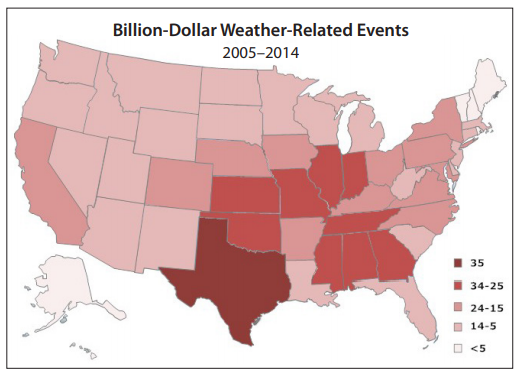
Over the past three decades, the number of weather-related loss events in North America grew by a factor of five, according to a 2012 report by Munich Re.4 This compares with a four-fold increase in Asia, 2.5 in Africa,2 in Europe, and 1.5 in South America. North America faces every type of hazardous weather risk-hurricanes, tornadoes, drought, flood, wildfire, and storms, according to the report. One reason is that no east-west mountain range exists in North America to prevent southern warm air from colliding with cold Canadian weather fronts.
 |
Rising Property/Casualty Costs
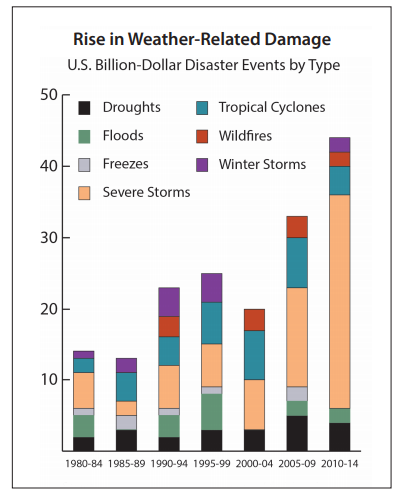
As weather-related damages increase, these costs fall on insurers, businesses, and consumers. The world’s five largest natural catastrophes ranked by insured losses in 2012 all occurred in the United States, including Hurricane Sandy, drought in the West, and various storms and tornadoes, according to Munich Re. The National Oceanic and Atmospheric Administration (NOAA) recorded 80 U.S. weather/climate events that each had losses exceeding $1 billion between 2004 and 2013, compared with only 46 events in the previous decade.
 |
Here is NOAA’s breakdown of weather-related events:
- The western U.S. has experienced hotter and drier temperatures over the past decade, which has led to more wildfires and crop failures. There were 14 drought and wildfire events where each loss exceeded $1 billion in 2004-2013, according to NOAA data, compared with 10 similar events between 1994 and 2003.
- Damage from winter storms and freezes, which generally hit the eastern half of the United States, fell over the past decade. NOAA reported three winter storm and freeze events where losses exceeded $1 billion between 2004 and 2013, compared with seven similar events in 1994-2003.
- Water damage has surged over the past 10 years, in large part caused by increased hurricane activity. NOAA reported 23 flood and hurricane events with losses exceeding $1 billion between 2004 and 2013, compared with 16 from 1994-2003.
- The biggest increase in damage from weather events over the past decade came from severe storms, which NOAA classifies as tornadoes, hail storms, severe thunderstorms, derechos, and flash floods. There were 40 such events with losses exceeding $1 billion from 2004-2013, compared with 13 between 1994 and 2003.5
Actuaries Climate Index and Climate Risk Index
In order to monitor climate changes, the American Academy of Actuaries is part of a group of other North American actuarial organizations that jointly developed the Actuaries Climate Index (ACI), which focuses on measuring the frequency and intensity of extremes in key climate indicators based on controlled observational data of temperature, precipitation, drought, wind, sea level, and soil moisture. The ACI initially covers the United States and Canada, but could be expanded to other parts of the world where reliable data is available.
As a follow-on to the release of the ACI, the Actuaries Climate Risk Index (ACRI) will assess who and what is at risk because of climate change, and quantify that risk. The ACRI will review where people live and the surrounding infrastructure, and look for relationships between climatic and socioeconomic factors. Both indexes will function as a useful tool for actuaries, policymakers, and the general public.
Additional Resources from the American Academy of Actuaries
- Presentation to CIPR on Actuaries Climate Index
- Determining the Impact of Climate Change on Insurance Risk and the Global Community
- Actuaries Climate Index
|
1 “IPCC Fifth Assessment Report: Climate Change 2013,” Intergovernmental Panel on Climate Change. 2 “Climate Change Indicators in the United States, 2012,” Environmental Protection Agency. 3 “Perception of Climate Change,” James Hansen, et al. Proceedings of the National Academy of Sciences of the United States of America, March 29, 2012. 4 “Severe Weather in North America,” Munich Re. |
 1850 M Street NW • Suite 300 • Washington, DC 20036 • 202.223.8196 Copyright 2016 American Academy of Actuaries. All rights reserved |