
By Josh Feldman
Every once in a while, some random person on the street asks me what happened with Doc and Hoss, the two runners I profiled two years ago who didn’t get along and decided to settle their differences by racing 50 quarter-mile intervals. Well, it’s fair to say that there is still a lot of bad blood between these two, as they have continued to challenge each other around town in the most unconventional venues. At this point, everyone here in Columbia has seen these two trying to assert their superiority in any locale imaginable, whether on or off the track.
The latest event took place at the local mini-golf course. I am not sure how this challenge came about, but one day Doc claimed he was a better golfer than Hoss, and before you knew it, the two decided to try to settle the score once and for all on the Putt-Putt course. So when Hoss and Doc finalized a date to meet on the course, I, of course, had to be there to witness whatever shenanigans were about to take place. This putt-off was the competition we needed but truly did not deserve.
And what a scene that day was! The indoor mini-golf course was filled to capacity, as everyone tried to get a glimpse of the two heated rivals. After 17 holes, Doc had a one-shot lead over Hoss as they approached the 18th and final hole. Then, in what would be known around Columbia simply as “The Shot,” Hoss did the near-impossible: he putted his tee shot over the hill, through the clown’s mouth, and somehow straight into the hole. After a Doc two-putt, our two combatants were back where they started, all tied up.
As expected, Doc threw a temper tantrum after this dramatic hole-in-one, which everyone from Moberly to Jefferson City got to hear. Doc finished his tirade by saying that at least he still held the record for the most-holes-in-one in a single round, with Doc somehow making a mind-blowing six holes-in-one during one 18-hole round. Hoss countered by saying, “I don’t care how long it takes; I am going to take that record from you, even if I have to play a round of mini-golf every day for the next 10 years.” A new challenge has arisen!
I sat next to my friend Big T during the 18th hole madness, and he asked me if I thought Doc had a chance to break the record. After watching the 18-hole match, I told Big T that it appears that Hoss has a 1-in-3 chance of holing out each of the easiest six holes, a 1-in-20 chance of holing out each of the toughest six holes, and a 1-in-6 chance of holing out each of the remaining six holes. Big T agreed with my assessment and asked me, “What chance does that give Hoss of completing the challenge?” After watching Doc and Hoss go at it, I was in no position to come up with an answer, but I bet my puzzle-solving friends could help!
For each part below, assume that each hole is independent (no hot or cold streaks) and that Hoss has a 1-in-3 chance of making a hole-in-one on six holes, a 1-in-6 chance on six holes, and a 1-in-20 chance on the final six holes.
What is the probability that Hoss ends the round without making a single hole-in-one?
What is the probability that Hoss completes the challenge during his first round and gets seven or more holes-in-one on the 18-hole course? Also, what is the mean number of days it will take Hoss to break Doc’s record?
Bonus: What is the probability that the first day Hoss completes the challenge, he will do so in epic fashion, demolishing the record with at least eight holes-in-one during the round?
Solutions may be emailed to puzzles@actuary.org.
In order to make the solver list, your solutions must be received by April 1, 2026.
Solutions to Last Issue’s Puzzles—Happy New Year
By Stephen Meskin
It was mid-November, and I already had my 2026 calendar. It was Your Daily Epsilon of Math Wall Calendar 2026 from the American Mathematical Society. Each daily box contained a little math problem whose answer was the day of the month. The directions said “If a problem has no directions, solve for x.”
This month, I had five problems for you in the style of my new calendar, but without the day of month (i.e., without answers). I labelled them A, B, C, D, E, so you wouldn’t be tempted to use the problem number as the answer. You could assume that the answers are positive integers, probably less than 32 and probably distinct. You should show how you solved the problems.

Answer: x=25
Solution: We observe that by equation 1, y is a perfect square and by equation 2, less than 14, so it is either 1,4, or 9. Consequently, from the 1st equation, x is 27,26, or 25. By the 2nd equation x is also a perfect square. Thus, x must be 25.
Problem B: Find the number of factors of 1152.
Answer: x=24
Solution: The prime factorization of 1152 is 2732. Thus, the number of factors is (1+7)*(1+2) = 8*3=24.
Problem C: How many integer partitions of 8 are there?
Answer: 22
Solution: 8, 7+1, 6+2, 6+1+1, 5+3, 5+2+1, 5+1+1+1, 4+4, 4+3+1, 4+2+2, 4+2+1+1, 4+1+1+1+1, 3+3+2, 3+3+1+1, 3+2+2+1, 3+2+1+1+1, 3+1+1+1+1+1, 2+2+2+2, 2+2+2+1+1, 2+2+1+1+1+1, 2+1+1+1+1+1+1, 1+1+1+1+1+1+1+1.
Problem D: Find the Frobenius number of {4,10,13}
Answer: 19
Solution: The Frobenius number of a set is the largest number that is NOT a positive integer linear combination (“PILC”) of the numbers in the set. The PILCs of 4 and 10 are {4,8,10} and all larger even integers. To get to 19, one needs an odd integer such as 15,11,9 or smaller. But 13 doesn’t cut it so 19 is NOT a PILC of the numbers in the set. But is it the largest? Observe, 20=10+10, 21=13+4+4, 22=10+4+4+4, 23= 13+10 and every larger integer differs from one of 20 to 23 by a multiple of 4 and thus are PILCs of {4,10,13}. Thus, 19 is the largest which is not.
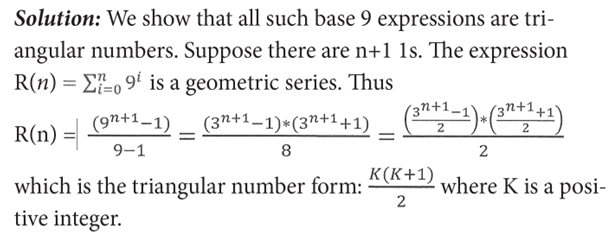
Problem E: Find the count of triangular numbers among the following base nine numbers: 119, 1119, …, 1111111119.
Answer: all 8 of them.
Solvers: Bob Conger, Bill Feldman, Rui Guo, Clive Keatinge, David Promislow, Daniel Ropp, Michael Schachet, Jason Shaw, Matt Stephenson, Daniel Wade, and Abraham Weishaus