The Academy’s Spring Policy Summit brought actuaries, regulators, and congressional staff together to discuss pressing midterm-year policy issues and more. Panels highlighted how the Academy’s nonpartisan expertise informs policy and the event underscored the value of the Academy and its members.
By Barbara Bryant
Actuaries provide a broad range of information and analysis to many different stakeholders, and the methods they use to deliver their insights matter just as much as the information they provide. That was the message repeatedly underscored at the Academy’s inaugural Spring Policy Summit in Washington, D.C., on March 9.

As Academy Executive Director and CEO William Michalisin shared in his opening remarks, the summit offered a unique opportunity for experts who benefit from Academy members’ expertise to share their insights and priorities in this midterm election year, as well as to offer their perspectives on how the Academy and its members can help address these key public policy issues.
Over the course of several panels, Academy volunteer leaders led conversations with representatives from several key Academy stakeholder groups, asking them about their priorities for 2026 and how the Academy can be helpful. Although the panels were not coordinated in advance, a common theme quickly emerged: Actuaries and the Academy are highly valued, particularly for decision-makers and advocates in Washington, D.C. Panelists repeatedly emphasized that the balanced, objective, and nonpartisan expertise the Academy and its volunteer actuaries bring to the policy table every day is deeply valuable and more impactful than actuaries themselves may realize.
What Are the Priorities?
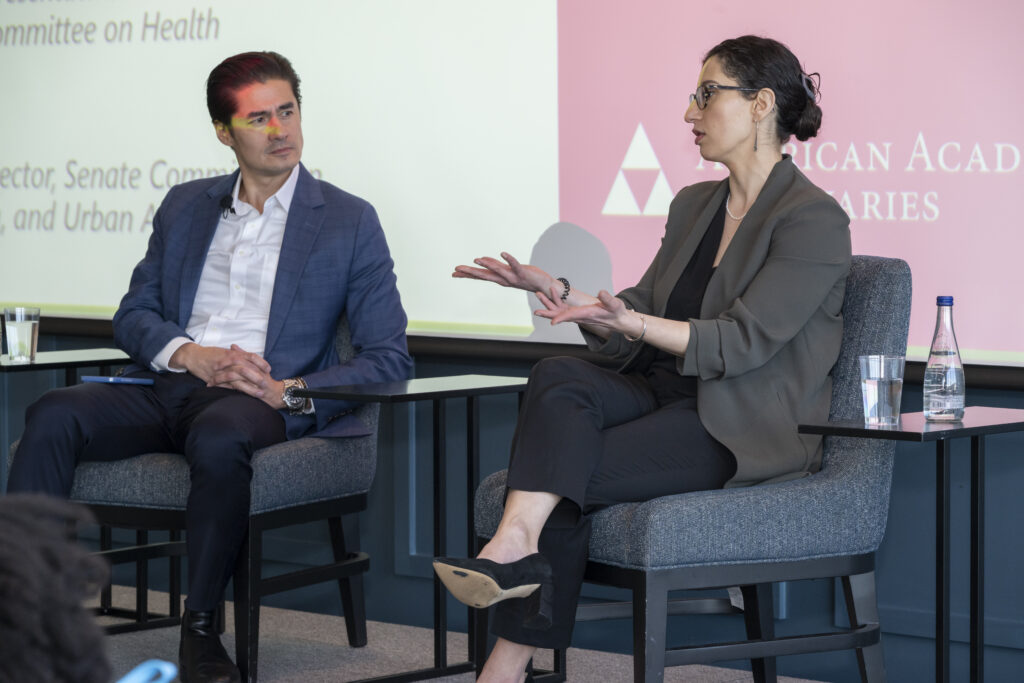
The summit kicked off with an energetic conversation between Jason Russell, former vice president of the Academy’s Retirement Practice Council, and Rachel Dolin, minority staff for the Health Subcommittee of the U.S. House Committee on Ways & Means. During their hour-long conversation, the two discussed current pressures on federal health policy, including the predicted expiration of premium tax credits and reductions to state Medicaid programs, both of which are anticipated to have significant impacts on uninsurance rates, the cost of care, and access to care. Although Jared Sutton, majority staff for the Senate Committee on Banking, Housing, and Urban Affairs and a scheduled panelist, was unable to attend, the discussion provided a comprehensive look at these issues.
As minority staff, Dolin shared her perspectives on likely priorities for Democrats in the House. She predicted that Democratic priorities would include making health care more affordable and less complicated and restoring Medicaid funding and tax credits. “We need a balance between premiums and deductibles. How do you prevent one from jacking up the other?” she asked. Her question reflects some of issues explored in recent work from the Academy’s Health Practice Council, including its health insurance market dynamics resource guide.
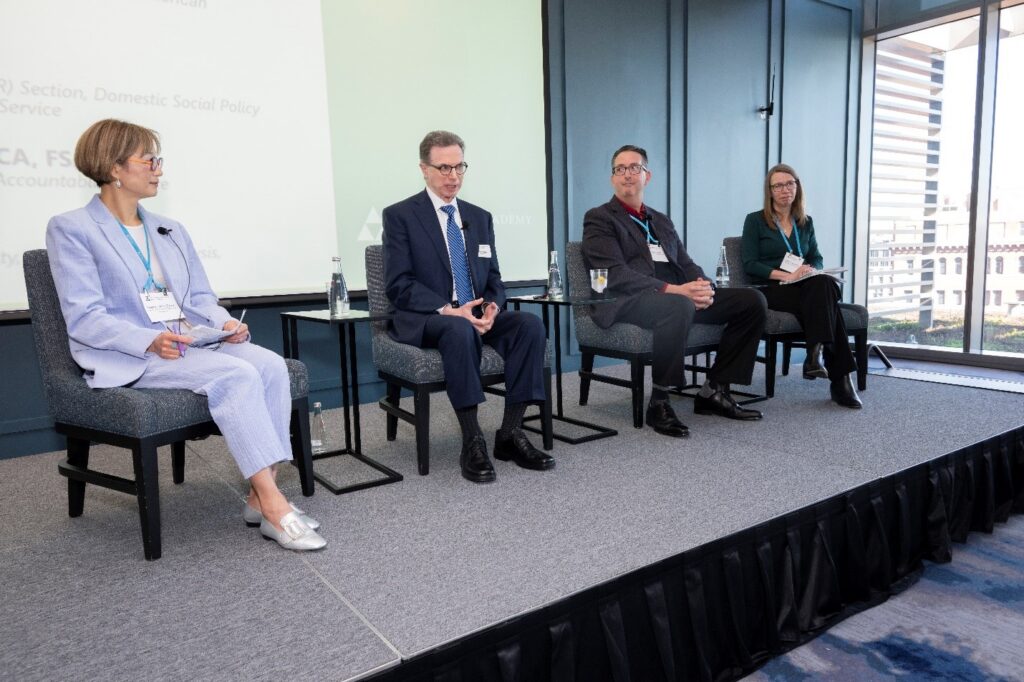
The discussion then shifted to another perspective from Capitol Hill—the congressional regulatory agencies that provide analytical and technical expertise on a variety of issues and proposals. The session, led by Seong-min Eom, chair of the Academy’s Joint Committee on Climate Change and a state regulator from New Jersey, focused on clarifying the role of congressional agencies and highlighting some of their work. Matt Barry, the section research manager for health services and research at the Congressional Research Service (CRS), Frank Todisco, chief actuary at the U.S. Government Accountability Office (GAO), and Julie Topoleski, director of labor, income security and long-term analysis at the Congressional Budget Office (CBO), highlighted the differences between their federal agencies and the executive branch regulatory agencies, such as the Department of Health and Human Services, the Social Security Administration, and the Federal Emergency Management Agency.
Barry manages one of two health care groups in CRS, which is housed under the Library of Congress and provides legislative, oversight, and constituent services support to every congressional office. Topoleski described CBO as the federal government’s “scorekeepers,” working on budget issues, revenue projections, and cost estimates of legislation. Describing the GAO, Todisco explained that it serves as Congress’s watchdog and investigative arm, auditing agencies’ performance, gauging how well programs are doing, and making recommendations to executive branch agencies and Congress to help government operate more efficiently and effectively. GAO also focuses on the country’s fiscal outlook and makes long-term projections related to Social Security, Medicare, Medicaid, as well as tax revenue and fraud.
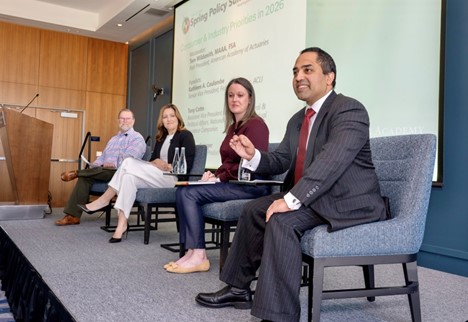
Staying with the federal focus, Tom Wildsmith, a former Academy president and managing director, Legislative and Regulatory Policy, Blue Cross Blue Shield Association, led a conversation with three industry association staff. Joined by Kathleen Coulombe, senior vice president for federal relations at the American Council of Life Insurers (ACLI); Tony Cotto, assistant vice president and counsel for federal & political affairs with the National Association of Mutual Insurance Companies (NAMIC); and Meghan Stringer, vice president for product and commercial policy at AHIP, the panel discussed how their trade groups are approaching Congress during this particularly fractured political climate. Many of their key issues align with the Academy’s priority issues (see the Policy Forum for more on the Academy’s mega issues), most notably concerns around insurance access and affordability.
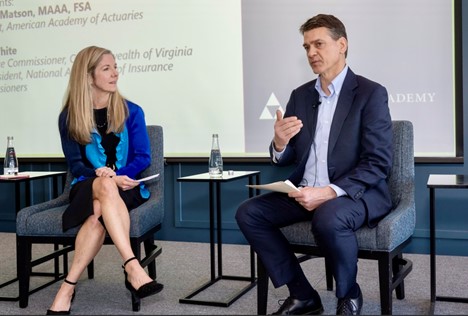
Before lunch, Academy President Tricia Matson spoke with Scott White, Virginia’s insurance commissioner and 2026 National Association of Insurance (NAIC) president. Their fireside conversation offered a state-level perspective while echoing many of the issues discussed in the federally focused panels discussed. The commissioner shared that he anticipates a variety of public policy issues to continue to dominate conversations at both the state and federal levels. For state insurance commissioners, that list includes the debate over whether the federal government should play a larger role in insurance regulation, increased attention to cyber insurance, and whether states should take a bigger role in providing flood insurance. A proposed moratorium on states regulating artificial intelligence (AI) also looms large, along with the states’ desire to address the recently expired Affordable Care Act premium health care subsidies. The increasing need for affordable and available long-term care insurance options also remains another top NAIC priority.
How Can the Academy Help?
Commissioner White thanked the Academy for contributing expertise and consultation to the NAIC on a variety of issues and challenges. “You provide us with so much actuarial bandwidth when we’re tackling these complex regulatory policies.” He cited the Academy’s comments on asset adequacy testing in connection with asset-intensive reinsurance and principle-based reserving, as well as the insurance industry’s recent adoption of the new statutory reserve requirement for non-variable annuities, VM-22.
He also expressed appreciation for the Academy’s work with the NAIC’s RBC Model Governance (EX) Task Force, and thanked Academy volunteer Steve Smith for his ongoing efforts to help commissioners and regulators think through issues related to collateralized loan obligations. “You go beyond just focusing on actuarial or financial solvency and [look more broadly] at risk management…there are so many opportunities in terms of modeling. You’re in the very space where we’re trying to find solutions.”
Dolin emphasized that when the Academy is looking to share its work and expertise with legislative offices, brevity is the best approach. “Think about whether they have the ability to do deep dives on issues. They appreciate high-level summaries that don’t use complex language. Deliver what you need to say to my boss in four bullets.” She also said that congressional audiences benefit from making the impact personal through real-life stories and examples. “Don’t focus on gold, silver, or platinum plans but on Suzanne in New Jersey who needs to get breast cancer treatments. Policy is important but start the conversation from an individual’s perspective.” Her message was clear—legislative staff and their elected leaders look to actuaries to help provide insight and understanding. “We need conversations with people like you for answers.”
Topoleski noted that in addition to Congress, CBO’s work is read widely by academics, the press and other interested parties. “We’re putting more of our models online for feedback and would welcome ideas on how we can be clear and transparent in the documents we publish.” When asked about how the Academy can be helpful to her team, she started off a little differently from Dolin, “The more you provide the better. We want more detail than most normal people.” But she quickly pointed out that most on Capitol Hill would probably prefer one-page, at-a-glance materials in addition to the deeper dives.
Barry suggested providing a suite of products to meet people where they are, since committees of jurisdiction will likely have more time and expertise to do a deep dive into a subject area. He pointed out that CRS deals with deadlines that range from months to minutes, which means that his team asks questions to tease out how much and what kind of information the audience really needs. Todisco said that some readers on the Hill prefer shorter documents, so the GAO is experimenting with Q&A formats and short-form reports.
When asked about what role the Academy can play in supporting the policy debates associations are engaged in, Cotto, Stringer, and Coulombe agreed that the information and analysis the Academy provides are both relevant and useful. Stringer said she uses it to explain how rising costs affect premiums. “It is so important for us in these conversations to go in armed with information, numbers, and a way to help policy makers, decision-makers, and elected officials understand the relationships,” she said. “You know, when you pull on this lever, this thing happens. And so, I think it’s important to help them understand at a very high level how the math works, and that it is not partisan.”
Cotto offered a slightly different perspective on how the Academy advocates in the public policy space, saying that it is an advocate for the actuarial profession and for math. “The Academy’s ability to flag, assess, and evaluate risk matters.”
What’s Next?
Dolin made the audience laugh more than once—particularly when she noted that “I told a colleague that ‘I made it’ because the actuaries asked me to come and speak to them.” When asked by Russell what message she wanted the audience to take away, she noted, “Our staff always want actuaries’ views on issues. Continue to be nonpartisan. It’s more important than ever to shed light on the facts.”
Todisco shared that other GAO staffers are sometimes among his customers, noting that they frequently hold “Actuary 101” discussions with staff, help draft sections of reports, and develop methodologies to examine issues. He also recommends Academy webinars and public comment letters to his colleagues within the GAO, noting that the agency’s actuarial teams have been taking full advantage of the Academy expertise.
Barry said that CRS looks to the Academy to provide credible, thoughtful work and values its commitment to objectivity. “As an organization, we are militantly neutral; our existence depends on it, and it’s important to be able to say ‘According to the Academy…’ It’s really useful to have [the Academy] to turn to, meet with, share information, and do some brainstorming.”
The trade representatives also stressed the importance of providing information in language and formats that are easy for people to understand and that demonstrates how policy decisions affect day-to-day lives. Coulombe emphasized knowing your audience and offering a variety of products, recognizing that there is always space for complicated white papers, but that equally valuable are those high-level bullets that a 22-year-old congressional assistant can understand, absorb, and pass along.
By the end of the summit, attendees heard strong affirmation of who the Academy is, what it does in the public policy space, and why that work matters. As one attendee noted, “The policy summit was a nice refresher for what we do as the Academy from the policy side. It was good to better understand the macro issues on the congressional agenda that affect consumers.”
Participants urged the Academy to continue serving as a source of balanced and objective truth for policymakers. Particularly in these political times—when it can feel nearly impossible to have productive conversations across both sides of the aisle on Capitol Hill—being seen as and respected for the Academy’s neutral, apolitical stance is highly valued. Protecting and maintaining the Academy’s reputation and fulfilling its mission and vision, will continue to serve the organization as well as its work on behalf of the profession and the public.
As Executive Director Michalisin said when closing the policy summit, a key takeaway of the day was the importance of the Academy’s nonpartisan nature and its commitment to being guided by data.
Professionalism and Policy: Two Pillars of the Actuarial Profession
The Spring Policy Summit concluded the day with a professionalism panel, tying together the two arms of the Academy: public policy and professionalism.
Moderated by Academy Past President Darrell Knapp, attendees heard from Tim Geddes, Actuarial Board for Counseling and Discipline (ABCD) member; David Heppen, Actuarial Standards Board (ASB) member; and Lisa Slotznick, Academy penultimate president, former Committee on Qualifications (COQ) member, and current chair of the Joint Committee on the Code of Professional Conduct, who shared insights about how the profession is self-regulated and how actuaries can get involved in the professionalism.
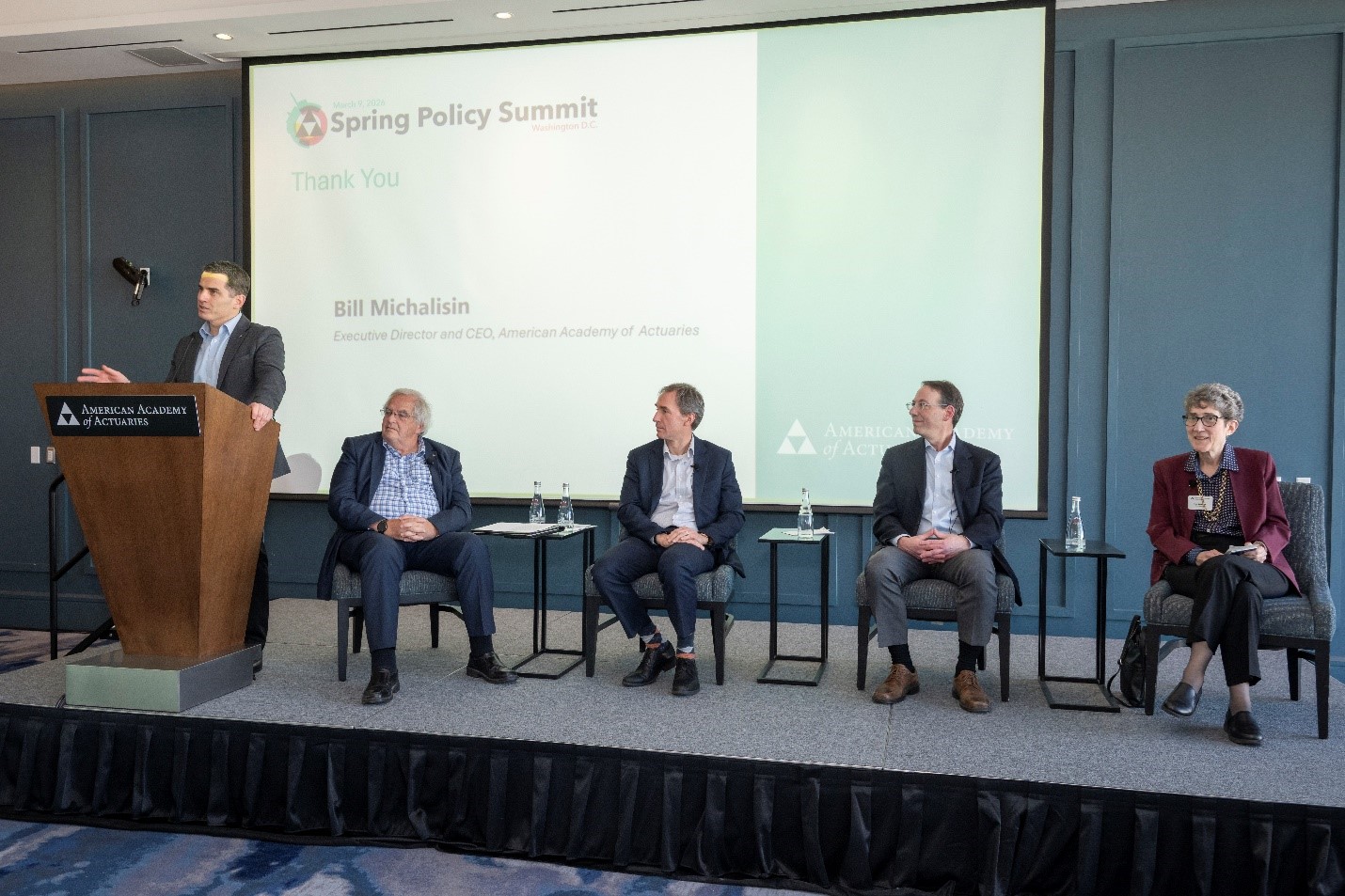
Knapp opened the session by explaining how the actuarial profession is grounded in the Code of Conduct and cited Precept 2, which states that “an actuary shall perform actuarial services only when the actuary is qualified to do so on the basis of basic and continuing education and experience, and only when the actuary satisfies applicable qualification standards.” He also quoted Precept 3: “an actuary shall ensure that actuarial services performed by or under the direction of the actuary shall satisfy applicable standards of practice.”
Slotznick then described the Code of Conduct, which defines what it means for an actuary to act as a professional and identifies the responsibilities that actuaries have to the public, to their clients and employers, and to the actuarial profession. It is jointly supported by five U.S.-based actuarial organizations, including the Academy. The standards serve as a cornerstone of excellence, laying out the necessary education, experience, and ongoing professional development that actuaries must achieve to issue statements of actuarial opinions (SAOs).
She also highlighted that the COQ regularly updates more than 60 frequently asked questions available on the Academy’s website.
Heppen shared an overview of the ASB, which sets standards for appropriate actuarial practice in the US through the development and promulgation of actuarial standards of practice (ASOPs) As he explained it, these standards function as a compass for Academy members, guiding them through the complexities of their work with clear and consistent direction. Adherence to these standards ensure that actuaries’ recommendations align with industry-leading principles while maintaining the integrity and reliability of their analyses. These standards are drafted by a designated task force and then reviewed by the board and exposed for comment.
Geddes spoke about the ABCD’s role, describing it as ensuring that actuaries meet qualification requirements. This, he stressed, is essential to the actuarial profession’s commitment to self-regulation. Most ABCD investigations, hearings, and discipline decisions arise when an actuary notifies the body of a material violation of the Code of Professional Conduct. If a complaint is found to have merit, it is investigated and a report based on the investigation’s findings is reviewed by the full ABCD to decide whether to take action. The ABCD also provides counseling to actuaries upon request, and a significant portion of the ABCD’s time is devoted to responding to these requests.
The panelists also discussed the connection between professionalism and public policy. Slotznick shared that the Academy’s and the profession’s commitment goes hand-in-hand with the policy work it undertakes.
When asked how they explain professionalism to stakeholders, such as staffers during Capitol Hill visits, the message shared was: “We have a Code of Conduct that guides us in what we do and ensures we work with due care.” Heppen noted, “Ours is a specialized field involving technical work. We need a framework that allows us to do it in the best possible way, which leads to the standards.” Geddes added, “A qualified actuary has the education and training to remain current and has the professional background and moral guidance to behave in a professional way.”
Knapp encouraged Academy members who want to participate in professionalism activities to volunteer by contributing to comment letters to the ASB on proposed and revised ASOPs, as well as seeking opportunities to join one of the committees or work groups of the Council on Professionalism and Education and the ASB. “Speak up in committees on how standards apply to the public policy work you’re doing.”
Barbara Bryant is a technical writer at the Academy.