By Stephen Meskin
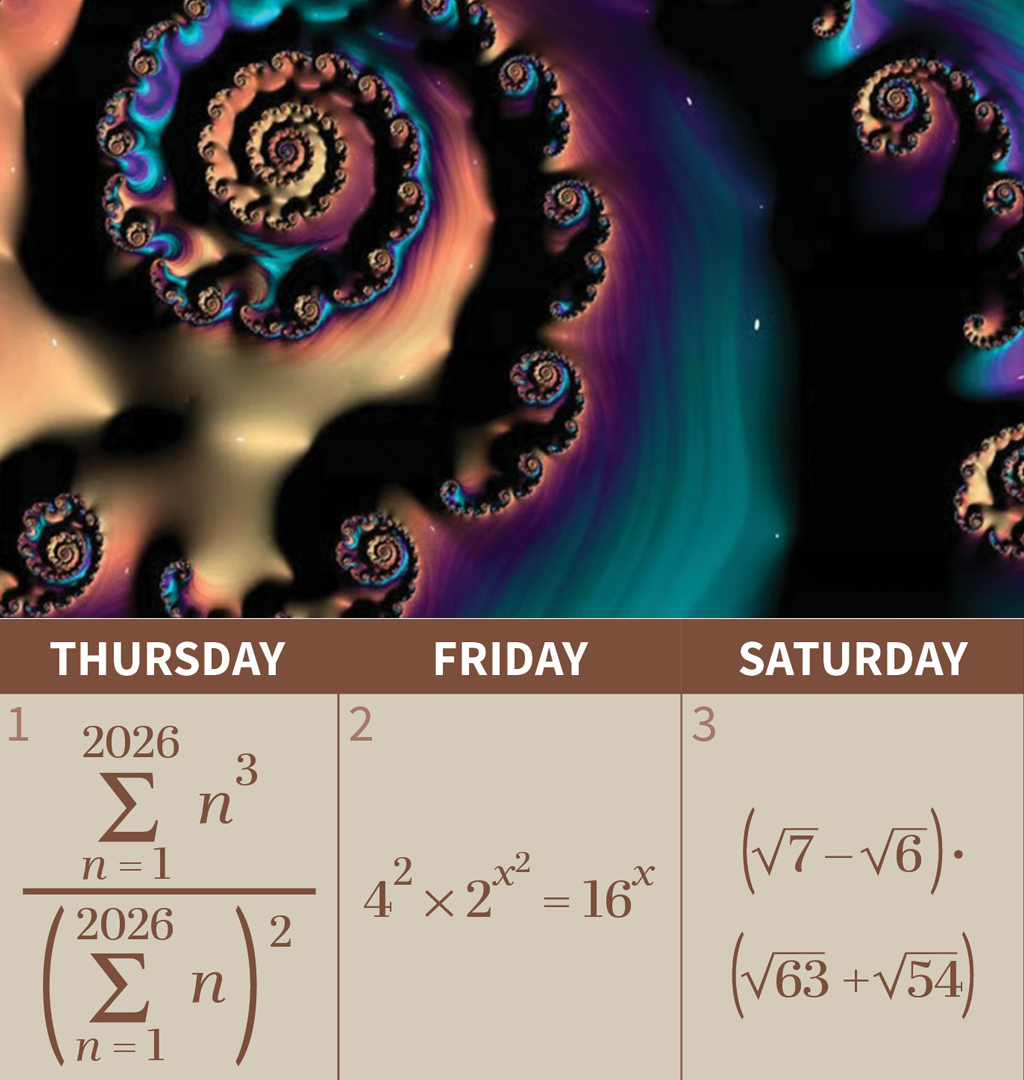
It is mid-November, and I already have my 2026 calendar. It’s the Your Daily Epsilon of Math Wall Calendar 2026 from the American Mathematical Society.At almost 2 feet by 1 foot, it is about 80% larger in area than the calendar the Humane Society sent me last year. See the top illustration. The Humane Society calendar has 12 pictures of animals (dogs, cats, deer, bears, horses, a monkey, two rhinos, etc.). Almost all of them have appealing eyes.
My 2026 calendar has 365 math problems—one for each day of the year—to keep my mind sharp. Indeed, I am not concerned with the answer, since the answer is the day of the month on which the problem appears. I only need to figure out how to get the answer, as you can see in the bottom illustration.
The directions say, “If a problem has no directions, solve for x.”
This month, I have some problems for you in the style of my new calendar, but without the day of the month (i.e., without answers). In fact, I will label them A, B, C, D, and E so you won’t be tempted to use the problem number as the answer. You can assume the answers are positive integers—probably less than 32 and distinct. You should show how you got your answer.
Problem A: y + x = 28, x + y = 14
Problem B: Find the number of factors of 1152.
Problem C: How many integer partitions of 8 are there?
Problem D: Find the Frobenius number of {4, 10, 13}
Problem E: Find the count of triangular numbers among the following base nine numbers: 119, 1119, …, 1111111119.
Solutions may be emailed to puzzles@actuary.org.
In order to make the solver list, your solutions must be received by Feb. 1, 2026.
Connections Solutions

What is the probability of solving the puzzle without making any mistakes? The first of your 16 guesses can be anything. Only 3 of the 15 remaining squares will connect with your first choice, and then only 2 will connect for your guess after that, and then 1 after that. Once you are down to 12 squares, the process starts anew, but with fewer squares remaining. This simplifies (3/15)*(2/14)*(1/13)*(3/11)*(2/10)*(1/9)*(3/7)*(2/6)*(1/5) = 0.000038%.
With 16 squares remaining, what is the probability your guess will have 3 right answers with 1 wrong answer? There are three cases where this can happen, where your second, this or fourth pick is wrong. If your second pick is wrong (12/15 chance), then for your 3rd pick 6 of the remaining 14 squares will create a match. Finally, only 3 of the remaining 13 squares create a final match, so the probability is (12/15)*(6/14)*(2/13). If your second guess is wrong, that is just (3/15)*(12/14)*(2/13). If the final guess is wrong, the probability there is (3/15)*(2/14)*(12/13). Summing these 3 probabilities = 10.55%. The same logic applies to the case with only 12 squares remaining: (8/11)*(6/10)*(2/9) + (3/11)*(8/10)*(2/9) + (3/11)*(2/10)*(8/9)=19.39%
What is the probability of winning the game before your 4th wrong guess? We first need to compute the probabilities of getting a connection with 16, 12 and 8 squares remaining. After we do that, the next step is to figure out all the paths to lead you to winning the game, realizing that your last guess must be correct and that you have at most 3 wrong guesses. So for example, one path could be X,O,O,X,X,O, where X is a wrong guess and O is a right guess. Once you have the paths you can multiply the probabilities and then sum everything, to get an answer of approximately 0.0007%.
What is the probability of correcting your one away guess? First, you need to guess which of your four original guesses was wrong (1/4), and then you need to replace that wrong guess with a right guess (1/12). Multiplying this leads to 1/48. If you weren’t 1 away, you can eliminate 49 wrong guesses, so your new probability is 4/(1820–49) = 0.00226, where 1820 is the number of possible guesses, where 4 of which are correct.
How does the answer change if there are 12 words remaining? Applying the logic form part 4 leads to (1/4)*(1/8)=1/32.
Solvers: Rui Guo, Clive Keating, David Promislow, Bob Conger, Jason Shaw, Don Onnen, Mike Schachet, and Daniel Wade