
The 2026 Rising Actuary Award recipients share their perspectives on careers, mentorship, AI, the future of the profession, and the value of Academy membership.
Meet the 12 actuaries honored with the Academy’s 2026 Rising Actuary Award, which recognizes young actuaries whose dedication to professionalism and leadership contributes to the profession and the communities they serve. Through national recognition by the Academy, the award encourages the development of the next generation of actuarial leaders, who bring new perspectives, skills, and innovation to the profession.
We asked this year’s recipients the following questions about their careers, mentors, challenges, artificial intelligence (AI), the future of the profession, and the value of Academy membership.
1. What inspired you to become an actuary?
2. Do you have a mentor? If so, how have they inspired you?
3. What’s the biggest professional challenge you’ve faced in your career so far, and what did you learn from it?
4. How are you using AI or other emerging technologies in your work? How do you ensure that you uphold the principles of actuarial professionalism while using them?
5. How do you see the role of actuaries evolving over the next five to 10 years?
6. What is one piece of advice you’d give to actuaries who are just starting their actuarial careers?
7. What’s been the most valuable benefit of your Academy membership?
Here are their responses.
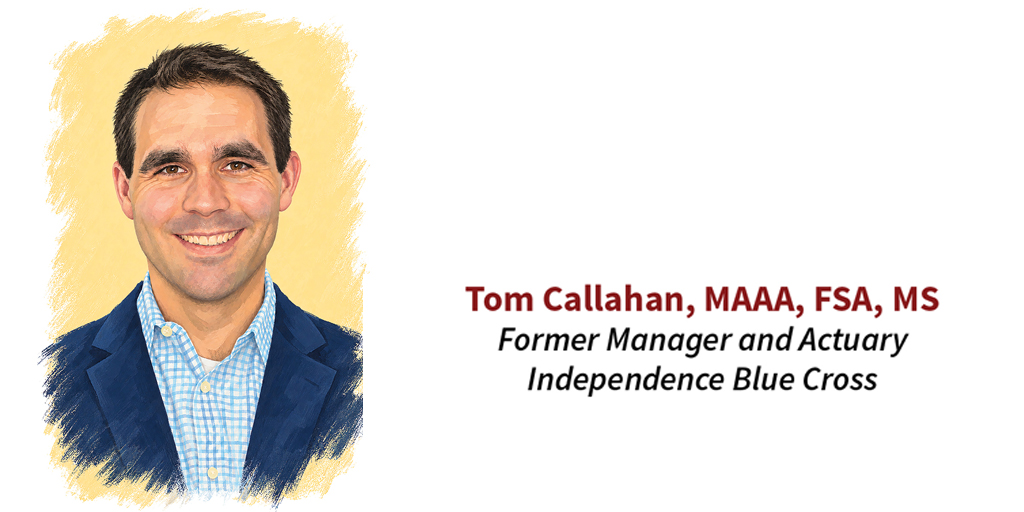
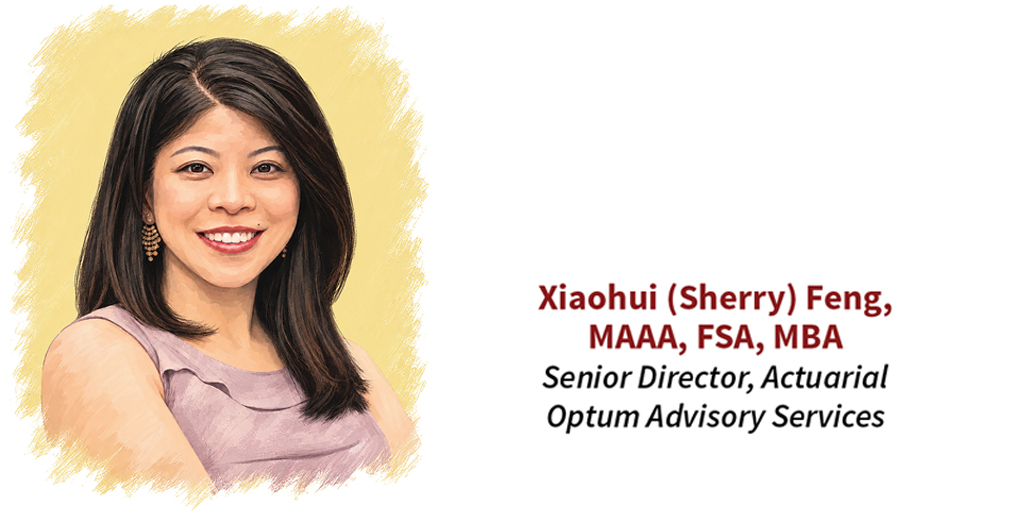
Xiaohui (Sherry) Feng, MAAA, FSA, MBA
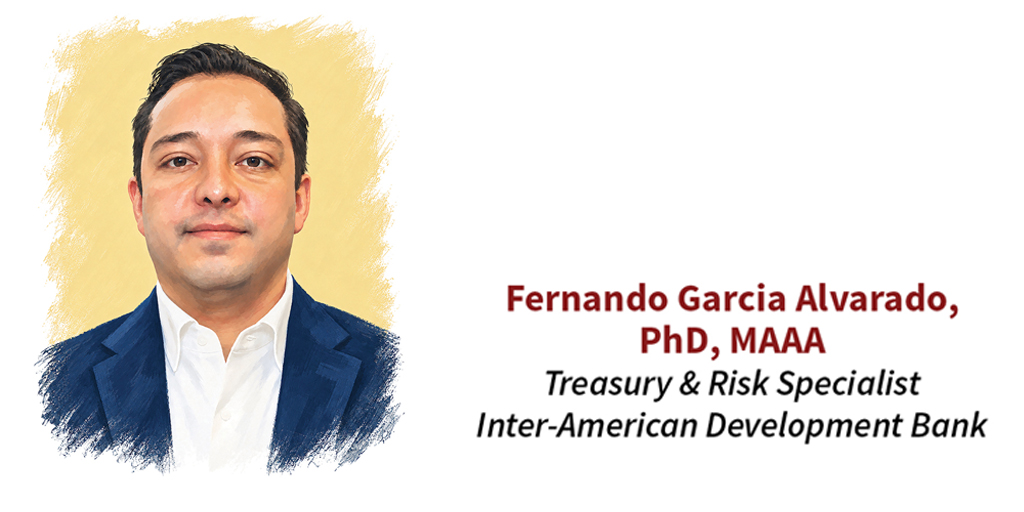
Fernando Garcia Alvarado, PhD, MAAA
Francisco Mojica III, MAAA, FCAS
Melanie Zuber, MAAA, FSA, CERA
Keeping Judgment at the Center
When I was in high school, my favorite class was mathematics. My dad is an adjunct professor at Temple University; he flagged actuarial science as a potential major and career path. I went to Temple as an actuarial science major, and while I found the exams to be very challenging, I never considered a different career path.
In the actuarial sphere, I would call out Dan Rachfalski, the chief actuary at CVS/Aetna, and Jon Forster, professional development director at the Society of Actuaries. Both have been supportive in my life and career. I admire their generosity, professionalism, honesty, and poise under pressure. I trust them very much and know I can count on them whenever I have career questions or need advice.
Outside of actuarial, I have been very blessed to call Charles Chaput, the retired archbishop of Philadelphia, one of my mentors. His wisdom, intelligence, and example of making the right decisions, even when they’re difficult, are all attributes I hope to emulate.
When I became president of the Actuaries Club of Philadelphia, we had to confront the issue of whether—and how—to return to in-person events after COVID. We all felt it was important to get back in the room together. However, with so much uncertainty, I recall how nervous I was to be the visible face of the first in-person event after COVID. I think I was literally shaking as I walked to the hotel venue. In fact, for the first event, turnout was smaller than our pre-pandemic norm and we lost money. But the event still went well, and I think there was a prevailing sense that “we can do this.”
I learned that sometimes leadership requires a willingness to see through the immediate results and keep a long-term perspective. It would have been easy to stay with virtual events, but being in-person has been a much richer experience.
For the last couple of years, I have served on the SOA’s Professional Development Curriculum and Content Creation Council (PD4C) AI Subgroup. I have studied in detail how large language models work, and pay close attention to how AI responds to my prompts and how different phrasing can affect results.
I use AI as a thought partner rather than a replacement for judgment. For example, it has helped me write performance appraisals—I send it my draft and it helps me refine the message so that critical feedback lands clearly without being unnecessarily harsh.
In terms of maintaining professionalism, the key for me is retaining ownership. I never accept an AI output without being willing to stand behind it completely. I have found that it’s possible to use AI to save time, and it’s possible to use AI to improve the quality of your output, but it’s probably not possible to do both at the same time.
We are in for an eventful next 5 to 10 years. I think it is of utmost importance that we retain the trust of the public. We live in a partisan, divided, time, and actuaries are one of the few professions trusted for their objectivity. Maintaining that trust, and using it prudently, will be very important given that few other professions can wield as much influence as we can.
No answer to this question would be complete without mentioning AI and the massive, but unpredictable, impact it is going to continue to unleash.
I have found that it is our job to be the ones connecting the silos across a company. I think my greatest skill is in communication; I am confident in speaking with actuaries, accountants, database administrators, and clinical areas, among others. Yet, the way I speak and the facts I emphasize will be different depending on the audience. We need to master our own domain, but we also need to see the big picture and connect all the different elements contributing to the larger project.
The Actuaries Club of Philadelphia has a warm relationship with the Academy, and the Academy has supported us through the years by sending us professionalism speakers. I think it is great that we have such a resource on hand to help us navigate the ethical gray areas that can present themselves.
Back to top
Thinking Beyond the Model
I first learned about the actuarial profession from my mother when I was in high school in China. At the time, actuaries were relatively rare, and I was initially drawn to the profession because it was technical, specialized, and offered a distinctive career path. That interest brought me to Temple University, where I had the opportunity to study in a strong actuarial program and learn from inspiring professors, including Dr. Krupa Viswanathan.
What has kept me passionate about the profession, however, is something I came to appreciate later: Actuarial work provides a unique lens for solving strategic business problems. As actuaries, we have the technical foundation to bring together pricing, product, provider strategy, risk adjustment, operations, and an evolving regulatory environment—and translate all of that into decisions that can meaningfully influence an organization’s future. That ability to start with actuarial analysis and ultimately influence broader strategy is what continues to inspire me today.
I have been fortunate to have had many mentors throughout my career, and each has helped me see possibilities in myself that I might not have seen on my own. At Temple, Dr. Viswanathan gave me opportunities to lead, teach, and speak publicly through Gamma Iota Sigma and as her teaching assistant, helped me build confidence and find my voice.
Later, my managers repeatedly trusted me with opportunities outside my comfort zone—from unfamiliar responsibilities to major career moves, including returning to China. They recognized that I was willing to embrace change and uncertainty and then challenged me to go further than I might have gone on my own. Over time, their trust has reinforced one of the principles that now guides my career: Growth often requires stepping into unfamiliar territory before you feel completely ready. I hope to give the people I mentor today that same combination of trust, opportunity, and encouragement.
One of the biggest professional challenges of my career was leaving the U.S. to join a health care startup in China. I went there expecting to leverage my actuarial experience to build an actuarial function and help integrate the company’s products with health insurance. Instead, I found myself in a very different market, with limited resources and few defined roles. I often describe what I learned there as becoming an “octopus”—developing the ability to stay connected to many parts of the business at once, from actuarial modeling and research to sales, product, and relationship building, while understanding the different incentives and perspectives driving each stakeholder. I learned that solving a strategic problem is rarely about optimizing one piece in isolation; it requires seeing how the pieces connect and influencing people across functions to move toward a common outcome.
The experience also showed me the limits of technical expertise alone and motivated me to pursue an MBA after returning to the U.S. to build a more systematic foundation in business and strategy. What felt like a difficult career transition at the time ultimately reshaped how I work today: I still approach complex problems like an octopus, staying connected to many parts of the organization while keeping sight of the bigger picture.
What excites me most about AI is not simply that it makes actuaries faster but that it makes the boundaries between functions much more permeable. I use AI across the lifecycle of a project—from research and Excel modeling to reporting and presentations—but its greater value is that it allows me to quickly learn how other disciplines approach a problem, understand their workflows and tools, and bring those perspectives back into my own actuarial work. AI dramatically lowers the barrier to cross functional boundaries, allowing actuaries to broaden the capabilities we can bring to a problem and bring together ideas across disciplines much more quickly.
At the same time, broader reach does not mean broader authority without judgment. AI can help me enter unfamiliar territory, but it does not make me an expert in every field or relieve me of my professional responsibilities. I still need to validate the methodology and results, understand the limitations and intended use, protect confidential information and data privacy, and recognize when additional expertise is needed. To me, that is both the opportunity and the responsibility of AI: It can expand the boundaries of what an actuary can do, while actuarial judgment determines what we should stand behind.
I believe the role of actuaries will increasingly shift from producing analysis to exercising judgment beyond the model. As AI makes technical analysis faster and more accessible, our value will depend less on our ability to produce an answer and more on our ability to determine which questions are worth answering, understand what different stakeholders are optimizing for, evaluate trade-offs under uncertainty, and influence decisions across an organization. Technical expertise will remain essential—it is what grounds our judgment and gives us credibility—but it will no longer be enough on its own.
To me, this is an enormous opportunity for the profession. Actuaries are already trained to make decisions under uncertainty; the next evolution is to apply that judgment much more broadly. The actuaries who create the most value will be those who are able to connect technical insight with business context, people, and strategy—and exercise sound judgment in the places where the model cannot provide the answer.
Don’t wait for seniority to start thinking like an owner. Early in my career, a mentor told me that the true test of your work is whether you can take something from beginning to end and own the outcome. That advice has stayed with me because ownership is difficult at every stage of a career—it means taking responsibility, not only for your piece of the analysis, but for whether the problem was framed correctly, the work gets across the finish line, and ultimately creates the intended impact. It can be uncomfortable to take that level of responsibility before you feel completely ready, but I believe it is one of the fastest ways to grow. The earlier you stop asking, “What is my part?” and start asking, “What will it take to make this successful?” the faster your career can accelerate.
The most valuable benefit of my Academy membership is not any single resource that I use, but being part of a profession with a shared commitment to professionalism and the public interest. Much of my work sits at the intersection of actuarial analysis, business decisions, and public policy, and the Academy provides an important framework for what it means to practice responsibly in that environment. It reminds me that being an actuary is more than having a technical skill set or producing the right number; our work carries a responsibility to exercise sound judgment, uphold professional standards, and contribute an objective actuarial perspective to decisions that can affect businesses, policymakers, and ultimately the people they serve.
Back to top
Making the Math Matter
I have always been good at math. I took many courses in pure mathematics but, although I was very interested in these topics, I always wanted to apply them to “real world” problems. For instance, I have always been interested in business and finance. For me, becoming an actuary was the meeting point of both: being a mathematician who knows business, and a businessperson who knows math.
Back in college, a professor once told me that actuaries are “the mercenaries of mathematics.” Now I am not entirely sure if that was meant as a compliment or the opposite, but I have always loved the way it sounds!
I have been fortunate to have had several mentors over the years. More than anything, they have inspired me to be a better person. I always viewed them as role models, and my hope is that one day I can pay that forward and be that same kind of source of inspiration for someone else coming up in the field. Their guidance has also reminded me that success is not just about technical expertise but also about how you treat people and the example you set for others.
As mathematicians, our instinct is to dive straight into sophisticated formulas and complicated theorems. But I always say that selling the model is actually the hardest part of the job. Trying to convince salespeople, accountants, and lawyers that they have been under-reserving capital, and need to raise risk premiums and raise prices, is painstakingly tough. So, actuaries have to be excellent quantitative thinkers and persuasive.
Ultimately, I have learned that having the right answer is only part of the job. You also need to be able to explain it clearly, understand your audience, and convince people why it matters.
I view AI with equal parts gratitude and fear. On the positive side, it saves a tremendous amount of time when writing emails, polishing notes, and checking spelling and grammar. It has become a useful tool for improving the clarity and efficiency of my communication. On the other hand, I have seen AI hallucinate responses that are wild. Professionalism, therefore, comes down to human oversight. You can use AI to assist and speed up your workload, but you have the responsibility to own the final output. Ultimately, technology can help you work more efficiently but it does not replace your professional judgment or accountability.
The next several years will be about normalizing AI and establishing best practices around how, where, and when it is acceptable to use it in our day-to-day work. I also think actuaries will continue to play an important role in bringing quantitative rigor and professional judgment to increasingly complex business decisions.
Hard work pays off, without a doubt. Whether it comes in the form of higher compensation, better opportunities, or simply the respect of your peers, the effort you put in always yields results. The pain of the long hours is momentary, but the glory is forever!
More importantly, do not underestimate the value of simply being willing to put in the work, learn from others, and take on challenges that may initially seem outside your comfort zone. Those experiences tend to pay dividends later in your career.
The most valuable benefit of my Academy membership is networking. Being able to connect with people from so many different backgrounds, practice areas, and regions across the country has been incredible. I cannot imagine any other setting in which I could have built such a diverse professional network in such a short amount of time. The opportunity to learn from people with different experiences and perspectives has been just as valuable as the connections themselves.
Back to top
Investing in Relationships
I first learned about the actuarial profession when I discussed career options with my high school guidance counselor during my junior year. He had a family member pursuing an actuarial credential and thought my interests in applied mathematics, economics, public policy, and business would make the profession a good fit. After researching the career path, I became excited by both the value actuaries provide and the wide range of opportunities the profession offers.
My college search centered around schools that had the Society of Actuaries’ Centers of Actuarial Excellence designation, and I ultimately selected Drake University in Des Moines, one of the country’s major insurance hubs. In my first year there, I had the chance to meet the former CEO of Principal Financial Group, who was a Drake alum. He started at Principal as an intern before building his career to eventually become CEO. It was inspiring to see the landscape of roles available within the profession while I was at such an early stage of my career exploration process. A year later, I was in the same role as an actuarial intern at Principal, seeing those opportunities firsthand. Since that internship, I’ve enjoyed the many chances I’ve had to learn and grow within the profession.
I have felt incredibly lucky to have great leaders and mentors throughout my early career. My leaders, Ryan Ramsey, Adam Feller, and John Ripley have facilitated on-the-job learning and included me in important discussions that have furthered my personal development. They have inspired me to be a future leader who carves out time for education and development for direct reports. Additionally, they have exemplified how to be an advocate for team members by providing opportunities that will bring elevated exposure to their work and skills.
I have also had the pleasure of working closely with many leaders within the actuarial career path at Principal, specifically in developing learning opportunities in my role as chair of the Actuarial Education and Development Committee at Principal. Working with our actuarial community leadership team (including Ken McCullum, Dwight Soethout, Liz Dietrich, Chris Kinnison, and many others) has allowed me to witness firsthand how the actuarial profession can open a pathway for impactful leadership. They have demonstrated this through influencing business decisions, shaping culture, and developing future leaders in the profession. Their leadership has allowed me autonomy to lead and take risks by putting together learning sessions for the community while providing support along the way.
I have had many other mentors over the years (too many to name) that I have appreciated immensely. Most of all, these relationships have inspired me to invest my time, knowledge, and intentional effort in helping the next generation of young professionals in the future.
The biggest professional challenge was transitioning from working fully in person to fully remote for a two-year period. I first experienced remote work along with practically everyone in the industry when COVID hit in early 2020, but I was able to return to the office once it was safe to do so. However, a few years later, my spouse’s job took us to California, leading to a fully remote work arrangement while many of my coworkers were in the office in Des Moines collaborating in person. One year into this fully remote work arrangement, I transitioned to a new team, creating the need to learn a new job function and build relationships entirely virtually with a team that was once again largely in person.
From this experience, I learned how important relationships with my colleagues are to my work success and day-to-day enjoyment. The strong relationships around the company were what kept me from pursuing other opportunities, but I learned that maintaining and building those relationships took intentional effort in a fully remote role. I also learned that how you set up and engage with a fully remote team member is not the same as when someone is sitting next to you day in and day out. Successfully navigating that relationship takes effort from the remote team member and those who are in the office.
After two years of my remote work arrangement, my wife was able to get a fully remote role, and we decided to move back to Des Moines, allowing me to return to the office. The future of workplace collaboration will continue to evolve, but I feel that having the experience of being a primarily remote employee equips me to better understand and collaborate across many future arrangements. Regardless of the setup, I learned that building relationships through intentional communication is key to achieving the best outcomes.
AI is evolving extremely quickly, and it is changing current and future work processes in real time. It is highly valuable and necessary to experiment with AI to learn how to enhance productivity while ensuring the work is understood, validated, and communicated effectively. In my work, this has included experimenting with code generation, advanced analytics methods, and agentic AI tools to enhance my output. Especially in this learning phase, I am keeping a close eye on the risks associated with overextending reliance on AI results without sufficient context and human interaction.
I have been working independently and across teams to champion learning opportunities in leveraging AI, especially in the context of data analysis and exploration of agentic AI. In my role as chair of the Actuarial Education and Development Committee, I led a team in developing a case study to use AI models across multiple platforms to perform quantitative and qualitative tasks using a mock dataset. The goal was to encourage experimentation with these emerging technologies while having a balanced conversation about the risks associated with solely relying on these tools.
It is crucial to understand these emerging tools, use them to improve day-to-day work, and ensure human review and context is given to the results. To protect actuarial professionalism, we cannot rely on AI results blindly. The profession will continue to add value by providing needed expertise to make decisions that drive our businesses to better outcomes.
I anticipate that AI will significantly shift how actuaries work, but I do not believe that it will diminish the need for our expertise. Given the ability to leverage AI for data aggregation and analysis, actuaries will need to lean into their contextual expertise even more to translate data into meaningful business insights. Actuaries will need to build connections with other areas of the business to help communicate these results to drive better business decisions. Actuaries will also play a crucial role in creating risk guardrails and oversight for AI and other emerging technological solutions to ensure responsible and measured adoption.
Additionally, insurance companies are continuing to innovate in terms of products, investment strategies, legal structures, and more. I believe this will require actuaries to understand emerging risks from those trends, help define evolving regulations, and ultimately guide businesses in complying with regulations and making responsible decisions. I anticipate that actuaries will provide valuable expertise in defining regulations that balance the interests of multiple stakeholders in the increasingly complex backdrop of the insurance industry.
For those who are just starting out their actuarial careers, I would suggest building up a network of colleagues and advisors that can help answer questions and encourage your curiosity. Building a broad network and being curious about what they do can help provide context that will build your understanding of the profession much faster than exams and day-to-day job performance alone. Additionally, hearing how different colleagues think about the same problems can help you develop your own views on how to best approach your work. For example, you may get multiple opinions on how to create an executive-level presentation, and you can piece together the advice that resonates to develop your own views and approaches.
Along with this, I would recommend giving back in this same way by offering to be a mentor for newer employees, even early in your career. I’ve often found that answering questions teaches me just as much, because it forces me to explain complex ideas in simple terms. While math and analytics skills are crucial to the actuarial profession, I believe that communicating ideas and building relationships are even more important to driving results. Actuaries who can combine these skills with business context are perfectly positioned to make an impact in the profession.
Academy membership has allowed me to gain access to education and professional development opportunities. The Academy focuses on fostering professional excellence and using expertise to inform public policy and insurance regulations. With my Academy membership, I have had access to valuable webinars and research articles on emerging topics in the insurance industry. This has uniquely positioned me to help facilitate learning experiences for colleagues and better understand how actuarial expertise can influence policy conversations to ensure the best outcomes for policyholders, companies, and other stakeholders. The intersection of actuarial expertise and public policy is an area I hope to become more involved in throughout my career.
Back to top
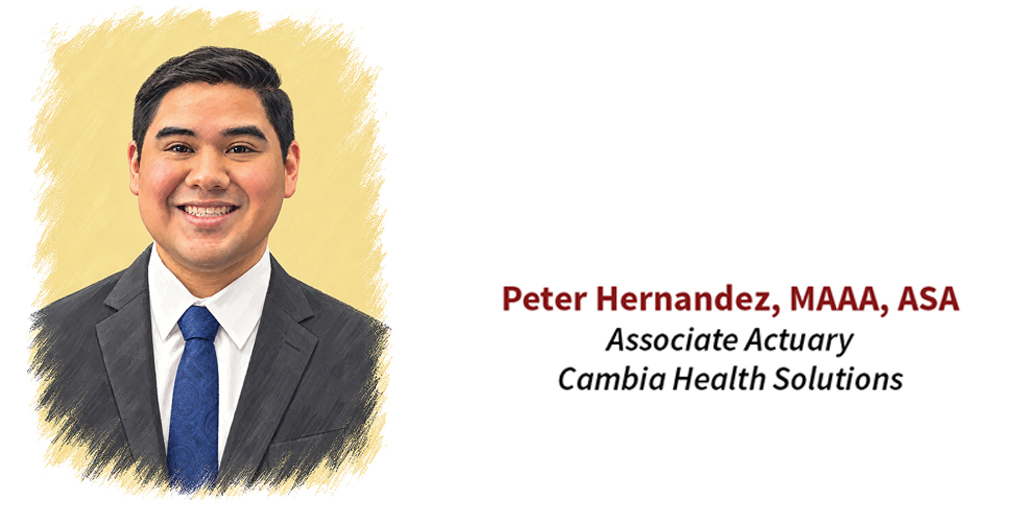
Finding Growth Outside the Comfort Zone
I originally wanted to be a teacher, but I soon realized that I wanted a career in which I could apply my math skills to real-world problems. My college, California State University Stanislaus (Go Warriors!) didn’t have an actuarial program or professors actively promoting the profession, so I discovered actuarial science by Googling what I could do with my degree. Being an actuary really checked all the boxes for me. One of the biggest draws was knowing that I would get to continue learning and challenging myself throughout my career. The challenge of joining the profession really sank in after I failed my first actuarial exam. Strangely enough, that was the moment I knew this was the field I wanted to be in. I did more research, changed my game plan, and the rest is history.
I’m very fortunate to have found myself at a company that has given me multiple mentors throughout my career. My first mentor, Dan Boeder, really helped me push forward early on. I appreciate that he always shoots it straight with me and has given me great career advice. He has inspired me to tackle challenges head on and to be willing to step out of my comfort zone to take on new opportunities. My second mentor, Shannon Ramsey, really helped me shape my professional presence and find my voice in a room. She helped give me the confidence to speak up, share my perspective, and recognize the value I can bring to a conversation.
My other two mentors are my current managers, Biljana Guchereau and Brian Orr. They’ve inspired me to always question why, to help mentor others as I progress in my own career, and to remember the importance of putting myself first. Each of my mentors has influenced me in a different way, both professionally and personally. As I said, I’m very fortunate to have so many talented actuaries and friends in my corner helping guide me along my journey.
My biggest professional challenge happened early in my career when I struggled to ask for help because I worried people would think I didn’t belong. (Imposter syndrome is so much fun!) I would sometimes sit with a problem for far too long when a simple question could have helped move things along. It also didn’t help that I was starting my career right around the beginning of COVID, when so much of the normal interaction and learning from coworkers had changed. My first mentor, Dan, really helped me through that period. He set up weekly meetings in which I had a dedicated space to ask questions and worked alongside me on recurring projects, which helped me quickly build my confidence. I learned that it’s okay not to know something and to ask for help. There are so many people willing to offer guidance, you just have to be willing to speak up and ask. That experience has changed how I approach joining new teams and taking on unfamiliar projects, but it has also shaped how I work with newer actuaries. I really enjoy being involved in onboarding new hires to my team, and I’ll set up weekly meetings with them to make sure they have a space to ask questions. I benefited tremendously from someone doing that for me early in my career, and I want to make sure I can provide that same support to others.
At the moment, I’m primarily using AI to help build and troubleshoot code. It can really speed up the process by giving me a skeleton to start from, but it doesn’t always get things perfectly right. Because I understand the foundation and what I’m trying to accomplish, I’m able to identify areas that aren’t working and make the necessary adjustments. Outside coding, I use AI for tasks such as meeting notes, drafting emails, brainstorming, and even anticipating questions that might come up based on an email or presentation deck.
When it comes to actuarial professionalism, I follow a piece of advice I’ve heard from several people: Treat AI like an intern! It can be incredibly helpful, but you still need to review its work, question its conclusions, and ultimately take responsibility for the final product. I never want to rely on an AI response simply because it sounds confident or reasonable. Many times, I’ll use AI to help brainstorm or point me in a direction, and then I’ll go find reliable sources to validate the information myself. At the end of the day, AI is another tool in our toolbox, but it doesn’t replace actuarial judgment or our responsibility for the work we produce.
I anticipate the actuarial profession continuing to evolve beyond traditional modeling into more of a strategic and collaborative advisory role. AI is here to stay, and with it we’ll continue to see improvements in efficiency and analytical capabilities. As some of the technical work becomes faster and more automated, I think there will be even more emphasis on understanding the output, questioning whether the results make sense, and being able to communicate what they actually mean. Being able to explain your results and analysis to a non-technical audience becomes more important every day, and actuaries will increasingly be looked to as the people who can bridge that gap between complex analysis and business decisions. At the end of the day, the actuaries who can combine strong technical skills with sound judgment, communication, and an understanding of the bigger picture will be the ones who make the greatest impact.
Some advice I would give to actuaries just starting their careers is to stay curious and don’t be afraid to make mistakes. Take advantage of opportunities outside of your immediate role, volunteer for stretch projects, and ask lots of questions. If something doesn’t go the way you expected, look at it as a learning opportunity rather than simply a failure. Everyone is going to make mistakes throughout their career, especially when they’re learning something new. What matters is how you respond to them, what you learn, and how you move forward. Growth usually comes from being a little uncomfortable, and I think embracing that early in your career can take you a long way.
One of my most valuable benefits of my Academy membership is my handy-dandy pocket-sized Code of Professional Conduct! I truly think it’s awesome, but in all seriousness, one of the most valuable benefits of my Academy membership has been access to exceptional continuing education, especially around professionalism. As actuaries, our technical skills are obviously important, but so is understanding the professional responsibility that comes with the work we do.
Back to top
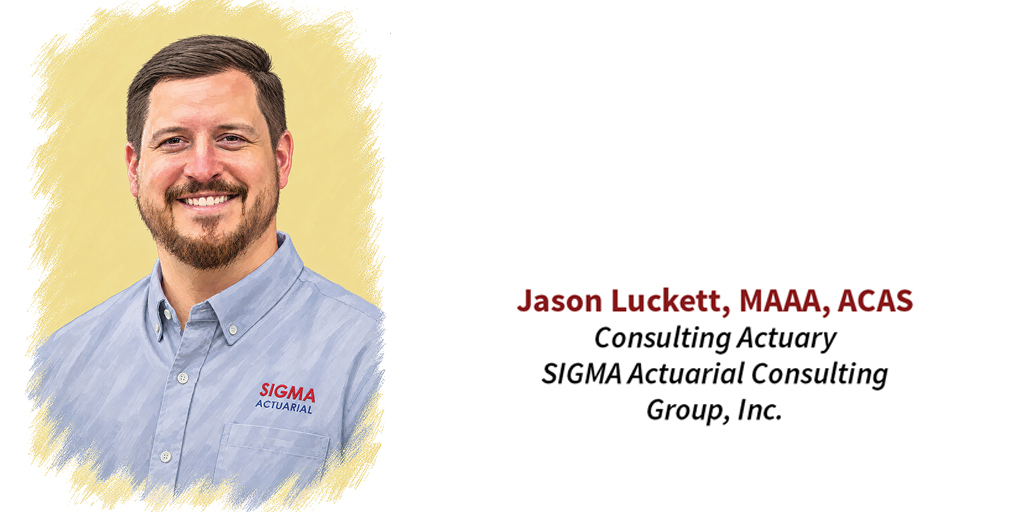
Growing Into Leadership
I always seemed to have an affinity for mathematics. And I have family members who are involved in the accounting, finance, and engineering fields, so something based in mathematics always seemed like an obvious option for me as I entered high school and started thinking about what to do with my life.
When many of my peers signed up to take physics, I decided to take a different path and signed up for AP Macroeconomics. I really enjoyed that class and realized that mathematics can have such a large impact on the business world. That class planted the first seed in my mind about finding a career in which my skill in mathematics could be put to use for business.
I have been fortunate to work with the same company since I graduated from college, and a large reason for my success has been the mentors that have trained me along the way. SIGMA is a relatively small company (less than 25 employees), but the actuaries and long-term consultants who work here have a vast array of experience from their time prior to and with the company.
Al Rhodes, Michelle Bradley, Tony King, Keith Hein, Enoch Starnes, and Tim Coomer have all been foundational to my professional growth. It is a long list and might be more than the original intent of the question, but each of them played a role in my development. Drawing on the unique insights from their different perspectives and backgrounds has helped me to develop into the actuary and person that I am today.
As my role has evolved from working daily in the weeds of data files and analyses as I did as an actuarial analyst, I have had to learn how to delegate tasks and guide the team members who are working on projects for which I now serve as the opining actuary. Letting go has not always been easy after being so hands-on earlier in my career, and it has required growth in maturity and judgment to identify which parts of the work can appropriately be delegated. I have also had to develop more efficient ways to review team members’ work without fully reproducing it myself. This stage of my career has reinforced that, even as I achieve goals I set earlier in my career, there is always continued opportunity for growth and development.
I would describe my company’s integration of AI into our day-to-day workflow as measured. I’ve found the most value in using it while doing research, almost as a supercharged Google search that I can talk to, as well as using it to help me compile benchmark information that my company annually aggregates into an easy-to-use file.
AI is similar to other tools that actuaries may have historically relied upon—work of other industry professionals such as catastrophe modeling or assessment from a company’s legal department—and as such actuaries are allowed to make use of it.
The most important steps to take when making use of this type of outside source are:
- Assessing the qualifications of those producing the work;
- Understanding the methodologies used;
- Documenting my reliance; and
- Determining whether the information was appropriate for my intended purpose.
Because AI does not have specific qualifications that we can assess, the due diligence burden may shift toward understanding the tool’s limitations and validating its output.
I believe automation will change how future actuaries develop professionally. Many of the foundational skills I gained early in my career came from performing analytical tasks that may eventually be automated. As the profession evolves, it will be important to balance the efficiencies gained through technology with opportunities for analysts to develop the technical judgment and critical thinking skills necessary for future leadership roles.
I recommend that early career actuaries become comfortable with the increasing role that technology will play in data analytics while maintaining their own professional development. From my perspective, the best actuaries in the future will not simply use AI to do their work, but rather utilize AI for appropriate tasks while being able to still own and understand the whole process. The business world relies on the ability of actuaries to translate data analysis into indicators for their decision-making. An actuary who can find the right balance between technical expertise, AI-driven work efficiency, and high-quality communication will be an invaluable part of the business world.
The Academy does a great job of providing information related to emerging issues. I regularly receive information from the Academy that provides highlights and discussions of topics that help me in my day-to-day profession and in keeping up with my continuing education requirements. One example is a recent Q&A conducted with members of the Property & Casualty (P&C) Committee on Equity and Fairness regarding some of the key issues around bias in the P&C market.
Back to top
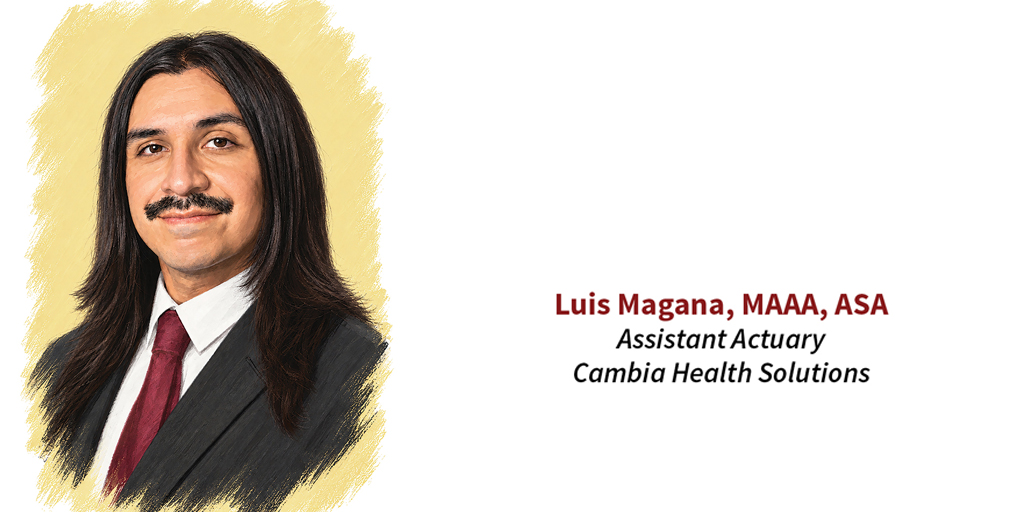
Finding Your Own Path
I started college wanting to be a sign language interpreter, but after my first math class I knew that I wanted to pursue something in mathematics. It was my Calculus 1 professor who first introduced me to the actuarial profession, and after much discussion with her, I decided to switch my major. When I transferred to a four-year university, I got my first exposure to actuarial coursework. I was immediately drawn to it, especially the materials that paralleled the exam process. I found it to be pretty fun—as much as schoolwork could be. That was long ago, and, looking back, I’m so grateful that I made the change. I genuinely can’t imagine doing anything else.
Over the years, I’ve been fortunate to have several mentors, some formal, some informal. Honestly, I consider my entire team in government programs to be mentors in their own right. They are incredibly supportive, always willing to go the extra mile, and have genuinely helped build my confidence along the way. One of the most valuable things they’ve taught me is that it’s okay to make mistakes—just keep trying. They inspire me every day by just being themselves, this pushes me to match their level of professionalism, intelligence, and candor. I would not be where I am today without every one of them.
The biggest challenge I have faced was failing my first FSA exam twice in a row. Failing the first time was discouraging, but the second time forced me to take a step back and really think about my approach. I realized I was putting unrealistic expectations on myself throughout my entire exam journey and stressing myself out more than I needed to, which likely impacted my performance on the exam and at work. That failure taught me that progress is not linear; sometimes it’s very messy and unpredictable. It also taught me that I need to stop comparing myself to others who are on the same path. Comparison is the thief of joy, and I am on my own journey, just as everyone else is on theirs.
The use of AI in my work is limited, but there are ongoing efforts to broaden its use across work tasks. I primarily use it for code generation and troubleshooting, preliminary memo reviews, and Excel workbook optimizations.
When it comes to professionalism and AI, I think it comes down to one thing: You should never let AI generate content without reviewing it and claim it as your own. Whenever I engage with an AI model, the ideas, perspectives, and direction are always mine. Allowing an LLM to dictate the conversation without proper disclosures and appropriate caveats is dangerous, and professionally irresponsible. All output is reviewed before being communicated, and personal health information is never shared. These principles are always at the forefront of my mind when using AI.
I see the actuarial profession and technological advancement continuing to evolve in parallel, which I think has always been the case. As AI and data tools become more sophisticated, we will spend less time on tasks such as data cleansing, and manual data updates. This frees senior actuaries to focus on deeper analysis, understanding model results, and refining recommendations that may have previously been deprioritized due to time constraints.
For newer analysts, I see this as an opportunity. Rather than spending early career years on tasks that are increasingly automated, they can dive right into core actuarial work sooner. This allows them to have a stronger understanding of business functions and how their work connects to broader corporate objectives. Ultimately, it will fast-track young professionals along the path to becoming more well-rounded actuaries. To capitalize on this opportunity, the actuarial profession must continue to be adaptable and utilize these new tools in the most effective way possible.
When you’re starting your career, ask as many questions as possible. If you’ve already asked the question, ask again and ask different people. This career can be challenging, and the concepts are complex. We were all there, and we understand, so just ask. And if you’re taking an exam, take a break! Go for a walk, watch a movie, treat yourself.
The most valuable benefit of my Academy membership is having access to extensive continuing education materials. Having the opportunity to continue learning throughout my career is invaluable. In addition, being a member of the Academy comes with professional credibility and connects me with other actuaries who are committed to the professional standards set forth by the Academy.
Back to top
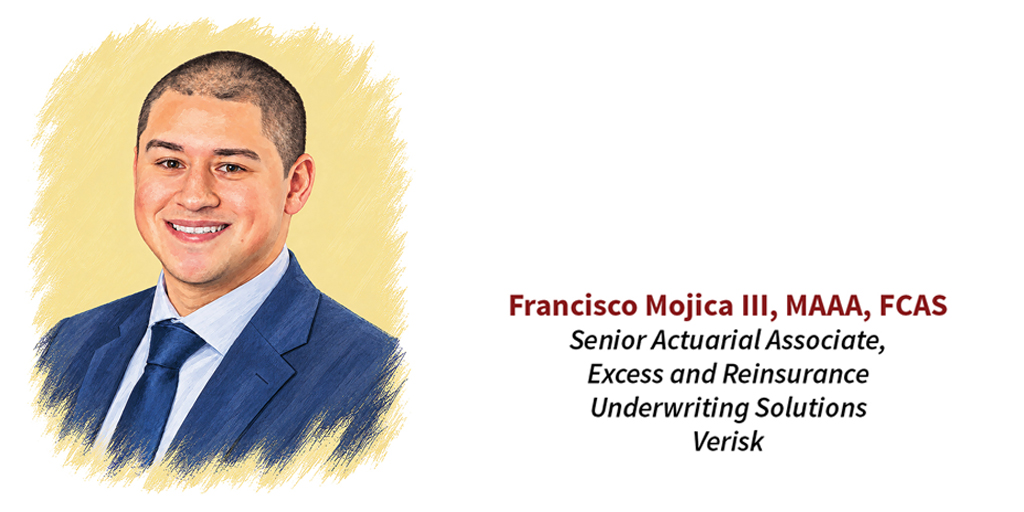
Creating New Possibilities
I learned about the actuarial profession during my senior year of high school. I was searching for careers that were math intensive and came across the profession. As I learned more, there were two aspects of the career that stood out to me. First, the property and casualty insurance industry is very dynamic. New risks are constantly emerging. Determining their impact and how to mitigate them is essential to many industries. The constantly changing insurance environment indicated that my work would continue to be new and exciting.
The other aspect that appealed to me was the exam process. While it proved more difficult than I anticipated in high school, the ability to further my career through a process that was entirely in my own hands was unique. The exams allowed me to learn about the profession while advancing my career.
I do have a mentor, and the relationship has been extremely valuable for me. They have inspired me by showing different ways I could approach my career and continue to grow within my organization. For example, they uniquely built out a role and team within the organization that didn’t previously exist. This taught me a significant lesson about not only performing within your role but also finding new ways to build out solutions that hadn’t been developed yet. It has taught me the value of thinking outside of the box and continuing to find ways to innovate.
Failing exams was the toughest challenge I faced in my career. The preliminary exams didn’t take much time, and once I reached the CAS exams, it was a drastic change. Every fail weighs on you and can feel like you have set your career back six months. I learned early on to accept failure as part of the process, while taking time to understand what led me to fall short. Each exam helps you learn how much time you need to study and the most and least effective study methods for you. Continuing to push forward and not dwell on your shortcomings is essential.
I am treating AI as an extension of myself. AI can process documents, generate Excel formulas/workbooks, and write code more efficiently than any person. This allows me to increase my output while simultaneously improving accuracy. To uphold the principles of actuarial professionalism, I thoroughly review AI-generated output and sources to ensure their accuracy and reliability.
The profession will continue to evolve alongside technology as new tools and resources emerge. The most prominent technology currently is AI. I view AI as learning a new programming language. Understanding how to prompt effectively and check the outputs for accuracy is similar in approach to how you’d go about querying data, but applied in a new way that’s susceptible to a wider range of issues. Actuaries will not only use AI to automate their current processes but develop resources for other actuaries to use AI effectively and safely.
Find coworkers who are at a similar point in the exam process and keep each other accountable. It’s easy to skip studying when you begin preparing for an exam so far in advance. Keeping up with coworkers is a great way to stay motivated. Doing something difficult in coordination with others is easier than doing it in isolation. There will always be topics that some people understand better than others. Explaining concepts to others, and having them explained to you, offers more and different perspectives than the study material alone and helps deepen your understanding.
An additional benefit is the connections you build at work, which help you develop as a professional, learn about other groups in your company, and understand the work happening around you. This can help you coordinate your own work and will provide valuable knowledge as you grow in your career.
The most valuable aspect of being an Academy member is the work it does to maintain rigorous actuarial standards. For our work to be effective, the profession must maintain its reputation. Our profession is self-regulated and to do that effectively, we need a clear and concise framework of professional standards. The work the Academy has done to uphold and improve these standards has been instrumental to the growth and effectiveness of the profession.
Back to top
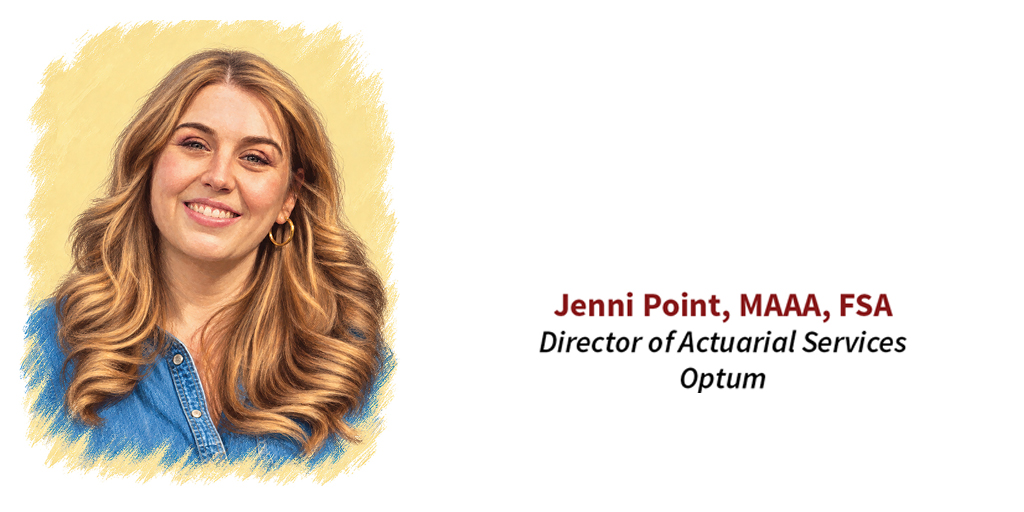
Seeing the Bigger Picture
I had a very round-about journey in college to begin this career. I started as a music major and then filtered through about six others before taking calculus for an easy A and remembered how much I loved problem-solving and math. Then I sat down at the end of my freshman year and looked through all the options I could try with a math major and actuarial science stuck out; lucky enough for me, my college was beginning their actuarial program the next year so I decided to take a stab at it and sit for Exam P, and now I get to enjoy a career filled with exciting problem-solving and strategic thinking.
I found a lot of purpose in this work. Insurance might seem like a boring topic, but I know firsthand how devastating it can be to really need care and not be able to find coverage. My mom was diagnosed with cancer when I was young, pre-Affordable Care Act (ACA), and her small employer told her she was too expensive to have on the insurance anymore and dropped her from the plan mid-treatment. Then she had to begin a job search while she should have been focused on recovery. It was grueling but, in the end, she found work at a larger employer in our small town, working nights as a nurse, which really took a lot out of her. I am so grateful the ACA became law and changed the rules, which makes it harder for something like this to happen to vulnerable people, and it really solidified to me why insurance is security and safety and how it really plays a huge role in protecting people. I am happy to be working to provide care for those who need it.
I am fortunate enough to have had an amazing boss who has developed into both a mentor and a friend, since our time working together. Jenny Sun is one of the smartest people I have ever met, and she has shown me by example how to really utilize the actuarial foundations and take our work to the next level. She has taught me how to go from just doing excellent work and passing off the results to being an active participant in the journey, helping to determine what questions we need to answer, developing the tools needed to analyze and find solutions, and then taking those outputs and analysis and providing those next steps and recommendations with thoughtfulness and proactive responses to potential questions or pushback.
This more strategic approach has been so helpful working in value-based care. So much of what I do involves understanding why it needs to be done and how we will make sure all stakeholders are benefitting in the end. Jenny has really taught me not only strategic thinking but also negotiation skills and impressed upon me the need for actuarial rigor to build faith in our ability. I am so grateful for her mentorship.
One of the hardest challenges in my professional career tends to be work-life balance. I have a track record of becoming incredibly involved in a myriad of projects and professional endeavors and forgetting to take time to be human, especially when I was studying for exams. It can also be hard once that is the norm to make changes and be comfortable doing an appropriate amount and not too much. I have had to really sit back and think about what I want out of life and how I am going to achieve it and realized what I want is balance. I love the work I do, and I get a huge amount of fulfilment, purpose, and, honestly, I just think problem solving and strategy are fun, but I also work hard to leave work at work and fill my life with other ventures and projects after 5 p.m.
Learning to turn down unnecessary opportunities and push back more on timelines has been a game changer, and I think it also helped me when I started managing analysts; I didn’t want them to be working their lives away so I needed to protect their peace as well and lead by example. It’s been so fun to get more involved in my community and return to some of my old hobbies, such as art and music, since working on balance.
I do not currently use AI to a large degree in my work. I am in a role where a lot of what I do is strategy, program design, and technical work I am very comfortable doing on my own without AI assistance. I do view AI as a tool and have heard some ideas about using this tool, which I am excited to explore more as time allows. However, I do think as actuaries we have a responsibility to be able to explain every aspect of our analysis and be able to verify and stand behind the results. As such it is important to not only disclose any reliance on AI tools but also fully vet, understand, and validate any work using AI just as you would quality-assure your own work. If you are unable for some reason to validate the results, then you should not be using the tool.
I foresee the next five to 10 years will be a challenging time for most professions, including ours. The actuarial profession is uniquely positioned to grow and change due to its self-regulated nature, which will allow us to remain at the forefront of new technological growth. Increased pressure is being placed on actuaries to do things faster with fewer resources as companies struggle with regulatory changes and cost constraints and much of that demand is being met using different AI technologies. While this can be a helpful tool and really aid in some of our work, we have all seen instances in which AI produces less than ideal results and sometimes those results slip through the cracks and get put into production. I believe we will need to evolve as a profession to address the threat to our integrity that these AI models bring and grow our expertise to be able to effectively use these technologies, interpret the results and know when not to use them. I fear we are headed toward a time when much of our work is clouded by close-to-accurate information that we will need to be competent to parse through and find accuracy. I have been discussing AI use with my team and colleagues and working to understand when it makes sense. I am also challenging myself and my analysts to work through these analyses collaboratively first to understand the processes inside and out so that when/if they do rely on AI assistance they can easily perform common sense checks. I am also requesting that reliance on AI be disclosed so we can view that work in a more accurate light.
As a health actuary, I see things moving from more traditional fee-for-service payments and toward more outcome-based alternate payment methods, due to the low-resource and high-cost health care landscape we find ourselves in today. This will require actuaries to broaden the focus from simple financial metrics as a form of success and push us to be creative and look to where value can be derived and quantified differently. These results-driven models require a much fuller understanding of the systems in place, from patient to provider to payer. It is important for actuaries to remember that we are only one small part of a greater health system and learning about how those other pieces work and navigate will help us better do our jobs and create better outcomes for the people receiving these services.
New actuaries are stepping into a tough space and AI is doing a lot of the tasks we normally relied upon our analysts to perform, so they are seeing increased pressure to be faster and more knowledgeable from the jump. I would advise analysts not to be discouraged or outsource their learning. Part of growth is the journey and learning to do simple analysis and grow your skills from there is how the journey starts. Try not to be discouraged by the time it takes to learn and be comfortable investing in yourself. You must grow those technical skills but, at the same time, begin working on the skills that are uniquely human. Explore the “why” behind your work and look for ways to bring that work forward into tangible outcomes and recommendations.
Membership in the Academy has opened many doors I didn’t even know about. Initially I just viewed the Academy as a way to get continuing ed and the place to go to for extra guidance on a new topic. Since then, I have learned it is so much more. I am involved in the health equity and research committees, and get to meet some amazing and intelligent people while giving back to and helping propel this profession forward. The Academy has provided a venue for me to have an influence on health-equity-related topics that are near and dear to my heart, as well as education on upcoming innovations and research being done by incredibly smart people that have potential to drive change. I am so grateful for all the Academy provides and especially for the incredible connections I’ve been able to make with people I love to learn from.
Back to top
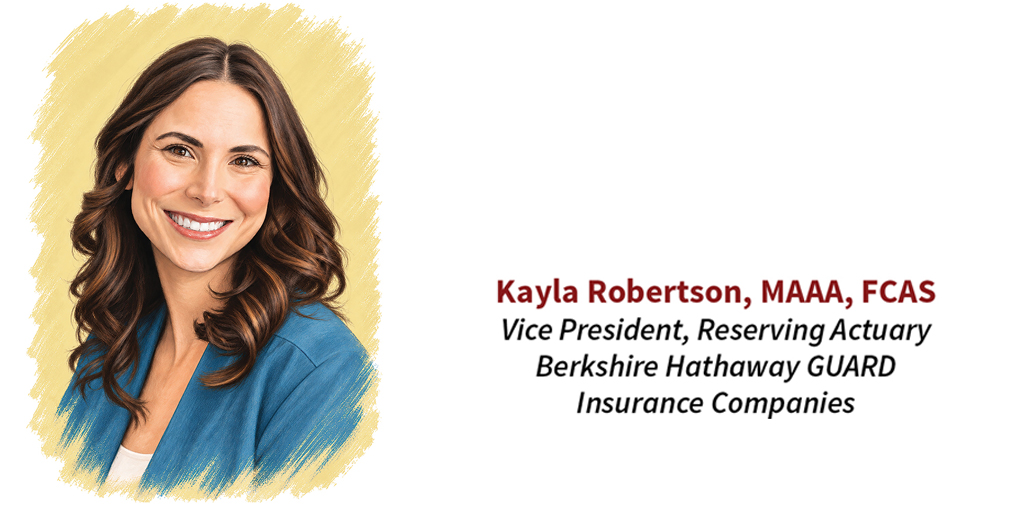
Investing in the Next Generation
I made the decision to pursue actuarial science a while ago. At the time, I was attracted to the combination of mathematics, problem-solving, and business applications. What has surprised me most is how many different directions the profession can take you.
Over the years, I’ve had opportunities to grow as a technical expert, leader, mentor, and advocate for emerging technologies, which has kept the work both challenging and rewarding. The profession continues to evolve, and I enjoy helping organizations navigate uncertainty while developing the next generation of actuarial talent.
One person who had a particularly meaningful impact on my development was Brad Eastwood, the chief actuary at Erie Insurance, when I started my career in 2014. Brad was a strong advocate for me early in my career and opened doors that helped me grow professionally. He also gave me leadership advice that has stayed with me over the years, including the importance of being consistent so that people know what to expect from you as a leader. Beyond his advice, I learned a great deal simply by observing how he led and interacted with others.
That experience reinforced the importance of investing in others. As I’ve taken on leadership roles, I’ve become increasingly focused on mentoring and sponsoring actuaries earlier in their careers. Many of the opportunities that helped me grow came from people who believed in me, and I try to do the same for others.
The biggest professional challenge I’ve faced has been building and leading a reserving function during a period of significant change. When I joined Berkshire Hathaway GUARDin 2024, the company was undergoing management transitions, changes in claims practices, and re-underwriting efforts. At the same time, I was responsible for producing quarterly reserve analyses while helping establish the processes, frameworks, and governance needed to support long-term success.
In many ways, it felt like a difficult actuarial exam question in which several assumptions are changing at once and the traditional approaches don’t always work as expected. The experience taught me that progress doesn’t always come from finding the perfect solution. I’ve learned that incremental improvements are often more valuable than becoming overwhelmed by a complex problem and doing nothing. As actuaries, we understand the power of compounding, and I’ve found the same principle applies to leadership and organizational change. Small, consistent improvements can add up to significant progress over time.
I use AI in a few different ways. At a practical level, it helps me work more efficiently by synthesizing information, writing and editing code, and accelerating routine tasks. Those capabilities save time, but what I find most valuable is that AI serves as a sounding board when I’m working through complex business problems. It helps me organize my thoughts, challenge my assumptions, and clear enough mental space to focus on creativity and strategy.
One of the most exciting aspects of AI is that it allows me to explore possibilities that I may not have known were available. As an actuary, I don’t need to be an expert in every technology to understand how it might solve a business problem. AI helps me discover potential approaches, ask better questions, and evaluate solutions that I might not have considered otherwise.
That said, actuarial judgment remains essential. I view AI as a tool that supports decision- making, not one that makes decisions. Any analysis, recommendation, or output must still be reviewed critically, validated, and evaluated within the framework of actuarial professionalism. The technology expands what’s possible, but professional judgment and accountability remain the actuary’s responsibility.
Looking ahead, I think actuaries will spend less time gathering and manipulating data and more time interpreting it. AI, automation, and modern data platforms are making data and reporting more accessible across organizations, which is a tremendous opportunity. However, greater access to information also creates a greater risk that results will be misinterpreted or used without fully understanding their limitations.
The real value of the actuarial profession has never been calculating numbers. It’s combining technical training, business knowledge, and experience to understand what those numbers mean, recognize when they don’t make sense, and help organizations make informed decisions in the face of uncertainty. As technology continues to evolve, I believe actuaries will play an increasingly important role in providing context, communicating uncertainty, and ensuring data is interpreted responsibly.
I would suggest early-career actuaries to not underestimate the value of communication skills. Technical expertise is important, but your ability to explain complex concepts, build relationships, and earn trust will often have just as much impact on your career.
I’d also encourage actuaries early in their careers to step outside their comfort zones. You learn the most when you’re challenged, and some of the opportunities that shaped my career came before I felt completely ready for them.
The most valuable benefit of Academy membership has been the relationships I’ve built with other actuaries through volunteer work. Throughout my career, I’ve benefited from the perspective, encouragement, and professional support of actuaries who have generously shared their knowledge and experience.
Through Academy involvement, I’ve developed friendships and professional connections with actuaries who bring experiences and perspectives that differ from my own. It’s reassuring to know that we’re part of a broader professional community, and many of those relationships would never have developed had I not chosen to volunteer.
Back to top
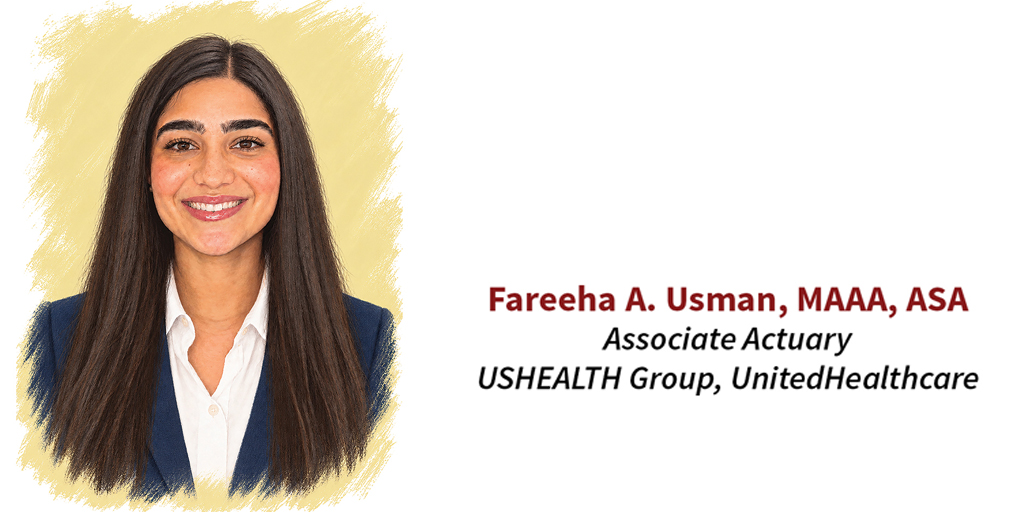
Staying Open to What’s Next
In school, I was always drawn to math and genuinely enjoyed it because it felt like solving riddles. So, when I started thinking about my future in high school, it felt natural to pursue that direction for both my bachelor’s degree and career. After weeks of research, encouragement from my parents, and an oddly insightful career finder quiz, I landed on the enigmatic discipline of actuarial science. What appealed to me most was the idea of using mathematical subjects I loved, such as algebra and calculus, in real-life applications. I am happy to report that, as an actuary, I do indeed feel like I am solving riddles every day.
I have been lucky enough to have two mentors in my career so far. Russ is someone I will always identify as the person who showed me the ropes when it comes to the skills needed to be a pricing actuary. Some bosses go above and beyond to develop their mentees, and mine definitely did. Over the years, I have tried to learn as much as I can from him, though in this case, I am not sure the student will ever surpass the teacher. He truly has a brilliant mathematically inclined mind that continuously inspires me.
Adam brought me onto his team after I completed my bachelor’s degree, and I have been thriving under his leadership ever since. He treats the process of developing aspiring and young actuaries like an apprenticeship, and the time and energy he has put into helping me grow as a professional is a testament to that. His rare balance of sharp intellect and genuine humility is something I will always admire and strive to learn from. I owe both of them a great deal of gratitude and have tremendous respect for them.
It is something I am still facing today: balancing career growth and exam progress. On one hand, I would not want to pass up meaningful work in my role for faster exam success. On the other hand, I would also not want to give up the learning opportunity that fellowship studying presents, just as associateship studying did, for career growth alone. The credentialing process really is a marathon, and every time I stumble, the simplest thing to do has been to adapt so I can reach my goals. I truly believe adaptability has been one of the most important lessons this endeavor has taught me, and it is something I will carry with me even after I finish the SOA exam curriculum.
I approach AI and other emerging technologies the way actuaries are relied on to approach most things: through testing, scrutiny, and validation. I see this as an important time to specifically explore AI’s capabilities while staying disciplined in evaluating its output critically instead of accepting results at face value. So far, I have used AI to troubleshoot code, support Excel-related work, and edit actuarial memorandums for clarity, and I plan to explore more complex uses as opportunities arise. While the results have not been perfect, I truly believe the right approach to making meaningful progress using AI and emerging technologies involves not having all the right answers, but asking the right questions.
It is hard to talk about the next five to 10 years of the actuarial profession without acknowledging the growing influence of AI. I believe one of the biggest shifts will be the thoughtful integration of AI into actuarial work to improve efficiency and support day-to-day practice. Ideally, these advancements will give actuaries more time to apply our knowledge and skills in more sophisticated ways. The profession is full of highly trained individuals, but time constraints often limit the questions and curiosities we are able to explore. If AI can give us some of that time back, I hope it will allow actuaries to apply our expertise more thoughtfully and become even more effective in the work we do.
I would give the same advice I received when I first started, because it has served me well: Keep an open mind about where your career may take you and the type of work you may end up doing. Things are not always what we expect them to be, so early on, I think the best thing you can do is stay flexible and say “yes” to opportunities when they come your way. Over time, you will learn what fulfills you and what does not, but going in with too many preconceived notions can get in the way of that discovery. Openness can be the difference between building a good career and building a great one.
So far, one of the most valuable benefits of my membership has been the opportunity to attend Academy webinars. I genuinely enjoy them and always find meaningful takeaways from each session. When I am studying for an exam focused on specific topics, the webinars offer a refreshing opportunity to contemplate broader issues affecting the profession. I also appreciate how the Academy welcomes and encourages members to volunteer and help inform both the profession and its reputation. The Academy’s commitment to enriching its members is something to truly appreciate and make the most of.
Back to top
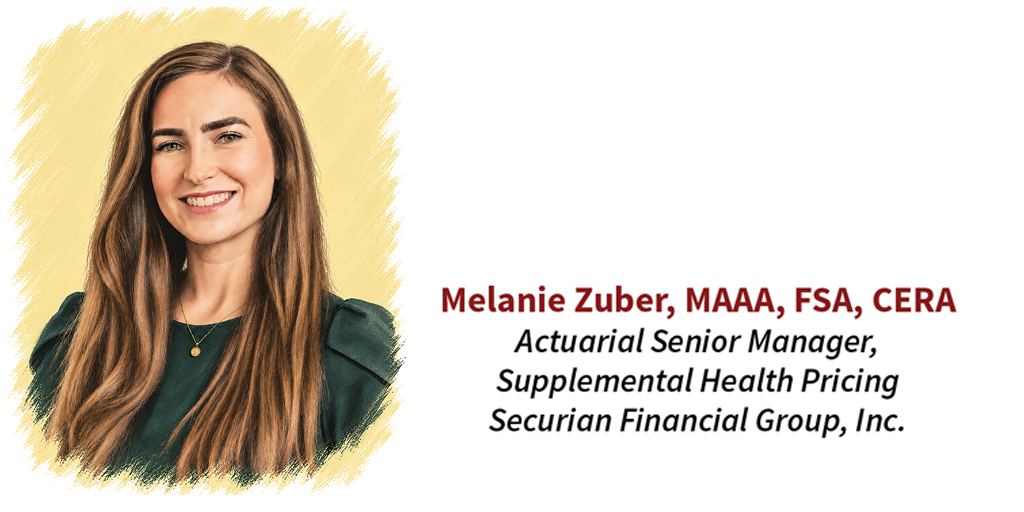
Making Room for Change
I have my mom—and her persistence—to thank for introducing me to the actuarial profession. My aunt is an actuary and, when I was in high school, my mom repeatedly encouraged me to talk with her about her career. Of course, as a teenager, I was convinced I knew better and initially resisted, but eventually gave in and, much to my surprise, discovered that my mom was right. I was intrigued by the idea of using math and analytics to help make real-world business decisions.
I’ve been extremely fortunate to have numerous mentors throughout my career. In college, a professor helped me think beyond simply finding a job and encouraged me to consider what I wanted from my career and what kind of company would be fulfilling to work for. Since then, I’ve benefited from managers, senior leaders, and others who have taken me under their wing. I especially value their perspectives as I navigate new challenges and grow as a leader.
Most importantly, I’ve appreciated the faith these leaders have placed in me—often giving me opportunities to stretch before I was completely comfortable. That has shaped how I lead today. When I recognize strong talent on my team, I try to extend that same trust and give people opportunities to grow into what they’re capable of.
One of my biggest professional challenges has been learning to lead through rapid growth and constant change. When I became a leader, my team was just two people; within two years, we grew to five and are still growing. At the same time, the business we support has grown quickly, and the questions we’re being asked to answer have become increasingly complex.
I’ve learned that you can’t just build for the problem in front of you. Early on, I sometimes stayed too far in the weeds or built one-off analyses that later had to be completely reworked. Now I spend much more time thinking about how we structure our data and our team, create opportunities for people to take on more impactful work, and create capacity for what my leader calls the “known unknowns”: the challenges we can’t predict, but know will come. The experience has taught me that being nimble requires planning for change, not just reacting to it.
I use AI regularly, particularly for communication—from developing the story for a presentation to drafting sensitive emails where tone matters. My team is also using it to assist with coding, and we’re experimenting with tools that can perform deeper analysis. I’ve been impressed with their ability to give us a jumping-off point and identify avenues of analysis we may not have prioritized on our own. Out of curiosity, I even asked AI to draft an actuarial memorandum for a hypothetical filing. The result was a good reminder that actuarial judgment still has an important role to play. At the same time, using these tools doesn’t change our professional responsibilities. We independently validate analysis and apply our own actuarial judgment to the results. Protecting client data is also critical in our industry, so we follow organizational guidelines around what information can be shared with AI tools. I view AI as a way to augment our thinking and capabilities, not outsource our judgment.
As AI makes it easier to analyze data and answer questions, I think one of the most valuable actuarial skills will be knowing which questions are worth asking. When we can answer more questions faster, we’ll need to think critically about which analyses are most actionable and will have the greatest impact on the business.
Looking ahead, I believe that curiosity, business judgment, and the ability to influence decisions will become increasingly important. Some technical skills may become less critical as technology advances, but actuaries will still need enough technical expertise to challenge results and recognize when something doesn’t pass the “gut check.” That also creates an interesting challenge for how we develop future actuaries. Much of our judgment comes from doing the work ourselves, so as technology takes on more of that work, we’ll need to be intentional about helping newer actuaries build the intuition and judgment they need to effectively evaluate it.
Early career actuaries should think deeply about what is important to them in a career and pursue opportunities accordingly. It’s easy, especially early in your career, to focus on the traditional markers of success without stopping to define what success means to you.
For me, finding an organization through which I felt connected to the people I worked with and had a sense of purpose in the work itself was incredibly important. Those priorities may be completely different for someone else, and they may change over time. The important thing is to revisit the question periodically and make intentional career decisions based on your own answer.
I value both the resources the Academy provides and the connection it gives me to the broader actuarial profession. My day-to-day work is focused on a specific part of the insurance industry, so I appreciate having access to resources that can help when I encounter a new or unfamiliar issue. I also value the opportunity to stay connected to the challenges, ideas, and perspectives actuaries are encountering outside my organization and practice area. That broader perspective is especially valuable as the profession continues to evolve.