
Find out how artificial intelligence is reshaping roles, skills, and the very structure of the profession—and how actuaries can thrive in this evolving landscape.
By Sally Ezra
The actuarial profession has witnessed various technologies that were considered threats to the profession. With each technological shift, the demand for the actuarial skill set has only increased. Will artificial intelligence (AI) be different? Will actuarial jobs be automated? Will they go away? This is one of the most frequently asked questions, and although no one knows for sure what the future brings, optimism outweighs pessimism. This is clearly a developing story!
To understand AI’s potential impact, it helps to reflect on how past technologies reshaped the profession.
“Predictions that technology will reduce the need for human labor have a long history but a poor track record,” says a Goldman Sachs article, “How Will AI Affect the Global Workforce?” The computer is a great example. Computing power was once viewed as a serious threat to the actuarial profession. Many thought actuaries would be replaced, but the exact opposite occurred, and it evolved into a highly useful tool that actuaries across the profession now embrace.
But AI, a technology that can tackle an expansive array of tasks, and generative AI that can learn, are evolving at a remarkably rapid speed. For some, AI is a technology that threatens to automate virtually any task and replace us all! For others, it is a tool that will allow actuaries to increase their value.
To better understand how new technologies can create opportunities, it helps to look at historical examples outside the actuarial field.
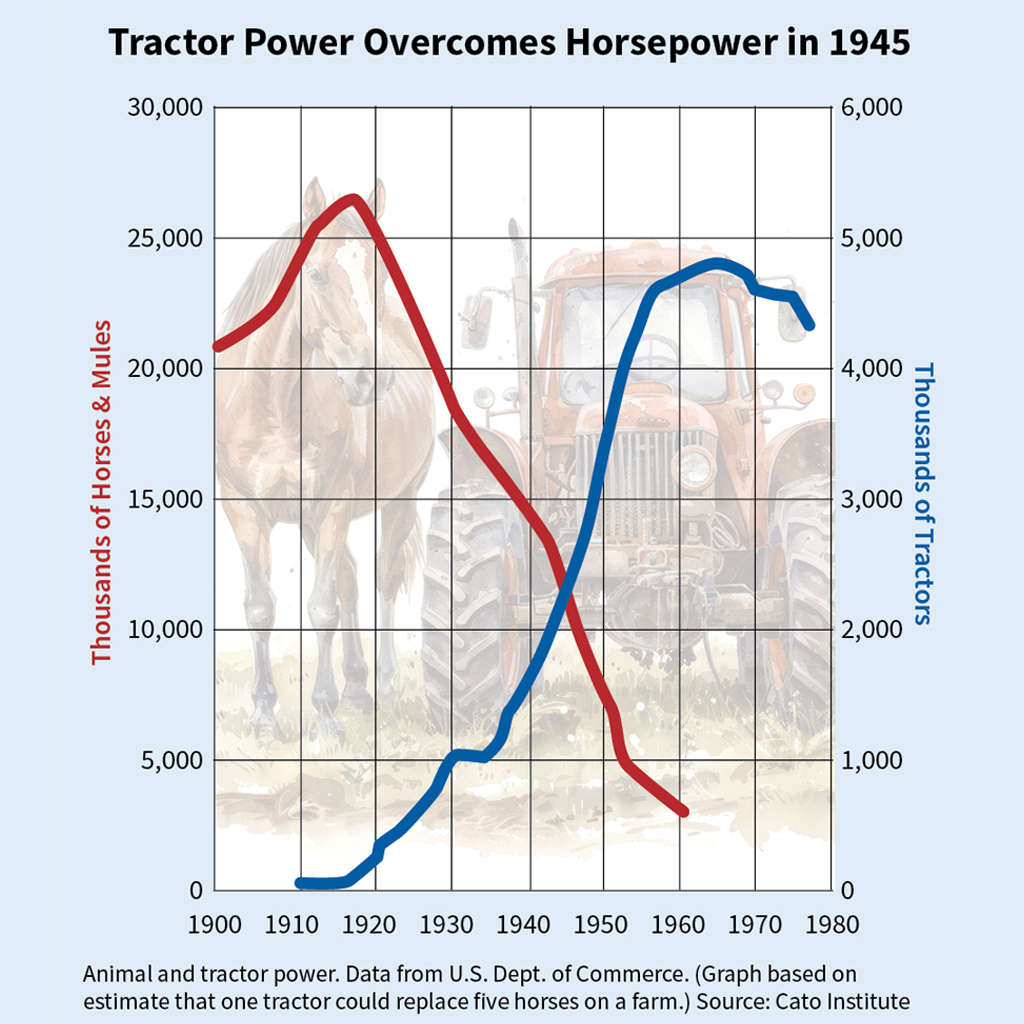
The quick rise of the tractor in the early 1900s gives an interesting perspective on changes brought on by technology. By 1945, it became evident that horses and mules had been sent out to pasture in favor of tractors.
The animals as tools were replaced, but the humans adapted. Perhaps fewer people were needed to work the land, but factories that made tractors had to be built, new factory jobs emerged, the tractors had to be sold, farmers were still needed to work the tractors, they needed diesel to run, and they needed to be serviced. Jobs evolved, and the new technology—the tractor—was a substantial net positive for job creation.
Similarly, AI may create new opportunities for actuaries, even as it changes or eliminates certain tasks.
New Opportunities
A Fortune magazine article quotes Nvidia CEO Jensen Huang, who, at the U.S.-Saudi Investment Forum in November 2025, said he believes “the technology will unleash a wave of new ideas and unfinished projects—leaving people busier, not freer, as ‘everybody’s job will be different.’” These new ideas, and the projects that will be picked up again as they can now be solved with the help of AI, will almost certainly result in more work that needs to be done.
Chuck Bloss, MAAA, FSA, FCA, believes actuaries stand at the crossroads of data and discovery. “By embracing emerging technologies like machine learning and automation, we can unlock deeper insights and redefine the value we bring to organizations and society,” he says. “Yet true innovation must always be grounded in the core principles and standards of practice that define our profession. Those who courageously adapt will shape the future of actuarial science, and those who don’t risk being left behind by it.”
John Buchanan, MAAA, FCAS, sees a shift in the role actuaries will play, predicting the possibility of a reduction in the need for traditional and repetitive skills, along with an expansion of the roles of savvy actuaries. It may take time to understand how and when, but it is widely understood that the role of the actuary is going to evolve.
Preparing Members for AI
The actuarial profession’s governing bodies and societies have always gone to great lengths to ensure two things: that the profession remains relevant and strong, and that its members are prepared for what lies ahead. Today is no different. All hands are on deck to ensure the profession is prepared to embrace this technological moment and flourish.
The Academy’s Actuarially Sound blog post, “The Academy Is Engaged as AI Use in Insurance Increases,” underscores the Academy’s commitment to serving as a trusted resource across actuarial disciplines and various stakeholders, particularly regarding policy and standards of practice, as AI adoption in insurance accelerates.
In his presidential address at the 2025 Casualty Actuarial Society (CAS) Annual Meeting, Dave Cummings, past CAS president, said, “We are a profession that collectively advances our knowledge and instills ethics to guide us through times of change and innovation. All of these factors matter in building and controlling AI applications that can be trusted by our employers, by our industry, and by society at large.”
A Google search of either the Academy, Society of Actuaries, or CAS, combined with the term AI will produce a significant number of results that illustrate the many ways the actuarial organizations are helping prepare their members for the changes being brought by AI.
When I speak with aspiring actuaries at various universities, the most common question that arises is about the impact of AI on hiring. I let them know they are entering a field with societies that are committed to the profession, and how unique that is. Most professions do not have governing bodies to prepare their field like the actuarial profession does, and do not have strict standards of practice that actuaries need to follow—standards that AI cannot be depended on to adhere to.
With the profession and its standards in mind, actuaries can take concrete steps to thrive in a landscape increasingly influenced by AI.
Building Skills to Thrive
Brad Lipic, ASA, whose career has been focused on the implementation of new technologies, recommends newer entrants to the field concentrate on developing deep foundational knowledge and strategic adaptability.
“Don’t rely solely on this super easy access that we have to external systems or automation to do the thinking or knowledge storing for you,” he says. “Fully understanding core actuarial concepts and technical skills is non-negotiable. Without that foundation, you won’t be able to judge whether an AI-generated solution is reasonable or useful. Organizations will always need people who understand the principles behind the models and the mechanics of machine learning and AI. AI is taking over many routine tasks, which means your value will increasingly come from thinking bigger picture; acting as an orchestrator, designer, and architect of solutions.”
AI Applications in Actuarial Work

Generative AI (GenAI). AI that creates new content (text, images, code, models) based on patterns in data.
Actuarial angle: Accelerates documentation, analysis, model building, and scenario design.
Agentic AI (AI Agents). AI systems that take actions autonomously, not just answer questions—like scheduling tasks, running workflows, or completing multi-step analyses.
Actuarial angle: Could automate end-to-end processes like data cleaning → modeling → reporting.
AGI (Artificial General Intelligence). Hypothetical AI with human-level reasoning across any task.
Actuarial angle: Not real today—but often referenced in conversations about AI’s long-term future in decision-making and risk. Some predict it can happen as soon as 2026, while others believe it will take decades.
Machine Learning (ML). Algorithms that learn patterns from data to make predictions.
Actuarial angle: Core technique behind pricing, reserving, and underwriting models.
Natural Language Processing (NLP). AI that reads, interprets, and generates human language.
Actuarial angle: Useful for policy review, claim notes, underwriting files, and consumer sentiment
Computer Vision. AI that interprets images and video.
Actuarial angle: Used for property inspections, auto damage estimating, and fraud detection.
Explainable AI (XAI). Methods that make AI decisions transparent and understandable.
Actuarial angle: Crucial for regulatory compliance in pricing and underwriting.
Large Language Models (LLMs). Advanced AI trained on massive text datasets to generate language outputs.
Actuarial angle: The brains behind today’s GenAI tools used for documentation, coding, and analysis.
Telematics AI. AI models using real-time driving data.
Actuarial angle: Used for UBI (Usage-Based Insurance)
Fraud Detection AI. ML systems that identify anomalous behavior.
Actuarial angle: Used in claims review.
Dominic Lee, ACAS, who is known as “the Maverick Actuary,” has interviewed hundreds of insurance professionals—with one of his goals being to help actuaries add value far beyond being technical resources. He describes three interrelated topics that are important for actuaries to keep at the forefront. “The first is not having a clear understanding of how their work impacts the organization,” he says. “That limits the scope and depth of their contributions. The second is when decision-makers are not aware of their contributions. In that case, they are not top of mind when new opportunities and promotion discussions arise. The third is not having a proactive mindset toward development. Actuaries who do not seek growth and stretch opportunities tend to stagnate in their careers.”
Another piece of advice that Buchanan gives is to “take AI courses and make it your friend.” He says that for actuaries to understand AI and use it effectively, “actuaries need to understand the limitations of AI, as it will be wrong quite often and just not stand up to actuarial or logical sniff tests. As human brains potentially get lazier just letting AI do it, the more difficult it will be to keep critical thinking skills sharp. Those who let critical thinking skills slide may have the farthest to fall; those who can master its amazing potential will rise the farthest.”
When asked what he believes actuaries need to understand about AI to use it effectively without losing the core actuarial mindset, Lee replied, “I think the question is more relevant today for generative AI. Always approach responses to prompts with a critical mindset. Never accept the answer as gospel without vetting it. Be grounded in your technical foundational knowledge, actuarial judgment, and ethical principles. As always, be guided by actuarial standards of practice.”
Beyond technical expertise, success in the profession also increasingly depends on how effectively actuaries communicate their insights.
Communication and Career Success
When discussing what it takes to be a successful actuary, actuarial leaders always mention the importance of communication skills.
When asked what differentiates the actuaries who advance quickly in organizations from those who plateau, Sherry Chan, MAAA, FSA, EA, FCA, MBA, said, “So much of what we deliver is technical at its core. Actuaries who are able to translate this concisely and simply enough for their audience (coworkers, senior leadership, board, client, or others) to grasp really set themselves up for success in the future. Additionally, their ability to stay ahead of the follow-up questions and needs of others and being proactive in delivering solutions to those is one key commonality I’ve observed in actuaries who have advanced quickly, and continue to advance, in their careers.”
Lipic agrees. “The future highly valued and sought-after skills aren’t the ones who code every detail, but the ones who can articulate the what and why, ensure quality, and connect disparate systems into something that makes a positive impact.”
The Impact of AI Hallucinations

Hallucinations occur when AI makes up facts, details, numbers, or citations and presents them confidently as true. These occur because language models predict plausible text, not factual correctness. In actuarial work, hallucinations can lead to regulatory problems, data quality issues, and incorrect assumptions if not carefully checked.
Examples include:
- Incorrect rate filing rules confidently stated as fact
- Invented mortality assumptions that don’t match any real table
- Fake loss development sources cited in a reserving memo
- Fabricated competitor rates in a marketing report
- Descriptions of nonexistent insurance regulations
Implications include:
- Regulatory Exposure. Providing fabricated or inaccurate reasoning behind pricing or underwriting decisions can violate actuarial standards and insurance regulations.
- Data Integrity Risks. AI may invent numbers, citations, or assumptions—damaging models or documentation.
- Client/Stakeholder Trust. Hallucinated explanations in reports or emails could lead to misunderstandings or errors.
- Model Governance Issues. AI-generated outputs must be verifiable and traceable—hallucinations break auditability.
In order to reduce hallucinations:
- Ask the AI to show reasoning or cite sources.
- Request step-by-step logic, not final answers only.
- Provide structured, complete input.
It’s important to learn how to communicate effectively to your audience. Analysis and the output are only valuable if they are effectively used to solve the business problem they aim to address. As technology advances, the ability to communicate not only the answers but also the analysis behind those answers will become increasingly important.
Curiosity and Lifelong Learning
Beyond communication, trust and intellectual curiosity are recurring traits cited as important for one’s career growth. Continued learning of both the technologies available and the business context is of utmost importance.
“Stay curious,” Lipic says. “Ask why certain prior efforts or solutions failed and always frame your work in terms of solving real business problems that matter to your organization, the industry, and/or society. Those who combine technical depth with strategic vision and adaptability will thrive, standing on the shoulders of this powerful new AI landscape.”
Buchanan recommends choosing a topic that interests you—whether it’s related to a hobby, your profession, or academics—and using AI tools to explore it by asking questions and following suggested prompts within those tools. “It won’t take long to see the power of the various AI tools. By actively exploring AI tools and supplementing your investigation with articles and books on the subject, you’ll develop your own informed perspective on this transformational technology.”
To remain well positioned for the future, Lee tells new entrants to the field to first learn the business. “That will help you understand the decisions your work supports. Then focus on developing the technical skills that will be used to support those decisions. Next, learn how the technical work translates into business impact. Finally, learn how to communicate the results of your work so that it actually supports decision-making.”
To stay relevant, actuaries need to learn the many uses of AI and continue learning, as changes and applications will evolve rapidly.
Evolving Roles and Responsibilities
AI usage by insurers has the potential to reshape the actuarial positions available by level. I often explain that actuarial opportunities can be described as a pyramid: many positions are available for analysts, fewer as the level rises, and at the tip, only a few very senior roles are available at any given time (with high competition when they do). There is talk of the shape of actuarial roles available shifting into a diamond. The repetitive skills of the analysts are some of the most at risk of being automated by AI, so fewer roles may be available at the junior levels. Then at the level where analysis and recommendations need to be made, the number of roles increases. The number of role reduces again at senior levels.
Insurers and actuarial leaders will need to decide how to align hiring with the needs at the middle and upper levels. The analysis and recommendations will need to be done by people who have learned core actuarial skills—the skills underlying the tasks AI can performing faster and more cheaply. If enough hiring is not done at the entry level, a dire situation could develop, and due to the actuarial path being a long-term journey, the mistake of not hiring and training future problem-solvers and decision-makers will take years to fix. That is a risk the actuarial leaders will need to anticipate and manage. They will need to clearly communicate to leadership that the cost of hiring and training future leaders will be substantially higher than simply plugging AI into those roles.
A Positive Outlook
I have faith that the employment outlook for actuaries will remain strong, and I am excited to see how the profession evolves as it adopts AI. Although I realize that AI is coming in faster and stronger than the emergence of predictive modeling did, there is a comparison I would like to make. When GLMs (generalized linear models) were a new phenomenon, there was talk that data analytics professionals might take jobs away, even at a significant level. The actuarial organizations worked hard to ensure actuaries had the tools and education needed so that data analytics professionals became collaborators instead. The emergence of predictive analytics ultimately increased the demand for actuaries and, in many ways, has become core to the analysis actuaries perform.
Although AI presents numerous potential pitfalls and challenges that make its integration less certain, I believe it will mirror what we saw with predictive analytics: an increase in demand for actuaries—particularly at the mid to senior levels—and new ways of address both old and new problems insurers face.
Actuaries are making bold predictions about AI’s impact on the profession. While some are pessimistic, the majority remain optimistic. I have shared some predictions here as well—but please remember, this is very much a developing story!
SALLY EZRA is a partner at Ezra Penland Actuarial Recruitment.