
Social Security Challenge Updated
The Academy’s Social Security Challenge has been updated to reflect projections from the Social Security Administration (SSA) Office of the Chief Actuary’s 2025 Trustees Report, as well as the mid-January SSA addendum.
Released originally in March 2023, the Social Security Challenge in an interactive tool that offers a look at the popular program’s funding and reform options, in line with the Academy’s public policy mission. The challenge immerses users in an animated trek through “Townsville,” where users can learn about Social Security’s challenges and reform proposals. The challenge has been previously updated based on the annual SSA trustees’ reports.
Social Security’s combined trust fund reserves are projected to be depleted around 2034—less than eight years from now—at which time its income would be able to pay only 81% of the benefits scheduled for its 80 million beneficiaries.
This latest update incorporates changes from last year’s report, which are also highlighted in the Social Security Committee’s policy paper, An Actuarial Perspective on the 2025 Social Security Trustees Report, including:
- The combined Social Security trust fund reserves are projected to become depleted in the third quarter of 2034, compared with a projected depletion in the second quarter of 2035 last year, almost a year earlier.
- If changes to Social Security are not implemented before 2034, only 81% of scheduled benefits will be payable as trust funds are depleted that year. The payable percentage is projected to decline to 72% by 2099.
- The long-range actuarial deficit in the 2025 Trustees Report increased to 3.82% of taxable payroll from the previous deficit of 3.50% of taxable payroll.
- The most recent projection is impacted by the law that repealed the Windfall Elimination Provision and the Government Pension Offset, a lower assumed share of GDP paid as labor compensation, and an extension of the period to reach the assumed ultimate total fertility rate.
- Social Security currently fails both short-term (over the next 10 years) and long-term (over the next 75 years) measures of financial adequacy. Over the short term, the current reduction in immigration counts may adversely affect the system’s financial condition. Over the long term, a continuation of the current historically low rate of fertility would also negatively impact trust fund finances.

Inaugural Academy Policy Summit Set for March
Will Be Followed by Annual Hill Visits in Washington
As the critical 2026 midterm election year kicks off, the Academy will hold its inaugural Spring Policy Summit on March 9 in Washington, D.C., to advance actuarial perspectives as federal policymakers consider next steps on key issues such as artificial intelligence (AI), climate risk, insurance access and affordability, as well as retirement-related issues including Social Security, lifetime income, and the aging U.S. population.
The summit, which will be followed by annual Academy Hill visits with federal policymakers on March 10, will provide attendees with a day of focused strategic public policy programming while also offering continuing education (CE) to participating actuaries. Over the course of several panels and a fireside chat with Virginia Insurance Commissioner and NAIC President Scott White, attendees will hear from federal legislative, federal regulatory, and national trade and association leaders, who will share their top priorities and challenges for 2026 and beyond. Wrapping up with a professionalism session, the summit will highlight how the Academy’s priority public policy issues, identified in our online Policy Forum, align with the priorities of our key federal stakeholders.
Join us in March for the Academy’s Spring Policy Summit—register today.
Livestream option—Can’t make it to Washington? Register for the summit livestream. Up to six hours of continuing education (CE) credit will be available, including one professionalism hour.

VP Corner
RPC 2026 Priorities Include Social Security, Retirement Symposium
By Bruce Cadenhead
Vice President, Retirement
Following the Academy’s November 60th Anniversary Leadership Summit & Governance Transition, where I participated in a vice presidents’ roundtable discussion on upcoming practice-area priorities, I wanted to highlight some of the Retirement Practice Council’s (RPC) key areas of focus for this year, which will also be incorporated into the theme for our fall Retirement Symposium.
Social Security—Social Security reform remains one of the RPC’s top priorities as the program faces trust fund reserve depletion, which the Old-Age, Survivors, and Disability Insurance (OASDI) trustees estimate will occur in 2034. The program’s future will be a key element of discussion in the upcoming Academy Hill visits on Capitol Hill in Washington next month.
Defined Benefit Revitalization—Congress has shown renewed interest in defined benefit (DB) pension plans, which presents an opportunity for the RPC to explore and discuss the topic with congressional staff. The RPC will continue to engage with Senate Health, Education, Labor, and Pensions (HELP) Committee staff and other policymakers to promote fuller understanding of DB issues.
Retirement Security—Recent RPC publications have focused on the needs of gig workers, public sector workers, spousal protections, and lifetime income. Future work in this area will cover issues related to evolving family structures, mortality, growing retirement concerns, and the future of Social Security and the Employee Retirement Income Security Act of 1974 (ERISA).
Read more about this in this month’s Actuarially Sound blog post, in the January/February edition of Contingencies, and on the Academy Event Calendar. And of course, in this issue!
Academy Presents on Gig Workers Paper at Retirement Conference
Lee Gold, chairperson of the RPC’s Retirement Policy and Design Evaluation (RPADE) Committee, spoke on behalf of the Academy at a Jan. 27 panel on “Gig Workers and Independent Contractors: What Do We Know About Them and the Pathways to Expanding Access?” at the 2026 State-Facilitated Retirement Savings Program Network Annual Conference at the University of Miami in Coral Gables, Fla. The conference was sponsored by Georgetown University’s Center for Retirement Initiatives.
Gold spoke on last year’s RPC policy paper, Retirement and Gig Workers, developed by RPADE and the Social Security Committee, which included a one-page infographic and the related Academy news release.
Webinar Covers PBGC Dispute Resolution
A Feb. 10 retirement public policy webinar, Navigating PBGC Disputes: Insights from the Plan Sponsor Advocate, offered insights on how the Pension Benefit Guaranty Corporation’s (PBGC) Office of the Participant and Plan Sponsor Advocate helps to resolve disputes, drawing from the PBGC’s newly released annual report (see below). Presenters were Anne Henderson and Emily Spreiser from the PBGC, and Pension Committee Chairperson Grace Lattyak moderated. Watch a replay on Academy Learning.
PBGC Annual Report—The PBGC released its 2025 Annual Report in late January. Academy Retirement Vice President Bruce Cadenhead said that while the report “provides good news for the financing of retirement income protections provided by both PBGC programs, which is critical to achieving one part of the PBGC’s mission,” the single-employer (SE) program’s “growing surplus due to the current, legally mandated SE premium structure, continues to be far out of proportion to the SE system’s risk.” Read the Academy news release.
Dave Gustafson Receives Myers Service Award
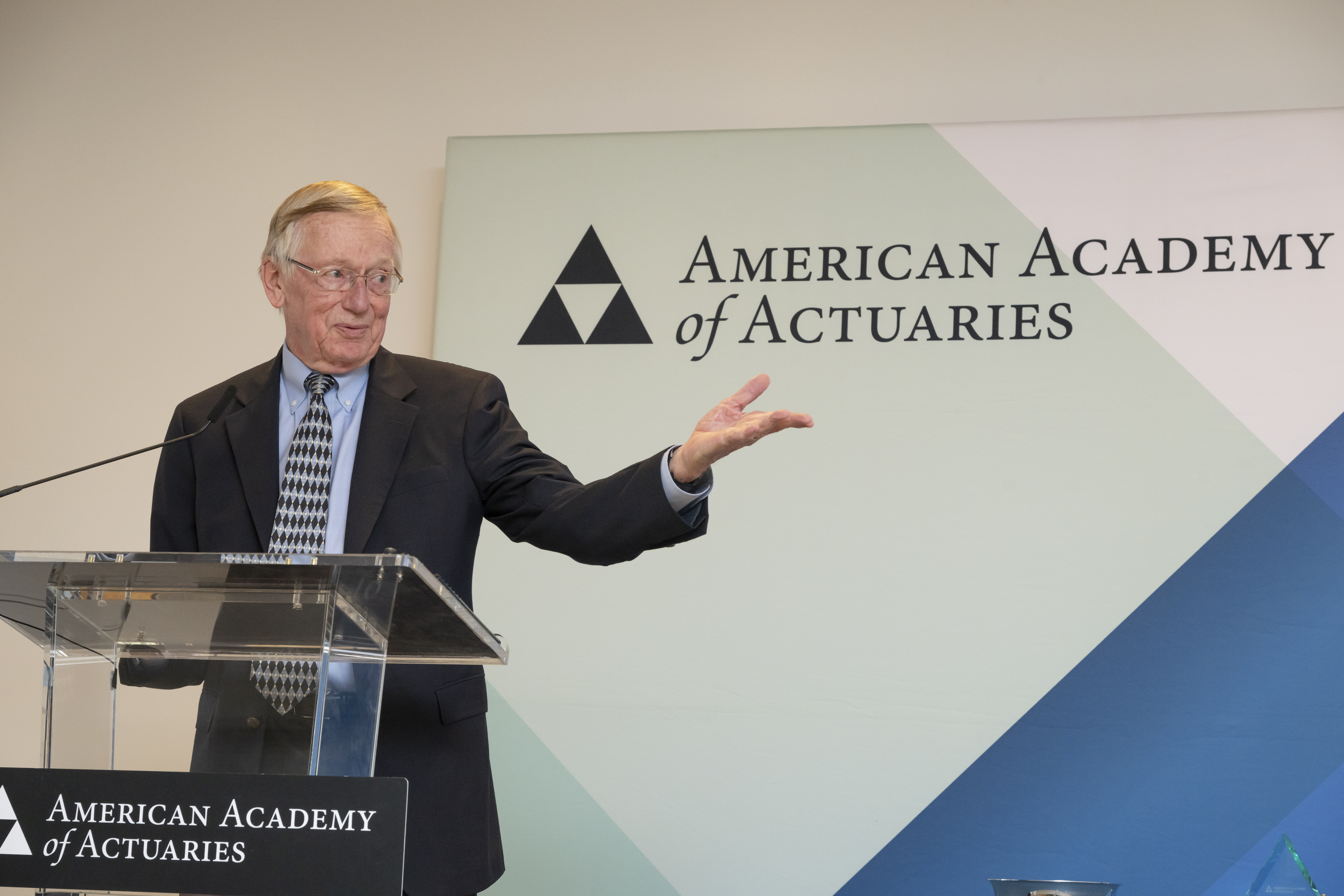
Former Pension Benefit Guaranty Corporation (PBGC) Chief Policy Actuary Dave Gustafson received the Robert J. Myers Public Service Award at the Academy’s 60th Anniversary Leadership Summit & Governance Transition in Washington in November. The Myers Award recognizes a member who has made an exceptional contribution to the common good, either for a single noteworthy public service achievement or a career devoted to public service. Gustafson, who retired in 2021, was selected for his extraordinary four-decade career at the PBGC, demonstrating an unwavering commitment to protecting the nation’s defined benefit retirement system.
Webinar Examines Capital Markets
In a December webinar, Capital Markets: What Now?, Pension Committee presenters addressed how uncertainties such as rising federal debt, demographic shifts, slowing globalization, and technological change add complexity to the market outlook. Presenters were Evan Inglis and committee member Jerry Mingione; committee member Maria Moliterno moderated. Watch a replay on Academy Learning.
Highlights From
Retirement Report

Prefer to watch your news? Check out this “Highlights From Retirement Report” video for a quick recap of what you need to know.
Academy in the News
A Forbes column on claiming strategies for Social Security retirement benefits used the jointly sponsored Actuaries Longevity Illustrator to highlight longevity considerations. It also covered the Academy’s presentation of the Robert J. Myers Public Service Award to Dave Gustafson at the Academy’s Leadership Summit and Governance Transition event.
Chief Investment Officer’s reporting on the recently released PBGC annual report cites comments from Academy Retirement Vice President Bruce Cadenhead, including on the impacts of the congressionally mandated single-employer premium structure.
Social Security Committee Chairperson Sam Gutterman was quoted in a MarketWatch story on generational equity and Social Security’s financial condition.
The jointly sponsored Actuaries Longevity Illustrator (ALI) was used to highlight longevity risk considerations in retirement planning by Barron’s, Yahoo!Finance, and Plan Adviser.
A Jan. 17 Motley Fool Money podcast encouraged listeners to try out the Academy’s Social Security Challenge. The Nov. 15 edition of the podcast highlighted the usefulness of the ALI in retirement planning.
A radio story on Social Security’s financial condition that pointed listeners to the Academy’s website for information on reform options ran multiple times during late December on San Francisco radio station KSFO-AM.
Academy work spotlighted in Supreme Court oral arguments—Jan. 20 oral arguments before the U.S. Supreme Court referred multiple times to a 2020 Academy withdrawal liability issue brief, as the court considers a major case on multiemployer pension plan withdrawal liability.
Legislative/
Regulatory Activity
Federal
Arjun Mody was sworn in as SSA deputy commissioner on Jan. 5 following confirmation by the Senate in December. His term runs through January 2031.
The House passed two bills in December related to Social Security: HR 5284 directs the Social Security Commissioner to change the Social Security Administration’s (SSA) terminology when describing benefit claiming ages in order to better reflect the implications of claiming decisions; HR 5345 requires the SSA to provide victims of identity theft with a single point of contact at the agency. Both have moved to the Senate for consideration.
Sens. Cory Booker of New Jersey and Todd Young of Indiana are co-sponsoring the Emergency Savings Enhancement Act, S 3333, which would double the maximum account limit of pension-linked emergency savings accounts (PLESA) to $5,000 and reduce their administrative burden. A companion bill (HR 6417) is being offered in the House by Reps. Eugene Vindman of Virginia and Glenn Thompson of Pennsylvania.
Reps. Jimmy Panetta of California and Darin LaHood of Illinois are co-sponsoring the Retirement Simplification and Clarity Act, HR 6324, which directs the Internal Revenue Service to redesign the 402(f) notice to more clearly outline distribution options and tax implications.
State
The Indiana Senate passed SB 14 on Jan. 6, seeking to allow individuals retiring after 2027 in the state’s public pension program to base their benefit on the highest five years of earnings, rather than basing the benefit on the final five years of service.
The New Jersey Senate’s Budget and Appropriations Committee passed S 4875 on Jan. 8, which would create a Common Pension Fund to manage the transfer of assets from public entities in an effort to improve retirement system funding ratios.
Missouri Sen. David Gregory is sponsoring SB 1287, which raises the state tax deduction on private retirement funds from $6,000 to $12,000 for moderate-income earning retirees beginning in 2027.
Virginia Del. Luke Torian proposed HB 176, which amends the state-facilitated IRA savings program by reducing the minimum number of eligible workers an organization must employ from 25 to five and ending a requirement that they work at least 30 hours a week.
California Assemblyman Mike Gipson introduced AB 1054, a bill that establishes a Deferred Retirement Option Program (DROP) within the Public Employees’ Retirement System for state highway patrol and firefighters. DROP allows eligible members to receive a lump sum or monthly payments in addition to their retirement allowance upon service retirement.
Academy Presents on Social Security to Hartford Club
Immediate Past Social Security Committee Chairperson Amy Kemp presented “Social Security at 90: A Time for Celebration—and Reform” interactively on Nov. 20 using the Academy’s Social Security Challenge at the Actuaries’ Club of Hartford and Springfield meeting in Hartford, Conn.