Hear from the 2025 class of Rising Actuary Award recipients. These young professionals discuss how they are navigating the complexities of the actuarial landscape, staying ahead of industry trends, contributing to the Academy’s mission and upholding the values that define our profession.
The Academy’s Rising Actuary Award recognizes outstanding early career actuaries who have demonstrated excellence, leadership, and a commitment to advancing the field.
The 2025 award recipients include:
- Kaitlin Creighton, MAAA, FSA, CERA
- Tim Koenig, MAAA, FSA
- Andrew Larocque, MAAA, ASA
- Zhe “Gigi” Li, MAAA, FSA
- Scott Merkord, MAAA, FCAS, CPCU
- Harrison Smith, MAAA, FSA
- Clara Xing Wang, Ph.D., MAAA, ASA
Volunteer for the Academy
Volunteers power the Academy’s mission. The Academy has always relied on the dedication and expertise of volunteers to advance the profession, establish standards, and contribute to significant public policy debates. It is often said that the volunteers and members are the lifeblood of the Academy and the U.S. actuarial profession, making it an essential aspect of a vibrant and progressive professional community.
Whether by contributing technical expertise or developing policy insights, Academy volunteers play a crucial role in advancing the profession. For those considering volunteering, there has never been a better time to get involved. The Academy offers countless opportunities to meet the diverse needs and interests of our over 20,000 members practicing in the U.S. Click here to learn more.
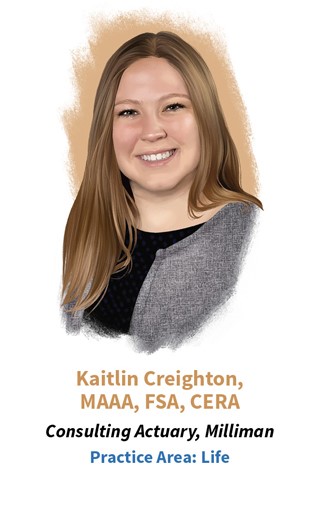
Kaitlin Creighton, MAAA, FSA, CERA
Consulting Actuary, Milliman
Practice Area: Life
Member, Tax Committee
How did you feel when you learned you were selected as part of the 2025 class of Rising Actuary Award recipients?
It is such an honor to be the recipient of this award! For many years, I’ve kept track of the recipients, and they were always people whose careers I have greatly admired. I feel really special to be in the company of such high achievers, and it is one of those moments that makes all the hard work and long days feel a little more worth it.
What first inspired you to pursue a career in actuarial science?
When I was a little kid, I always thought I wanted to be an accountant when I grew up. I have many accountants in my family, and I loved the idea of using math within a business application and solving puzzles all day. However, I wanted the math to be more challenging than what you use as an accountant. During my freshman year of high school, our Personal Finance teacher required us to research a career that used finance, so I picked actuary from the list of options. I found myself on websites like BeAnActuary.org, doing practice problems and having so much fun, and I was instantly hooked. I interviewed an actuary as part of that project, and after talking to her, I knew this was the perfect career for me. The rest is history.
Do you have a mentor who has shaped your career? If so, how have they influenced you?
I have been very lucky to have many mentors over the years, but there are a few who stand out—Sheila Melzer, Jason Elleman, Robert Astleford, and Daryl Brune. All of these people have taught me to look at problems through a unique lens and how to ask the right questions to tease out different things that are going on. Whenever I face challenges both in my career and in life, I often reflect on the guidance and advice they have given me over the years, and if I need advice, they are still the people I reach out to first. I wouldn’t be the actuary I am today without their investments and belief in me.
It’s really rewarding to be able to reconnect with my mentors at conferences or over the occasional coffee and see how our careers have grown over the years.
What has been your biggest professional challenge so far, and how did you overcome it?
After spending seven years working for two different insurance carriers, I decided I wanted a bigger view of the industry and a new challenge, so I changed my career to work in mergers and acquisitions, doing consulting work. While a lot of basic concepts about insurance and reserving transferred to the new role, it still felt as though I was starting a whole new career because there were so many new concepts to learn. It was really difficult going from an area where I knew what I was doing to projects where I didn’t even know where to begin to try to solve the issue. I felt like a new student all over again. I remembered to keep an open mind, be curious, and to not be afraid to ask questions. I still feel as though I have only scratched the surface of all the new things I have yet to learn in this new role, but it has been so rewarding to learn to look at the industry through a completely different lens.
What is one piece of advice you would share with actuaries who are just starting out?
Be curious. So much of an actuary’s job is solving puzzles and trying to answer the question “why?”. The more curious you are early in your career, the more it will serve you later when your role shifts from completing processes to answering stakeholders’ questions. It is so important not to just understand how your spreadsheet works or how to complete a journal entry, but also know how the spreadsheet is going to be used downstream or where in the annual statement a journal entry is showing up. Understanding how your work product will be used and being curious about the downstream impact of your work will help you design a better process and work product. It is also prudent to know that your work is being used for its intended purpose.
Are you incorporating any next-generation tools into your work? If so, how do you ensure that you uphold the principles of actuarial professionalism while using them?
While I am not currently using any next-generation tools, I have seen junior analysts using AI to write code and Excel formulas in their spreadsheets, and when I interviewed a college student recently, I asked how he prepares for exams. He said he uses AI to teach him the more difficult concepts. That’s just an example of how incorporating AI into our everyday work will make us more efficient and expediate projects like code conversions.
However, when I notice junior analysts using AI in their code or spreadsheets, I always make sure they can still explain what the code is doing. It is important for us to maintain the knowledge of how our tools are operating so that we can more easily detect when things go wrong. AI has already permeated the more mundane tasks of the actuarial world, but I believe it will continue to become integrated into more processes, such as pricing or perhaps doing strategic asset allocation. If we use generative AI for these activities, we will need to be hyper-aware of the unintentional bias we may be introducing and continue to ensure we understand the reasoning behind the results. We will also need to continue to have robust professional standards that determine what is appropriate.
How do you see the role of actuaries evolving over the next 10 years?
Technology advancements will have a profound impact on actuaries’ jobs. We have already seen the impact of developments, such as cloud computing and better machines on our jobs, and with the advancements in AI and having more accessibility to data, we will be able to do so much more. It will be imperative though, to set up the right guardrails to make sure the technology is being used appropriately. Being able to automate parts of our job is an incredible thing unless provided we don’t lose the core understanding of how the process is supposed to work.
What have you found to be the most valuable benefit of your Academy membership?
One of the things that really drew me to the actuarial profession is that it is self-governing. Having professional standards that we hold each other to and offer guidance on is paramount to ensuring the public has trust in what we do. I believe this standard is what sets actuaries apart from the growing fields of data science and AI. Providing those professional standards and guidance to its members is one of the most valuable Academy offerings. The Actuarial Board for Counseling and Discipline is such a unique and valuable resource, and I also get a lot of value from the work papers and practice notes the Academy provides. Volunteering with the Academy has given me a behind-the-curtain look at how some of these are developed, and I am always in awe of the great depth of expertise and knowledge that exists among the members.

Tim Koenig, MAAA, FSA
Head of Development, Integration, and Innovation, Resolution Life
Practice Area: Life
Member, ASOP No. 10 Task Force
How did you feel when you learned you were selected as part of the 2025 class of Rising Actuary Award recipients?
I was truly honored and humbled; not only to be recognized, but to find that my colleague and friend Jon Forster from the Actuaries Club of Philadelphia took the time to nominate me. That gesture alone meant a great deal.
I’ve always taken pride in our profession, and to be acknowledged in this way is gratifying.
What first inspired you to pursue a career in actuarial science?
My dad is a health actuary, so I always knew about the profession. The apple didn’t fall far from the tree, although I made sure to pick a different track (life) to avoid completely copying him! While majoring in actuarial science at Penn State, people like Ron Gebhardtsbauer—who was leading the actuarial program at the time—helped me see a clear path forward and get excited about the future. Early on, I could see this was a field in which one could apply analytical reasoning in a dynamic, real-world business environment. Years later, that’s exactly what it has turned out to be.
Do you have a mentor who has shaped your career? If so, how have they influenced you?
Tony Brantzeg, the former chief actuary and chief risk officer at Resolution Life, has had a profound impact on my career. I’m sure many other actuaries at Resolution Life would say the same.
Tony taught me lessons in his roles as an actuary and as a leader. As an actuary, he invested in his people, often playing the role of teacher and explaining complex concepts in depth. He also showed that, even in a senior leadership role, it’s okay (and often necessary) to get into the weeds. In our data-driven, analytical field, that kind of hands-on approach leads to better, more informed decisions.
But what’s stuck with me even more is the example he set as a leader. He genuinely cared about his people and always kept things in perspective. One of the reasons behind his recent retirement was to spend more time on volunteer and nonprofit work, a decision that speaks volumes about his values and priorities. As I face my own challenges as a leader, I try to lean on these lessons I’ve learned from Tony.
What has been your biggest professional challenge so far, and how did you overcome it?
The area I currently lead, Development, Integration & Innovation, is tasked with continuously improving our actuarial practice: finding new ways to evolve, add value, and drive meaningful change. That naturally comes with its share of challenges: resistance to change, underperforming processes, or promising ideas that run into technical constraints. Regardless of the specific challenge, I’ve found overcoming it always comes down to two cornerstones: communication and trust. Take the example of a process my team built and championed that failed. If I lack communication and trust with the leader of the area executing that process, he or she might abandon that solution altogether at the first sign of failure or underperformance. But if we trust each other and remain aligned on the importance and benefits of a target solution, our teams will address the issue at hand and learn, iterate, and improve together.
What is one piece of advice you would share with actuaries who are just starting out?
My advice to someone entering the profession is to actively seek out situations that push you beyond your comfort zone. Throughout my career, I’ve made a point to raise my hand for opportunities, even when they have felt like “extra work” or unnecessary—going out of my way to network with another actuary, stepping up to present to senior leadership, taking on roles that span beyond a strictly actuarial domain. I’d tell this person his or her job is not just the bullets in a job description, but to learn from others and seek out stretch opportunities for growth and development. Leaving one’s comfort zone almost always pays off. It helps to build confidence and open new doors. If you ever feel comfortable in your day to day, change that. I believe our profession rewards curiosity, initiative, and adaptability.
Are you incorporating any next-generation tools into your work? If so, how do you ensure that you uphold the principles of actuarial professionalism while using them?
Yes. I recently led a cross-functional project team that included actuaries, investment professionals, data engineers, and data scientists to develop a cloud-based solution using Amazon Web Services technology and combinatorial optimization. By leveraging powerful cloud storage and compute capabilities, we loaded granular asset and liability projections and applied a rule-based optimization framework to identify assets that best matched liabilities. It was exciting to know we were developing a solution that could not have been created within any single discipline alone. In fact, prior attempts to build a similar tool within an actuarial silo—primarily using Excel—presented significant storage and compute limitations.
While the technology was next-generation, we remained committed to actuarial principles—considering relevant ASOPs and establishing a series of controls throughout the process. Actuaries like me did not have full transparency into the code itself, so it was important that we communicated clearly with our data scientists, defining clear rules, constraints, and validation techniques for the process we built. As in my previous answers, this came down to communication and trust.
How do you see the role of actuaries evolving over the next 10 years?
I believe we’ll continue to see a growing emphasis on actuaries working cross-functionally— especially within data engineering and data science domains. Actuaries who can bridge technical and business concepts will be uniquely positioned to lead innovation and drive value. Applying traditional actuarial thinking in technology-forward environments opens the door to solutions that were previously out of reach when we relied solely on tools like Microsoft Excel and Microsoft Access. We’ll need to remain the “business experts,” but we’ll have to embrace these tools while maintaining a strong foundation in actuarial principles.
What have you found to be the most valuable benefit of your Academy membership?
I appreciate the structure provided by the U.S. Qualification Standards (USQS), especially that we are encouraged to continue learning beyond the exam phase of our careers. I particularly value the requirement for some learning to occur in person. In-person attendance at industry meetings and conferences is twice as beneficial—not only for deepening understanding on specific topics, but also for the networking opportunities they create across the profession. That’s one of the reasons I continue to volunteer with the Actuaries Club of Philadelphia; I think it’s important to maintain a strong actuarial community, especially at the local level.
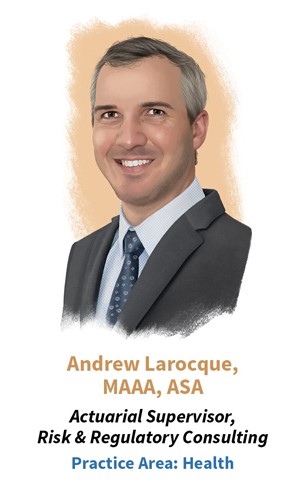
Andrew Larocque, MAAA, ASA
Actuarial Supervisor, Risk and Regulatory Consulting LLC
Practice Area: Health
Member, LTC Committee, Research Committee, and Volunteer Engagement Subcommittee
How did you feel when you learned you were selected as part of the 2025 class of Rising Actuary Award recipients?
I was extremely excited to learn that I was selected for this award. I felt that the hard work I have put into exams and my career have truly paid off. I instantly shared the news with my wife, kids, and extended family.
What first inspired you to pursue a career in actuarial science?
I originally pursued a career in accounting and finance in college and, at the time, did not have the actuarial career path on my mind. In my first job after college, my tasks included compiling professional and outpatient health care provider fee schedules. My company had one actuary on staff whose primary role was to analyze the impact of the new fee schedules for various markets and clients. Over time, I became more interested in analyzing the fee schedules than in building them; however, since it was not my role, I was unable to do so.
With more analytical pursuits in mind, I started a new position as a financial analyst. I also started studying for actuarial exams on my own time and passed several exams before switching to an actuarial role at a health insurance company.
Do you have a mentor who has shaped your career? If so, how have they influenced you?
I have worked with many talented actuaries and non-actuaries over my career. Currently, two of my colleagues at RRC, Becky Sheppard and Tricia Matson have been very influential in my career. They have put me in client-facing situations and on projects where I can develop my consulting and actuarial skillsets. They also encouraged me to become more involved with the Academy. Seong-min Eom, another actuary who has been influential in my career, was the person who first suggested that I volunteer with the Academy.
What has been your biggest professional challenge so far, and how did you overcome it?
My biggest professional challenge was working throughout the COVID-19 pandemic with a 2-year-old and a newborn. Daycares in my area were closed, so in the early stages of the pandemic, I was working and parenting at the same time. I was also working on completing all my requirements for my ASA. At that time, my job became fully remote, so I overcame this challenge through good communication with my wife and my work team, and by working flexible hours, which generally were at night.
What is one piece of advice you would share with actuaries who are just starting out?
My advice to someone pursuing the actuarial profession would include the following three themes: persistence, patience, and constant learning.
I think persistence is important because of the long haul that is the exam process and getting one’s footing in an actuarial position. The exams are foundational to developing a well-rounded actuary, but it’s not an easy time. Persistence is required to study late at night after work hours and on weekends. Actuarial students are often taking exams while balancing the demands of their actuarial jobs, so persistence is required to find ways to solve new problems or tasks.
I would also advise actuarial candidates to have patience. Building up one’s actuarial skills and industry knowledge takes many years. There are times when people new to the actuarial field may feel frustrated by not having all the information they need to do their jobs well. And studying for the exams requires patience and good planning techniques, because it takes time to absorb various actuarial concepts.
Lastly, I think it would be important for a potential actuary to know that this profession involves constant learning. Industry, regulation, policyholders, and markets are constantly changing, so it’s vital for actuaries to keep up with these changes long after they earn their credentials.
Are you incorporating any next-generation tools into your work? If so, how do you ensure that you uphold the principles of actuarial professionalism while using them?
At RRC, I utilize RStudio for data-driven work, such as exploring data sets and organizing and developing analyses. RStudio has many unique data-presentation packages. For example, I was able to create a customized county-level map graph that one of my clients could use to present health-insurance–related data.
We also utilize Microsoft Copilot (AI tool) to assist with our day-to-day work. I have found efficiencies in identifying information, such as state regulations and health insurance related guidance. I have also leveraged Copilot to create code.
How do you see the role of actuaries evolving over the next 10 years?
In the next 10 years, I see the actuarial profession being impacted by many rapidly evolving external forces. These include changes in legislation, markets, and industries, which will require the actuarial profession to adapt. For example, the One Big Beautiful Bill Act includes provisions, such as the elimination of enhanced Advance Premium Tax Credits and changes to the Medicaid program, which are expected to significantly change the number of people enrolled in health insurance and the overall health insurance industry. It is incumbent upon me and other actuaries to stay informed on these changes that impact our work.
Another constantly evolving area that I see affecting actuaries is the availability and credibility of data, and of new data sources, that we rely on to make decisions. With rapid change, historical data may not be as reliable for making forecasts or developing actuarial estimates as it once was. It is also important for actuaries to continue to improve their ability to identify biases in relevant data sets. Over the next decade, it will be important for actuaries to work with AI, predictive modeling, and people in other professions, such as data scientists.
What have you found to be the most valuable benefit of your Academy membership?
I particularly enjoy volunteering in the actuarial profession because it keeps me informed on many topics that specifically apply to my career as a health actuary and to the broader actuarial community. It has allowed me to learn from and gain new perspectives through other actuaries who work in other actuarial tracks and who have volunteered in other areas.
I started volunteering with the Academy in 2022 as a member of the Behavioral Economics Work Group. Since then, I’ve been a member of the Volunteer Engagement Subcommittee, the Long-Term Care Committee, and the Research Committee. I regularly participate in each and recently presented in an Academy webinar related to volunteering.
I also have presented for the Society of Actuaries on multiple occasions in the past few years; these presentations included several research papers that I have contributed to while working at RRC.
I like to volunteer because it builds upon my perspective as an actuary. It gives me the opportunity to contribute to the academy mission and the actuarial profession. It has also increased the number of actuaries I have been able to learn from, including those with more years of experience than me.

Zhe “Gigi” Li, MAAA, FSA
Senior Manager, EY
Practice Area: Health
Member, Health Committee of the Actuarial Standard Board
How did you feel when you learned you were selected as part of the 2025 class of Rising Actuary Award recipients?
I was very surprised and felt incredibly honored and humbled to receive the award! It is deeply rewarding to have my work recognized by the profession and it motivates me to continue growing and contributing to the actuarial community.
What first inspired you to pursue a career in actuarial science?
I was a finance major in college. My first internship was in the claims operations department at a health insurance company, where I met several actuarial interns and got my first glimpse into the profession. Quite frankly, their internship projects sounded way more interesting and challenging than mine. Later, I was fortunate to get an actuarial internship at the same company, where I met some of the best managers and colleagues. I’m so grateful for that opportunity—it introduced me to a profession that I truly enjoy.
Do you have a mentor who has shaped your career? If so, how have they influenced you?
I honestly can’t believe how fortunate I’ve been with all the support and guidance I’ve received throughout my career. I’ve had the privilege of working with many outstanding leaders—people who are not only exceptionally talented, but also hardworking and humble. Watching how they approach challenges with both technical expertise and diplomacy under pressure has taught me the importance of integrity, collaboration, and empathy in leadership. They are also active volunteers within the profession, which continues to inspire me to give back and stay engaged as well.
What has been your biggest professional challenge so far, and how did you overcome it?
One of my biggest professional challenges has been keeping up with the constant change in the health care industry. This, however, is also what makes being a health actuary fun and rewarding. The regulations, market dynamics, and data are always evolving, which means there’s always something new to learn. Sometimes it felt overwhelming to stay on top of everything, but I’ve learned to embrace that challenge as part of what makes this field so engaging. I always make it a priority to stay curious and informed; whether that means staying on top of new regulatory updates, learning something new from my clients, or exploring new analytic tools. I wouldn’t say I’ve “overcome” this challenge, because it will always be part of the nature of the work.
What is one piece of advice you would share with actuaries who are just starting out?
I’ll share a piece of advice that’s really stayed with me—something the CFO of my previous company told me before I left: “Surround yourself with great people.” It’s simple but incredibly powerful. The people you work with can shape how you grow, challenge your thinking, and support you when you’re learning or taking risks. I’ve benefited so much from the talented, collaborative, and inspiring colleagues and friends who have made all the difference in both my professional and personal growth.
Are you incorporating any next-generation tools into your work? If so, how do you ensure that you uphold the principles of actuarial professionalism while using them?
Yes. I’m starting to incorporate automation tools and technologies into my work, and also exploring AI-assisted modeling. We’ve recently modernized our IBNR calculation tool, which significantly enhanced efficiency and accuracy. We are also starting to explore machine learning capabilities to support IBNR selections. Throughout this process, upholding the principles of actuarial professionalism should always be a priority. We need to be diligent in verifying inputs and results, maintaining transparency about assumptions and methodology, and thoroughly documenting the process.
How do you see the role of actuaries evolving over the next 10 years?
I can certainly see the role of actuaries evolving significantly over the next 10 years as AI and advanced technologies become more integrated into our work. These tools will handle more routine calculations and data processing, which will allow actuaries to focus even more on business insights and strategic decisions. Continuous learning will be essential to stay current with new technologies and identify innovative ways to add value. Actuaries who can combine technical expertise with adaptability and curiosity will thrive in the next decade.
What have you found to be the most valuable benefit of your Academy membership?
The greatest benefit of my Academy membership has been the opportunity to volunteer and connect with fellow actuaries. I have had the pleasure of presenting webinars with fellow Academy members, being involved in developing actuarial standards of practice, and taking part in the Actuarial Standards Board’s Health Committee. These activities provided opportunities for me to learn from thought leaders and stay current on emerging trends and best practices. I also appreciate the many continued learning opportunities the Academy offers.
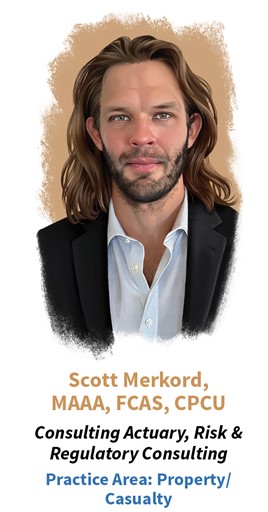
Scott Merkord, MAAA, FCAS, CPCU
Consulting Actuary, Risk & Regulatory Consulting LLC
Practice Area: Property/Casualty
Member, Climate Change Joint Committee
How did you feel when you learned you were selected as part of the 2025 class of Rising Actuary Award recipients?
I’m truly honored to receive this recognition, but above all, I feel deeply grateful to the many colleagues who have shaped my journey. I’m especially thankful to Taylor Davis and Lauren Cavanaugh for nominating me. Despite their many personal and professional commitments, they took the time to highlight the impact of my work, which made this acknowledgment all the more meaningful. To me, this award is a reflection of the collective effort and support of incredible people who have surrounded me throughout my time as an actuary.
What first inspired you to pursue a career in actuarial science?
I always expected to be a medical doctor, but I loved high school calculus. I went into university as undeclared but researched mathematics degrees. Actuarial science was one of the options, so I asked my dad about it. He re-sent me an email he’d written several years before pointing me to the Be An Actuary website. I saw some presentations about catastrophe modeling and hurricanes, which further piqued my interest in the profession.
Do you have a mentor who has shaped your career? If so, how have they influenced you?
I was a sophomore in college with no exams passed. I interviewed with Chuck Parsons from Allstate for an internship. After the interview, he called me and said that, although I was young, he enjoyed our conversation, and gave me a few things to focus on for the next year. He told me to reach out again when I was a junior. I did and he brought me to Allstate’s home office for an internship interview, which I accepted and where I started my career.
It always meant a lot to me that he took the time to provide the advice, then followed through with his word. There have been a lot of people around me that have shared the message to” keep your promises.”
What has been your biggest professional challenge so far, and how did you overcome it?
I worked on an economic capital model for a part of my career. It was the most quantitatively challenging area and concept I have ever worked on. One of my leaders, Cory Fujimoto, emphasized that I become an expert on a component of it and then move onto another component to become an expert rather than being overwhelmed by the overall complexity.
What is one piece of advice you would share with actuaries who are just starting out?
Be aligned with your true self and follow a career that aligns with your values, rather than following what you see others doing.
Are you incorporating any next-generation tools into your work? If so, how do you ensure that you uphold the principles of actuarial professionalism while using them?
The Actuarial Standards of Practice and the Code of Professional Conduct provide guidance for us. ASOPs No. 56 (Modeling), No. 23 (Data Quality), and No. 41 (Actuarial Communications) are some of the key documents for providing the relevant guidance when using next generation tools.
How do you see the role of actuaries evolving over the next 10 years?
Actuaries will better manage the risks associated with models as organizations develop increasingly complex models and apply them in more areas. While continuing to uphold the highest standards of professionalism, I hope to see our profession championing ethical decision making—prioritizing what is right over what is merely most predictive.
What have you found to be the most valuable benefit of your Academy membership?
I like the Academy’s volunteer opportunities, which span so many practice areas with several joint committees. The Academy stands out for offering high-quality continuing education with a strong emphasis on professionalism.

Harrison Smith, MAAA, FSA
Senior Director & Actuary, Security Benefit Life
Practice Area: Life
How did you feel when you learned you were selected as part of the 2025 class of Rising Actuary Award recipients?
Once the initial surprise wore off, I felt truly honored and proud. Recognition always feels great but, as I reflected on the accomplishments that led me here, I kept thinking about the people who supported me along the way. It’s funny, being personally recognized just reminded me how much I’ve relied on and learned from others to get here.
What first inspired you to pursue a career in actuarial science?
I have always loved math and learning, and I knew I wanted a career that would challenge me in both areas. While at Kansas State University I also started developing an interest in business and finance. My advisor pointed me toward an actuarial internship at Security Benefit. At the time, I had zero knowledge of the field, so I did some quick research on the profession and the company, took a few practice probability quizzes online to test myself, and decided to give it a try. I’ve been hooked ever since.
Do you have a mentor who has shaped your career? If so, how have they influenced you?
I can’t point to just one mentor—it’s really been a collection of people who’ve shaped me in different ways. My parents instilled the value of hard work early on. My wife has been an incredible source of support, especially during the countless hours I spent studying or working—her encouragement kept me going. Numerous leaders at my company have pushed me, given me opportunities, and taught me along the way. And my team has mentored me too, by showing me how I can be a better leader for them. All of those influences together have played a big role in my journey.
What has been your biggest professional challenge so far, and how did you overcome it?
Aside from a few failed exams along the way, I’ve been fortunate not to face major challenges in the traditional sense. However, I’ve come to view challenges, not just as obstacles, but as moments that push you beyond your comfort zone and drive personal and professional growth.
Early in my career, I was given the opportunity to develop and lead a new team within our department. With no established processes and no prior leadership experience, I had to build structure from the ground up. Not long after, I began managing for the first time—just as the pandemic began.
Both situations tested my adaptability and forced me to lead without a playbook. I discovered that success comes from perseverance, belief in yourself, and leaning on the support of mentors, managers, and colleagues. Those experiences taught me that real growth often comes from discomfort, resilience, and a willingness to step forward even when the path isn’t clear.
What is one piece of advice you would share with actuaries who are just starting out?
Dive in. This profession offers countless rewards—intellectual, professional, financial, etc.—and it’s rare to meet an unhappy actuary. But those benefits aren’t simply handed to you; they require a significant amount of effort in every sense of the word. Full commitment to your work will lead to one of the best investments you’ll ever make.
It’s also worth noting that, during the exam process, it’s easy to stay curious. Don’t lose that mindset later in your career. The profession is always evolving and staying on top means continuing to grow and challenge yourself.
Are you incorporating any next-generation tools into your work? If so, how do you ensure that you uphold the principles of actuarial professionalism while using them?
Yes, but always with caution. These tools can make us more efficient and open new ways to solve problems, but they also raise the stakes for professionalism to some degree. Upholding the actuarial standards means it’s necessary to understand the methods used, review results thoroughly, apply your own judgment, and document your work.
How do you see the role of actuaries evolving over the next 10 years?
The obvious catalyst is artificial intelligence (AI). I believe the actuarial profession will be one of the major beneficiaries of this wave. Actuaries will be able to spend more time analyzing and providing insight than preparing data, which could significantly enhance our impact.
That said, much of an actuary’s early career is spent in an apprenticeship-like role, focused on preparing data while gaining the skills to analyze it. This structure builds the foundational knowledge and judgment needed later. I’m curious to see how the profession evolves if AI reduces or replaces that “apprenticeship.” We will need to be intentional about ensuring that actuaries maintain sound judgment and accountability—understanding models and not just running them.
What have you found to be the most valuable benefit of your Academy membership?
For me, the most valuable benefit has been the continuing education the Academy provides. It helps me stay sharp and up to speed as the profession evolves, while also giving me a broader perspective on how actuaries impact the world outside my day-to-day work.
I also appreciate how the Academy reinforces the public’s trust in actuaries through its focus on professionalism and high standards. That reminder keeps me grounded in the bigger responsibility we carry as a profession.
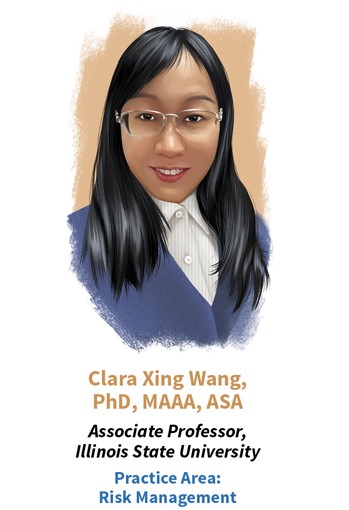
Clara Xing Wang, Ph.D., MAAA, ASA
Associate Professor, Illinois State University
Practice Area: Risk Management
How did you feel when you learned you were selected as part of the 2025 class of Rising Actuary Award recipients?
It brought me great joy and recognition for my firm. It’s my second honor from an actuarial association this year, following the 2025 Casualty Actuarial Society (CAS) Individual Research Grant—and what matters most is that the award acknowledges my work in both actuarial research and practical application.
Since I earned my master’s degree and decided to enter the actuarial research field, I’ve focused on connecting statistical theory to real-world risk challenges. Teaching actuarial courses and mentoring students has helped me turn theory into practical solutions, and working with bodies like the Society of Actuaries (SOA) and CAS has shaped my growth as a leader.
The award’s mission—investing in the next generation of actuarial leaders—aligns with my professional goal of making advanced risk management tools accessible to practitioners and students alike. This honor isn’t just a recognition of past work; it encourages me to keep pushing this effort to help young professionals understand how innovation and professionalism drive change in the field.
What first inspired you to pursue a career in actuarial science?
My pursuit of actuarial science started with a love for math—specifically its unique certainty and logical rigor. There’s something satisfying about how math feels like a precise, smooth “mental puzzle” that took root when I studied pure and applied math as an undergraduate. Back then, I often wondered how abstract ideas like probability or extreme value theory could pair with real-world data to solve problems we face in daily life.
Later, as a statistics master’s student and then a Ph.D. candidate in risk management and insurance, I learned about risk measurement and its statistical inference. My research focused on using available data to quantify losses and manage them effectively. That’s when I realized that this kind of work—starting with theory, using real data to solve current issues, and even predicting future—became my research drive and my goal to become an actuary.
Do you have a mentor who has shaped your career? If so, how have they influenced you?
Dr. Liang Peng—who guided me both during my master’s studies at Georgia Tech and Ph.D. studies at Georgia State University—has been the most influential mentor in my career. Under his direction, I launched my research journey with the Haezendonck-Goovaerts Risk Measure; as I dug into the theory, I also gained deeper exposure to the real-world insurance market and social issues, building a bridge between the two. He also pushed me to pursue my ASA actuarial credential alongside my Ph.D., nominated me to present at my first academic conference—the 2016 International Congress on Insurance: Mathematics and Economics—and taught me to engage with industry experts. Those skills later helped me win the SOA Hickman Scholar Award and secure grants, including my National Science Foundation’s Computer and Information Science and Engineering Research Initiation Initiative (CRII) grant.
After earning my Ph.D. degree, I joined Illinois State University as an associate professor in the Mathematics Department, where colleagues like Dr. Maochao Xu and Dr. Krzysztof Ostaszewski, along with other senior peers, stepped in as mentors for me. With their guidance, I grew as an educator—not just learning to pass on my knowledge to students effectively, but also to show them the discipline’s role in society beyond theory, which helps spark their interest and keeps them committed to their studies. I also took on volunteer service during this time, serving on committees at the department, college, university, and with actuarial organizations; through this work, I learned how to use my expertise to contribute to the industry’s growth and progress.
What has been your biggest professional challenge so far, and how did you overcome it?
My biggest professional challenge to date came early in my career. As a new assistant professor, I was balancing three competing priorities: advancing my research, earning actuarial credentials, and enhancing my education. So, figuring out how to allocate my time, coordinate these areas, and strike a balance became a major struggle in my first two years.
To tackle this, I first focused on “synergistic” tasks—aligning my research, exam prep, and teaching as much as possible so they could complement each other. For instance, I deeply dived into mathematical theory and learned about the practical actuarial models in preparing for actuarial exams; combining the two helped me develop innovative research topics. At the same time, I translated both theory and models into accessible lessons for students, which further connected theoretical concepts to real-world problems. I also turned to community support. I asked my advisor and my colleagues for time management advice. I also joined the Early Career Actuary Network to connect with others facing the same struggles. This community helped me realize I didn’t have to do everything alone— in the end, I overcame this challenge—I earned my actuarial credentials, made steady progress on my research projects, and improved my teaching skills.
What is one piece of advice you would share with actuaries who are just starting out?
My advice to actuaries starting is to embrace “hybrid expertise”; don’t just master actuarial fundamentals, but get fluent in the tools and perspectives that will shape the profession’s future. Actuarial science isn’t just about calculus, probability, and exam prep anymore—those are still foundational, but the next generation needs more. For example, currently, we need to speak the language of data science, including machine learning and big data, collaborate across fields such as engineering, climate science, and finance, and understand emerging risks, including cyber threats and climate volatility. The key is not to chase “shiny tools” for their own sake. Tie every new skill back to actuarial professionalism to improve the actuary’s skill and the profession.
Are you incorporating any next-generation tools into your work? If so, how do you ensure that you uphold the principles of actuarial professionalism while using them?
Yes, I regularly incorporate next-generation tools into my research and teaching. For tools, I’ve built machine learning models—like failure-averse active learning for physics-constrained systems—and deep learning frameworks, such as multi-view dynamic graph models for 3D defect identification to solve actuarial and risk management problems in interdisciplinary studies. For example, in a current project, we use 3D point cloud data and deep learning to improve manufacturing quality control—a step critical for cutting insurance claims stemming from product failures.
My team and I are also building an R package for actuaries who don’t have advanced statistical training. And I use multi-output extreme spatial models to quantify production system risks; these tools help insurers and manufacturers prepare for rare, high-impact events.
How do you see the role of actuaries evolving over the next 10 years?
Over the next decade, actuaries will shift from “risk calculators” to holistic risk strategists—driven by three key changes.
Traditionally, we’ve used historical data to set premiums or reserves. However, with advances in AI, big data, and extreme value modeling, we’ll increasingly predict emerging risks—such as how climate change impacts property claims or cyberattacks target small businesses—and build proactive solutions. We’ll also move from working in silos to being cross-disciplinary collaborators, needing to partner closely with data scientists, engineers, climate experts, and policymakers.
Solving complex risks, such as pandemics or supply chain disruptions, won’t happen in isolation; we’ll need to speak the language of other fields to make progress. Also, as models grow more complex, our role will shift from technical experts to trusted communicators. We’ll need to explain AI-driven risk assessments to regulators, clients, and communities in plain language to keep trust and transparency. When using a deep learning model to spot insurance fraud, for example, we won’t just share results—we’ll break down how the model works, its limitations, and how it meets ethical standards.
By 2035, actuaries won’t just manage risk; we’ll be leaders who help organizations and societies thrive in a risky world.
What have you found to be the most valuable benefit of your Academy membership?
The most valuable thing about the Academy is how it fuels my research and ties it to real-world problems.
First, it’s a rich information hub that keeps me in the loop on what matters most to society and the actuarial field. Whether sharing insights on climate risk quantification, AI ethics in underwriting, or shifting regulatory needs, these topics don’t just keep me informed—they give my research a clear, real-world context. I no longer chase abstract problems; instead, I frame studies around questions the industry actually faces. That direction makes my work more relevant and closes the gap between theory and practice.
Then there are the events the Academy hosts, such as conferences, webinars, and workshops that bridge academia and industry. These aren’t just passive listening sessions—they’re chances to swap ideas with folks from insurance companies, consulting firms, even policymakers. It’s where academic work stops feeling isolated and starts connecting to the people who’ll use it.
Another big plus is the volunteer opportunities—primarily serving on committees—that’s been an enormous learning experience. I’ve joined groups focused on actuarial education and industry service. These aren’t just “volunteer tasks”—they’re lessons in supporting the profession’s growth and pushing actuarial education forward.
All in all, the Academy isn’t just a membership organization. It’s a resource that keeps my research rooted in real needs, connects me to the people who use that work, and teaches me to give back—all things that make me a better actuary and researcher.